1. About the Journal

The Revista Mexicana de Fitopatología (RMF) / Mexican Journal of Phytopathology (MJP) is a scientific journal published by the Mexican Society of Phytopathology, A.C. (SMF). It is a non-commercial, open-access journal for authors and readers, bilingual, peer-reviewed using the double-blind method by specialists in plant pathology and related fields, and published continuously on a quarterly basis (January, May, and September). The RMF/MJP seeks to publish high-impact original research to disseminate, enrich, and strengthen knowledge in scientific and academic research in the field of plant pathology, in the interest of food security.

Focus and Scope

The RMF/MJP publishes contributions on plant pathogens and their interaction with plants, covering a range of topics from genomic to epidemiological studies and their management. Manuscripts must be based on rigorous research, supported by hypotheses and objectives that address the research question. Descriptive studies and those lacking an experimental basis will not be considered.

The main subject areas covered by the journal are:

  • Etiology and characterization of plant pathogens. Identification, morphology, genomics, and taxonomy of fungi, oomycetes, viruses, viroids, bacteria, phytoplasmas, and nematodes.
  • Plant-Pathogen Interaction: Mechanisms of pathogenesis, physiology of parasitism, biochemistry and molecular genetics of host resistance or susceptibility, and omics sciences in plant-pathogen interactions.
  • Alternate hosts and vectors. Weeds that act as reservoirs or hosts for plant pathogens, insect vectors, modes of transmission, and replication.
  • Plant Epidemiology: Pathogen population dynamics, mathematical modeling of epidemics, and the effects of climate change on disease distribution.
  • Integrated Disease Management: Biological and chemical control methods, plant extracts, nanobiocontrol, genetic breeding for pathogen resistance, and induction of defenses through the use of phytochemicals.

Scope Restrictions (Exclusions)

To maintain a high standard of scientific novelty, the RMF/MJP will not accept for publication:

  • Agricultural extension reports or basic regional surveys.
  • Efficacy trials of chemical fungicides or commercial plant extracts that do not include an in-depth analysis of the mechanism of action or a clear validation of hypotheses.
  • New reports on pathogens that are not supported by morphological and molecular identification and pathogenicity testing (Koch’s postulates).

Editorial Policy

RMF/MJP maintains a rigorous review process for all contributions published on its platform (see this section in the main page menu). The Editorial Team conducts a compliance review in accordance with the Author Guidelines before sending the manuscript to a review panel, with the aim of ensuring the document’s relevance and proper formatting. The review of each document is double-blind, meaning the author and the review panel remain anonymous to each other, to ensure an impartial and objective review. Once the editorial process begins, the document is sent by invitation to a reviewer who is a specialist in the field, and this reviewer in turn invites three reviewers. The assessment of at least two reviewers and the lead reviewer is incorporated. If a comprehensive evaluation is necessary, the editorial team forwards the document to an executive reviewer or Associate Editor for evaluation. The Editor-in-Chief is solely responsible for the final publication of a document.

Types of Contributions

Currently, the RMF/MJP accepts contributions in Spanish or English that conform to the corresponding format (Publication Templates) and in the following categories:

  • Scientific Article. Original, completed studies (repeated over time and space) with treatments, representative replicates, and statistical analyses. It must not exceed 20 pages (including tables, figures, and references) (Download the template from the main page menu).
  • Review Article. A retrospective analysis of studies that presents a hypothesis, theory, or other phytopathological topics of interest to a general or specialized audience. The RMF/MJP Editorial Board may invite specialized researchers to submit literature reviews or contributions on specific topics. Do not exceed 25 pages in accordance with the template, including tables, figures, and references (Download the template from the main page menu).
  • Plant Pathology Note. This section is intended for concise, original studies on techniques, specific observations, or historical aspects of plant pathology data. Do not exceed 10 pages (including tables, figures, and references) (Download the template from the main page menu).
  • Plant Pathology Report. Reports on epidemiological outbreaks, significant changes in the regional distribution of pathogens, new hosts, and/or detections of plant pathogens at the species or intraspecific level, resistance of plant pathogens to chemical or biological products, as well as the release of resistant varieties. Do not exceed 3,000 words; the inclusion of one table or figure is permitted (Download the template from the menu on the home page).
  • Letter to the Editor. Ideas, opinions, hypotheses, and other contributions presented briefly and concisely, inviting debate and reflection and fostering critical thinking. Do not exceed five pages (Download the template from the main page menu).

2. Preparing Your Manuscript

All contributions must adhere to the standard structure of Introduction, Methodology, Results and Discussion, and Conclusions. Only scientific articles will include the corresponding headings; however, all contributions must follow a logical sequence and avoid redundancy across sections. Avoid mixing methodology with results.

General Format

Maintain the format and margins specified in the template for the type of contribution. Indent the first line of each paragraph by 1.0 cm, except for subheadings embedded within a paragraph. Use 11-point Times New Roman font for the body of the document, with 1.15 line spacing and justified alignment, including between paragraphs. When a subheading begins at the start of a paragraph, leave one space. For the main title: Times New Roman, bold, size 18, centered, 1.15 line spacing, and 5–25 words in mixed case. For author names and affiliations, use justified text, Times New Roman, size 9, and 1.15 line spacing. Section titles should be in small caps, bold, and aligned to the left of the page. Use Times New Roman, size 13.

Document Structure

The following are the requirements for the document.

1. Title, Authors, Abstract, Keywords

Title

The title must be clear, concise, and specific, consistent with the document’s content. Titles linked to a series of related works will not be accepted unless submitted together. In Phytopathological Reports, the title must include the name of the disease, pathogen (scientific name), host, and location.

Author-Affiliation

Full names of the authors in lowercase, bold, separated by commas, with the corresponding author indicated by a superscript asterisk. Respect the way authors and co-authors spell their first and last names, including the use of hyphens. After the names, list the full name(s) of the affiliated institution(s) in lowercase and without boldface, linking each author with a numerical superscript. Include the address, postal code (C. P.), state, and country. Example:

First Name1 Last Name-Last Name1, First Name2 Last Name-Last Name1, First Name3 Last Name-Last Name2*. 1Institute of Horticulture, Department of Plant Science, 2Agricultural Mycology, Department of Agricultural Parasitology, Autonomous University of Chapingo, Mexico-Texcoco Highway, Km 38.5, Texcoco, C. P. 56230, State of Mexico, Mexico.

Abstract

Present a one-page summary that includes Background/Objective, Methodology or Experimental Procedure, Results, and Conclusions. Clearly state the essential aspects of the research, ensuring the inclusion of statistical data, variables, etc. Be self-explanatory; for example, use the scientific names of microorganisms and plants (without descriptive terms) and avoid generic terms. Do not repeat the title in the text of the abstract; use scientific nomenclature and avoid abbreviations. For word count and structure of the abstract according to the type of contribution, see the corresponding template.

Keywords

Include up to five simple, capitalized words. Avoid compound words and do not repeat words included in the title. Do not end with a period.

2. Main Body of the Document

Introduction / Rationale

In Scientific Articles, Phytopathological Notes, and Phytopathological Reports, this section should briefly describe the study and highlight the importance of the research. Carefully present the state of the art and cite relevant and recent publications. Ensure that the Introduction is fluid, understandable, and justifies the research. Finally, state the hypothesis and/or objective(s) of the research. In Review Articles, describe the scientific problem that motivated the review, thoroughly discuss the state of the art, and cite relevant and recent publications. In the Bibliographic Analysis section, clearly indicate the criteria and parameters used for the literature search; for example, the time period, types of journals, bibliographic repositories, geographic regions, crops, types of pathogens, etc. If necessary, include a flowchart of the bibliographic analysis process and indicate the basis upon which the Review Article was ultimately developed.

Materials and Methods / Experimental Design / Theoretical and Experimental Framework

For Scientific Articles, describe the methods and/or protocols that allow for the exact reproducibility of the experiment. New methodologies should be described in detail, while previously published methods may be briefly summarized and cited. Phytopathological Notes and Phytopathological Reports should present the information in a fluid manner without section headings. To maintain sequence and order, use subheadings embedded within paragraphs that refer to the methodology used, results, and discussion. In Review Articles, structure the text in an expository and analytical manner with a logical order; present the information in a comprehensible and organized way using mind maps, tables summarizing results, and other tools. In Letters to the Editor, sections should not have subheadings; the information must be organized in such a way that these sections are easily understood and distinguished. When using references and units of measurement, refer to the corresponding template.

Results and Discussion

The Results and Discussion sections may be placed in the same section or separately. Present the results of the experimental data obtained clearly, objectively, and precisely, with a general interpretation in accordance with the order presented in Materials and Methods. Cite relevant and current references to thoroughly discuss the results of previous research or similar studies and how they can be interpreted in light of prior studies, contrasting them with the hypothesis(es). Include logical deductions; avoid unsubstantiated speculation. Additionally, suggestions for future studies may be included. Use tables or figures for support; tables should not be repeated verbatim in the body of the document.

Conclusions / Conclusions and Outlook

These should directly address the objective(s) stated in the introduction, summarizing the main contribution and scientific advancement that your research has provided. Present representative values of the results, such as averages, ranges, proportions, percentages, etc. Include statistical significance associated with factors and/or treatments in the case of experimental designs. In review articles, integrate the analysis of information to establish perspectives based on the current state of knowledge in a convincing and well-founded manner; these perspectives should be framed within the authors’ vision, derived from the analysis of the scientific problem, and should establish mature and solid knowledge within the scope of the problem analyzed.

Supplementary Appendices

Limitations. Briefly indicate the methodological limitations that could be improved in similar studies, such as sample size, Koch’s postulates, number of replicates, among others. Also, indicate aspects that have been poorly studied or investigated, or that have yielded partial or inconclusive conclusions.

Conflict of Interest. If there are no conflicts of interest (see section 4), the authors must explicitly state this using the following text: “The authors declare that they have no conflict of interest regarding the research, authorship, and/or publication of this article.”

Funding. Mention the source(s) of funding (if applicable), which may include grants, institutional funds, in-kind support from companies, etc.

Acknowledgments. Express any acknowledgments you deem appropriate; these may include cooperating producers, groups or associations, and researchers who reviewed or contributed to the document, among others.

Authors’ Contributions. Briefly describe the role(s) of each author who contributed to the research, including the conception of the study, experimental design, data analysis, statistics, and review, etc.

Supplementary material. In this section, indicate, if necessary, any attached documents that support a process within the research project; these attachments should be in .doc, .xlsx, or similar formats.

References. It is the authors’ responsibility to verify the accuracy of citations in the text against the reference list and vice versa (see section 3). Cite current references: 30–40 for scientific articles, 20–30 for phytopathological notes, 50–60 for review articles, and 5–10 for phytopathological reports. Use a 0.5 cm French indent, arrange alphabetically, font size 9, single-spaced.
3. Style Guidelines and Standards

Citation and Reference Format

All references must strictly adhere to the RMF/MJP style. The author-year system is used. In the body of the text, punctuation depends on the position of the citation within the sentence: one author, Pfender (2010) or (Pfender, 2010); two authors, Leyva-Mir and García-Velasco (2022) or (Leyva-Mir and García-Velasco, 2022); more than two authors, Santos-Cervantes et al. (2020) or (Santos-Cervantes et al., 2020). Multiple citations should be listed in chronological order and separated by semicolons: (Villanueva-Arce, 2015; Ayala-Escobar and Yáñez-Morales, 2018; Santos-Cervantes et al., 2020). For the same author and year, insert a consecutive lowercase letter after the year: (Pérez, 2020a; Pérez, 2020b).

All articles must include a DOI hyperlink or web link. Use “et al.” starting with the sixth author and write the full journal name in regular text (without italics). The document will be returned to the author if it does not comply with the following guidelines:

Examples of citations according to publication type:

Structure of a Scientific Article

Authors’ full last names and first initials. Year. Full title of the article. Full name of the journal (not italicized). Volume (Issue): pages. DOI URL or link. Example of a scientific article:

Ortega-Acosta SA, Velasco-Cruz C, Hernández-Morales J, Ochoa-Martínez DL, and Hernández-Ruiz J. 2016. Diagrammatic logarithmic scales for assessing the severity of spotted leaves and calyces of roselle. Mexican Journal of Phytopathology 34: 270–285. https://doi.org/10.18781/R.MEX.FIT.1606-6

Book Structure

Authors’ full last names and first initials. Year. Book title. Edition number (if applicable). Publisher. City and country of publication. Total number of pages (e.g., 350 p.). DOI URL or catalog site (if applicable). Book example:

Anaya-Lang AL, Yáñez-Morales M, and Gómez-Rodríguez O. 2016. Pathology of Forest Seeds in Mexico. 2nd ed. Editorial Colegio de Postgraduados. Texcoco, State of Mexico, Mexico. 312 p.

Book Chapter Format

Full last names and first initials of the chapter authors. Year. Chapter title. In: Last names and first initials of the editors (Eds.). Book title. Publisher. City and country of publication. Pages covered by the chapter (e.g., pp. 45–68). DOI URL (if applicable).

Book example:

Cano-Madrigal, J., and Pérez-Brito, D. 2021. Serological and molecular diagnosis of phytopathogenic viruses in tropical crops. In: Silva-Rojas, H. V., and Martínez-Espinoza, A. D. (Eds.). Biotechnological Tools Applied to Plant Health in Mexico. Colegio de Postgraduados. Texcoco, State of Mexico, Mexico. pp. 112–135.

Web Page Format

Name of the institution or corporate author. Year of publication or update. Title of the document or online resource. Full web link (Available online at: URL). (Accessed: month, year). Example of a web page:

National Service for Agrifood Health, Safety, and Quality (SENASICA). 2024. Technical data sheet on epidemiological surveillance for Ralstonia solanacearum race 3 in Mexico. Available online at: www.gob.mx. (Accessed: March 15, 2026).

Tables and Figures

All graphic material must be uploaded to the editorial management system separately from the text files, using descriptive file names (e.g., Figure_1.tif, Table_2.docx).

1. Tables and Figures

They should be cited in the main text as Figure 1, Table 1, etc. Figures or diagrams should be inserted after they are cited in the text. Use high-quality images with a resolution of at least 300 dpi or proportional to the page size. Figure layouts should be submitted in an editable format (ungrouped). Tables should be created in Word, not Excel. They must contain three main lines: two separating the titles and a closing line (see templates). Write captions in lowercase letters. Footnotes for tables must be identified with lowercase letters (from the end of the alphabet) in superscript (in sequence: x, y, z). To indicate levels of statistical significance, use asterisks (* = p ≤ 0.05, ** = p ≤ 0.01). For numbers, use only one decimal place, separated by a period; for example, 3.2%, 5.7 cm, etc. For specific details, see the corresponding template.

Artificially increasing resolution in image editing software is prohibited. Images must be originally captured at the required quality:

Type of Visual Element Minimum Resolution Recommended File Format
Photographs and micrographs 300 DPI (or PPI) JPG or PNG
Graphs and line diagrams 600 to 1200 DPI Original open format
Composite figures 600 DPI Open original format

2. Multiple Photo Composite (Multiple Panels)

To compare symptoms, isolations, or treatments, please combine the individual images into a single composite:

  • Panel Identification: Label each quadrant of the composite with bold uppercase letters (A, B, C, D) in the upper-right corner. Use 12-pt Arial or Helvetica font.
  • Visual Layout: The background borders between panels should be minimal (21/4 pt), white, and perfectly aligned. Avoid unnecessary empty spaces.
  • Scale Bars: It is mandatory to include microscopic or macroscopic scale bars printed directly on each relevant image. Indicate the length of the scale bar in the figure caption (e.g., “Scale bar = 10 μm”), avoiding the use of relative magnification values (such as “100x”) that are distorted when the print size is changed.
  • Focus Annotations: Use high-contrast arrows (black with a white outline, or vice versa) to highlight specific pathogen structures or symptoms, taking care not to clutter the image.

3. Conceptual Models and Diagrams

Models explaining disease cycles, molecular defense mechanisms, or methodological workflows should be visually clear.

  • Graphic Style: Diagrams should be clean, with white or transparent backgrounds. Use understated, harmonious color palettes, ensuring they are readable for people with color blindness. If necessary, you may use contrasting colors, but avoid overusing them.
  • Accepted formats: Vector formats (PDF) are preferred. If exported to PNG or JPG, they must have a minimum resolution of 600 DPI to ensure that text does not appear pixelated.
  • Internal typography: Maintain consistency by using the Arial or Helvetica font. The text size for internal labels should range from 6 to 10 pt at the final publication size to ensure readability.

4. Figure captions

  • Captions must not be included within the graphic or image file. They must be written below the figure, where they should be clear and precise.
  • Structure: Begin with the figure label in bold and abbreviated form, followed by the corresponding number (e.g., Figure 1.).
  • Content: The description should be self-explanatory. The reader should be able to understand the purpose of the figure without referring to the main text of the manuscript.
  • Required details: Specify the host, the pathogen (genus and species in italics), the variables plotted, the meaning of each letter in the multiple panels (e.g., “A: Field leaf symptoms. B: Monospore isolation of X on PDA.”), and a description of any arrows or scale bars included.

Nomenclature and Abbreviations

1. Fertilizers. Describe fertilizer doses in elemental terms (e.g., N, P, K, etc.). If necessary, indicate the source of the fertilizer.

2. Pesticides. Use the technical name (active ingredient) and concentration of the pesticides; the trade name may be included in parentheses. Documents on agrochemical management will be considered provided their content contributes new technical and scientific knowledge.

3. Measurements. Based on the International System of Units (SI). Symbols should not be followed by a period, unless it is the end of a sentence. Maintain the same format for units of measurement throughout the document. Commonly used measurements are listed in the following table:

Quantity Unit Symbol
LengthKilometerkm
Meterm
Centimetercm
Millimetermm
Micrometerμm
Nanometernm
MassGramg
Milligrammg
Kilograms per hectarekg ha⁻¹
Kilogramkg
Metric tont
TimeHourh
Minutemin
Seconds
TemperatureDegrees Celsius°C
AreaHectareha
VolumeLiterL
MillilitermL

4. Ethical and Legal Considerations

This journal is firmly committed to maintaining the highest standards of scientific integrity and editorial ethics, strictly adhering to the principles established by the Committee on Publication Ethics (COPE).

Plagiarism Detection and Policy

Plagiarism, in any of its forms (verbatim copying, substantial unattributed paraphrasing, or appropriation of others’ ideas), constitutes a serious ethical violation and is grounds for rejection. We consider the ethics of the authors, as well as the professionalism and commitment of the reviewers; therefore, in the field of plant pathology, the review panel uses anti-plagiarism software or relies on their knowledge of the subject matter of the document under evaluation. If necessary, the Editorial Team conducts a thorough review of cases brought forward by the review panel to make a final decision on the document (correction by authors or rejection). A textual similarity index exceeding 20% or the detection of continuous blocks of text identical to other sources without citing the original source (including the author’s own work or self-plagiarism) will result in the document being returned or definitively rejected, in accordance with COPE protocols.

Integrity of Scientific Data and Images

In plant pathology, images of electrophoresis gels, PCR curves, and micrographs are critical scientific data. Any alteration that distorts the experimental reality will be considered scientific misconduct.

  • Gels and Blots: It is strictly prohibited to crop, move, or insert individual bands within a gel. If lanes from different gels or from different sections of the same gel are grouped together in a single figure, this must be made clear by using distinct vertical dividing lines and must be explained.
  • Microscopy and Digital Adjustments: Adjustments to brightness, contrast, or color balance are acceptable only if they are applied uniformly to the entire image (to all pixels) and if they do not obscure, remove, or misrepresent the original information, including the background. The use of software filters that “smooth” or alter the structures of pathogens or plant tissues is not permitted.
  • Preservation of Original Data: Authors are required to retain the original, unprocessed image files (raw data). The Editorial Board reserves the right to request these files at any stage of the editorial process or after publication if there is any suspicion of manipulation.

Institutional Approvals and Experimental Ethics

  • Collection Permits: Studies involving the isolation of plant pathogens, especially those of quarantine importance or invasive alien species, must explicitly state that they have obtained the institutional or governmental permits required in the country of origin for the collection and transport of biological material.
  • Genetically Modified Organisms: Research using genetically modified plants or fungi (GMOs) must indicate compliance with local biosafety regulations and approval by the Biosafety or Ethics Committee of the institution where the project was conducted.

Use of Generative Artificial Intelligence (AI)

In accordance with COPE’s position statement on AI tools, the journal establishes the following transparency rules:

  • Exclusion of Authorship: Generative AI tools (such as ChatGPT, Claude, or similar tools) do not meet the criteria to be recognized as authors or co-authors of a manuscript, as they cannot assume legal, ethical, or copyright responsibility for the work.
  • Mandatory Disclosure: The use of AI tools to assist in writing, language editing, data analysis, or graph generation is prohibited. The use of AI to generate or alter images of experimental results is strictly prohibited. AI-generated models are accepted only as partial support (60%); however, scientific ideas must originate from and be validated by the author, not by AI. The RMF/MJP is evaluating the integration of certified and licensed AI programs for the translation of submissions, with the aim of reducing costs for authors.

Copyright and Publication License

This journal is an Open Access publication that advocates for the free democratization of scientific knowledge.

  • Transfer of Rights and License: Authors retain intellectual property rights to their manuscripts but grant the journal the right of first publication under the international Creative Commons Attribution-NonCommercial 4.0 (CC BY-NC 4.0) license.
  • Implications of the License: This license allows third parties to share, copy, distribute, and transmit the work in any medium or format, as well as to adapt or remix the material, provided that:
    • Appropriate credit is explicitly given to the original authors and to this journal.
    • The material is not used for commercial purposes under any circumstances.

Statement on Conflicts of Interest

Authors must disclose any relationship that could be interpreted as a conflict of interest. This includes, but is not limited to: Funding or infrastructure support provided by agricultural companies, government agencies, private foundations, or NGOs to conduct the study. Commercial interests and intellectual property that may be affected by the results or conclusions of the manuscript. Professional and employment relationships with companies, producer associations, or individuals linked to the plant pathology sector or a related field.

Author Responsibilities

  • Explicit Statement: All authors must collectively disclose (through the corresponding author) any potential conflicts of interest at the time of submission.
  • Location of the Disclosure: This statement must be included in a specific section titled “Conflict of Interest” immediately before “Funding” and “Acknowledgments.”
  • Absence of Conflict: If there are no conflicts of interest, the authors must explicitly state this using the following text: "The authors declare that they have no conflicts of interest regarding the research, authorship, and/or publication of this article."

5. Submission Process

All manuscripts must be submitted via the journal’s official web platform by accessing the “Submit Manuscript” menu. Material submitted through other channels will not be accepted.

Author Registration and Metadata Module

Upon initiating the submission, the system requires the structured entry of data for all participants. This phase is separate from the manuscript file, which must remain anonymized:

  • Author Registration: Enter the full first and last names of each contributor.
  • Corresponding Author: Explicit designation of the researcher responsible for institutional communication with the Editorial Board.
  • Institutions and Affiliation: Formal details of the department, institution, official address, country, and postal code for each author.
  • Email Addresses: Record the email addresses (preferably institutional) of each co-author. The system will send simultaneous notifications regarding ethical approval to prevent registrations without consent.

Modular File Upload System

To ensure proper technical processing, the corresponding author must separately upload up to a maximum of 5 independent supplementary files to the web platform:

  • The Document or Manuscript: The complete manuscript formatted in an editable word processor (Microsoft Word), containing text, abstracts, and the reference list. It must be completely free of authors’ names or affiliations to safeguard double-blind peer review.
  • High-Quality Figures: Data graphs, epidemiological curves, or standalone vector diagrams. They must have a minimum resolution of 300 dpi for monochrome images and 500 dpi for color images.
  • Tables: Editable files in Word or Excel format (never pasted as static images), formatted with Arial font, using only three black horizontal lines and no cell shading.
  • Photographic Compositions: Consolidated multi-panel images showing the progression of symptoms, axenic culture isolates, or micrographs of pathogen structures. These must have a resolution of 600 dpi and must include legible metric scale bars.
  • Supplementary Appendices: Supporting files that include raw statistical databases, phylogenetic alignment matrices, or the original photographic record of the experiment to support future data audits.

Integration of Mandatory Forms (F01 and F02)

As a requirement for originality and phytopathological quality control, the submission process requires the additional upload of two standardized institutional forms:

A. Letter to the Editor (Form F02)

Form RMF/MJP_F02 is a sworn statement of originality and authorship that must be signed by all authors. This document must confirm:

  • Strict Originality: An explicit statement that the manuscript describes an original work that has not been published in whole or in part in another scientific journal, nor is it currently under simultaneous review.
  • Role of the Authors: A breakdown of each signatory’s level of participation according to the taxonomic methodology of contribution (e.g., conceptualization, methodology, data analysis, drafting of the original manuscript).

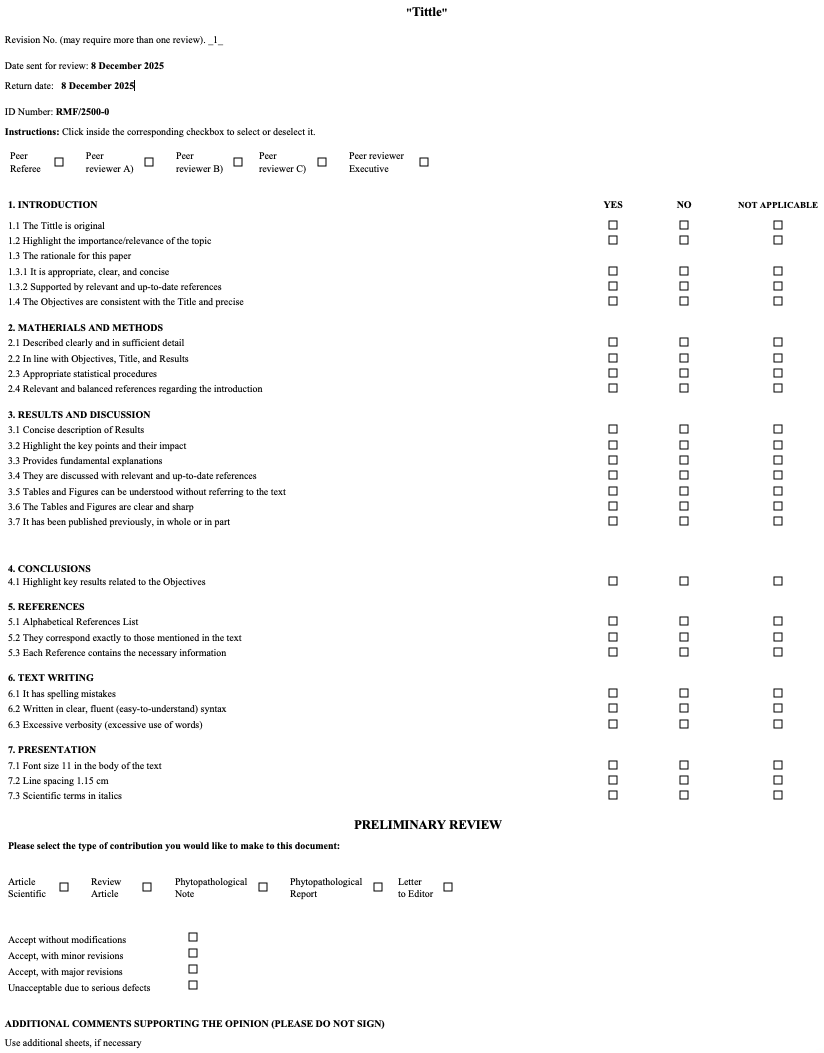
B. Compliance Checklist (Form F01 - Checklist)

Form RMF/MJP_F01 is the technical tool used to verify the manuscript prior to peer review. Authors must self-assess and confirm their strict compliance with the authors’ guidelines before submission:

  • Once the files have been uploaded and the signed F01 and F02 forms have been attached, the Revista Mexicana de Fitopatología system will issue a preliminary control number to initiate the editorial compliance review and double-blind peer review.

Review Process

The review process is double-blind and conducted by a panel of reviewers coordinated by a reviewer selected by the Associate Editor or Transdisciplinary Associate Editor in accordance with the Editorial Policies and Procedures of the RMF/MJP (see this section in the main menu). The scientific profile of the panel will align with the scientific focus of the manuscript to ensure an objective and constructive review.

6. Fee Policy

The RMF/MJP is a non-commercial scientific journal supported and partially funded by the Mexican Society of Plant Pathology, A.C. (SMF). In keeping with its open-access philosophy, the journal does not charge fees for manuscript submission, nor for reading or downloading articles, thereby ensuring the democratization of knowledge in plant health.

However, to ensure the project’s operational sustainability and maintain its bilingual (Spanish-English) international indexing, authors of accepted manuscripts are required to reimburse only the costs of essential editorial production services.

Contribution to Publication Costs

The financial contributions collected are used solely for technical maintenance and do not constitute a commercial profit. Once a manuscript has been formally published following double-blind peer review and editing, the following cost recovery items apply:

Fixed Layout Cost:

Equivalent to $1,000.00 MXN (Mexican pesos) per contribution. This amount covers typesetting, insertion of tables, high-quality digital processing of phytopathological figures, generation of galley proofs, and assignment of a DOI (Digital Object Identifier).

Essential Translation Service:

As this is a fully bilingual journal, the entire article must be published in both Spanish and English. Authors must reimburse the SMF for the cost of professional technical plant pathology translation services. The final translation fee will be calculated proportionally based on the exact number of words contained in the accepted manuscript.

Guarantees of Editorial Independence and Ethics

To maintain maximum financial transparency and comply with the core practices of the Committee on Publication Ethics (COPE), the journal stipulates that:

  • Free Review: Submission, technical anti-plagiarism review, and the entire peer-review process are completely free of charge.
  • Independence of Judgment: Scientific reviewers and editors evaluate manuscripts based exclusively on their methodological rigor, originality, and contribution to plant pathology. No member of the editorial team has access to billing information or knowledge of authors’ payment status. The RMF/JMP Editorial Board, Reviewers, and Editors perform their duties on a volunteer basis.
  • Issuance of Receipts: All amounts reimbursed by authors are officially invoiced by the Mexican Society of Plant Pathology, A.C., strictly for educational and scientific publishing services, ensuring transparent oversight of funds.

Sustainability Exemptions: To prevent translation and editing costs from becoming a barrier to scientific dissemination, the SMF offers partial exemptions for independent researchers or those affiliated with developing institutions that do not have grants for specific projects. Such requests must be formally addressed to the SMF Board of Directors at the time of submission.

7. Open Access, Self-Archiving, and Digital Preservation Policy

The RMF/MJP, the official scientific journal of the Mexican Society of Plant Pathology, A.C. (SMF), maintains an unwavering commitment to the global democratization of knowledge in plant health and crop protection.

Open Access and Continuous Publication Statement

This journal strictly adheres to the Open Access model, following international principles that promote the free circulation of scientific literature without financial, legal, or technical restrictions:

  • No Cost to Readers: All content is published in digital format freely, permanently, and immediately. There are no paywalls, embargo periods, subscription fees, or charges for viewing or downloading.
  • No Cost to Authors: The entire process—from submission and double-blind peer review to copyediting, typesetting, and DOI assignment—is 100% free ($0.00 MXN / USD). The RMF/MJP does not charge Article Processing Charges (APCs) or fees for printed pages or color figures.
  • Proprietary Web Platform Since 2012: The RMF/MJP has a proven track record in digital publishing. Since 2012, the journal has officially published and distributed its content through its own web platform, which is managed independently by the SMF.
  • Continuous Online Publication Model: In order to expedite the dissemination of highly urgent phytopathological findings, the RMF/MJP operates under a continuous publication model on its website. Approved and edited manuscripts are published individually online with their final layout and DOI immediately, eliminating the need to wait for the formal closing of a traditional issue.

Self-Archiving Rights

The RMF/MJP grants authors broad and unrestricted rights to self-archive their scientific contributions, classified as an open-access policy (Green Classification):

  • Permitted Versions: Authors are fully authorized to deposit the final edited version (Editor’s final PDF) upon request to the Editor-in-Chief.
  • Immediacy: Self-archiving and external indexing may take place immediately upon the exact moment of continuous online publication on the official RMF/MJP platform.
  • Citation Requirement: On any external platform where the document is self-archived, an explicit mention and an active hyperlink to the original DOI assigned by the RMF/MJP must be included to ensure the traceability of scientific citations.
  • Integration into Repositories, Library Consortia, and Universities

To maximize impact and ensure the preservation of the phytopathological scientific heritage, the RMF/MJP authorizes and encourages institutional archiving under the following guidelines:

  • RMF/MJP’s Own Repository and Specialized Library: Every published article is automatically integrated into the RMF/MJP’s digital historical repository and specialized library, serving as a central hub for the national agro-industrial and scientific community.
  • International Indexing Platforms (SciELO and Similar Systems): The RMF/MJP distributes its metadata and full-text articles under interoperability protocols (OAI-PMH) compatible with systems such as SciELO Mexico, Redalyc, Latindex, and national repositories. These partner networks hold a permanent license to harvest, mirror, and display the journal’s articles.
  • University Repositories and Library Networks: Universities (public or private), agricultural research centers (such as the Colegio de Postgraduados or its counterparts), and national and international academic library consortia have full authority to harvest, store, and provide public access to the PDFs of articles written by their academics and researchers. This is done at no cost to the institution or library, without requiring special agreements or infringing on editorial rights.

License of Use

All content published on the RMF/MJP web platform is distributed under the Creative Commons Attribution-NonCommercial 4.0 International (CC BY-NC 4.0) license. This license authorizes readers, higher education institutions, and institutional repositories to share, copy, distribute, print, or link to the full texts for any strictly academic, educational, or research purpose; any use, exploitation, or redistribution of this material for commercial purposes is strictly prohibited.

8. Errata, Retractions, and Experimental Transparency Policies

The RMF/MJP assumes responsibility for maintaining the integrity and accuracy of the scientific record. To this end, it establishes clear procedures for the prevention of errors, the correction of the historical record, and the management of serious breaches of publication ethics.

Proofreading and Errata

To ensure the highest level of technical and editorial accuracy, the RMF/MJP implements a final verification stage prior to the article’s final publication:

  • Purpose of the Proof: Once the manuscript has been approved and formatted, the editorial team will send the proof (a preliminary typeset version in PDF) to the corresponding author. This thorough review by the authors is intended solely to avoid minor and isolated errors in the final document. Authors must carefully verify:
    • The full name and exact spelling of all co-authors.
    • Institutional affiliations and contact email addresses.
    • Any remaining spelling or punctuation errors in the text.
    • The correct use of italics, a critical aspect in plant pathology for the nomenclature of genera, species, and subspecies of plant pathogens (e.g., Fusarium oxysporum, Phytophthora infestans) and gene names.
  • Replacement of the Document Due to Subsequent Errors: If, despite this rigorous quality control, minor errors or typographical inaccuracies are identified after online publication, the RMF/MJP will not issue a separate addendum but will instead directly replace the digital file of the document on its web platform to ensure the text remains clean and corrected for readers.

Changes to the List of Authors

Any request to change the order of the authors or to add or remove authors after the manuscript has been accepted or published will be considered a truly exceptional case.

  • Submission Requirements: In order for the Editorial Board to evaluate the case, the corresponding author must submit a detailed, free-form letter justifying the request. This letter must include, as a mandatory requirement, the handwritten signatures (digital or scanned) of all original authors and of the author to be added or removed, expressing their full and unanimous consent. This document will be formally incorporated into the editorial record of the research.

Retractions Due to Scientific Misconduct

The RMF/MJP emphasizes that retractions are proactively avoided throughout its rigorous editorial process, which includes an initial technical evaluation, the use of anti-plagiarism software, and strict peer review. However, upon the discovery of insurmountable ethical violations, the journal will act decisively:

  • Sanctions for Research Misconduct: In the event of scientific misconduct that is fully substantiated in accordance with the guidelines of the Committee on Publication Ethics (COPE), the RMF/MJP itself, or similar agencies, the article will be publicly retracted.
  • Rejection for Self-Plagiarism (Duplicate Publication): This sanction will be applied upon detection of self-plagiarism, which includes the total or partial publication of data, text, tables, or images that the same authors have already published in another peer-reviewed journal or thesis without proper attribution. The article will be permanently marked “RETRACTED,” and indexing systems such as SciELO will be notified.

Transparency in Complementary Experiments and Potential Duplication

Plant pathological research often requires multiple growing seasons, multi-year sampling, or large-scale analyses that are divided into different publication stages. To avoid any suspicion of duplication of experiments and results, the RMF/MJP requires a policy of absolute transparency from the initial submission:

  • Mandatory Disclosure in the Manuscript: If the submitted work is a continuation, extension, or complement to previous research by the same group of authors, the authors are strictly required to explicitly state this in the body of the manuscript (preferably in the Introduction or Methodology section).
  • Required Citation: Authors must cite the references of all their previous publications related to this project. The scientific novelty of the new manuscript must be explained with complete clarity to the reader and the reviewers, along with how the presented data differ from previously published experiments (for example, whether new variables, different growth cycles, new isolates of the plant pathogen, or a complementary genomic analysis are evaluated).
  • Consequences of Omission: Omitting this statement and presenting supplementary data as if it were completely new and independent will be classified as an attempt at data fragmentation or duplication, entitling the RMF/MJP to automatically reject the manuscript during the technical review in accordance with the institutional ethical policies of the RMF/MJP and COPE.

Attachment

Evaluation Form

Documento