RMF Logo

Article filters

Search Papers:

For searching before 2024 see Archive (2000-2023)
  • Vol. 2025, 43(4)
  • Phytopathological Note
  • Special Issue

Trichoderma afroharzianum and homeopathic substances on the in vitro growth of fungi associated with fungal diseases

By Miguel Ángel Ruiz González, Miguel Ángel Serrato Cruz*, Roney Solano Vidal, Ernestina Valadez Moctezuma

*Corresponding Author.

Received: 19/November/2024 – Published: 25/September/2025
DOI: https://doi.org/10.18781/R.MEX.FIT.2024-11

  • PDF
  • HTML
  • XML

Abstract Background/Objective. Trichoderma spp. is a sustainable alternative, as well as some homeopathic substances that are emerging as potential antifungal agents; making them promising solutions for combating and controlling diseases in crops of economic importance. The objective of the study was to evaluate the antagonism of Trichoderma afroharzianum and homeopathic substances against four fungi responsible for diseases of horticultural importance.

Materials and Methods. The antagonism of T. afroharzianum against Phytophthora capsici, Rhizoctonia solani, Botrytis cinerea, and Fusarium oxysporum was evaluated using the dual culture technique. The percentage of inhibition was estimated every 24 hours by measuring mycelial growth and type of antagonism. Homeopathic substances derived from essential oil of Tagetes remotiflora, Tagetes arenicola, and Tagetes lucida were evaluated using the poisoned agar technique on all organisms. A completely randomized design with four replicates was used. The data were analyzed using Tukey's mean comparison test (p ≤ 0.05).

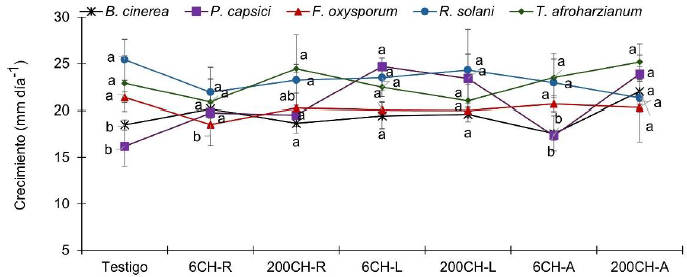
Results. T. afroharzianum inhibited over 50% of the fungi and stopped their growth in all cases. Only in the interaction between P. capsici and T. afroharzianum did the antagonist grow over P. capsici and deform the hyphae. Homeopathic oil of T. remotiflora in 6CH dinamization reduced the growth of R. solani (21.95 vs 25.38 mm in the control), F. oxysporum (18.52 vs 21.35 mm in the control), and T. afroharzianum (20.87 vs 22.86 mm in the control), while 200CH dinamization of T. arenicola stimulated the growth of T. afroharzianum (25.15 vs 22.86 mm in the control), P. capsici (23.85 vs 16.18 mm in the control) and B. cinerea (25.98 vs 18.48 mm in the control).

Conclusion. T. afroharzianum showed a greater ability to counteract the growth of P. capsici and B. cinerea. Homeopathic substances may have applications as inhibitors and stimulators of mycelial growth; further research is needed to better guide their applications

Keywords: Inhibition, Growth, Antagonist, Fungal disease, Agrohomeopathy

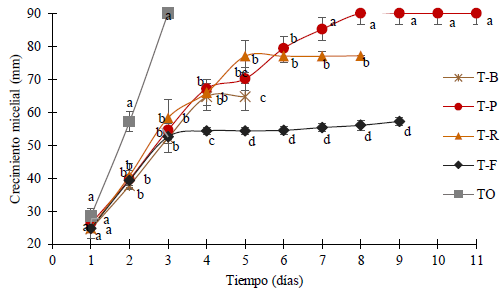
Figure 1. Mycelial growth inhibition of <em>B. cinerea</em> (5 days),<em> P. capsici</em> (11 days), <em>R. solani</em> (8 days), and <em>F. oxysporum</em> (9 days) due to the effect of <em>T. afroharzianum</em> under <em>in vitro</em> conditions. Mean ± standard deviation (n=4) with different letters are statistically different (Tukey, p ≤ 0.05).
Figure 1. Mycelial growth inhibition of B. cinerea (5 days), P. capsici (11 days), R. solani (8 days), and F. oxysporum (9 days) due to the effect of T. afroharzianum under in vitro conditions. Mean ± standard deviation (n=4) with different letters are statistically different (Tukey, p ≤ 0.05).
Figure 2. <em>In vitro</em> mycelial growth (mm) of <em>T. afroharzianum</em> in dual culture against <em>B. cinerea</em> (B), <em>R. solani</em> (R), <em>P. capsici</em> (P), and <em>F. oxysporum</em> (F). TO: control, T: <em>T. afroharzianum</em>, Mean ± standard deviation (n=4) with different letters are statistically different (Tukey, p ≤ 0.05).
Figure 2. In vitro mycelial growth (mm) of T. afroharzianum in dual culture against B. cinerea (B), R. solani (R), P. capsici (P), and F. oxysporum (F). TO: control, T: T. afroharzianum, Mean ± standard deviation (n=4) with different letters are statistically different (Tukey, p ≤ 0.05).
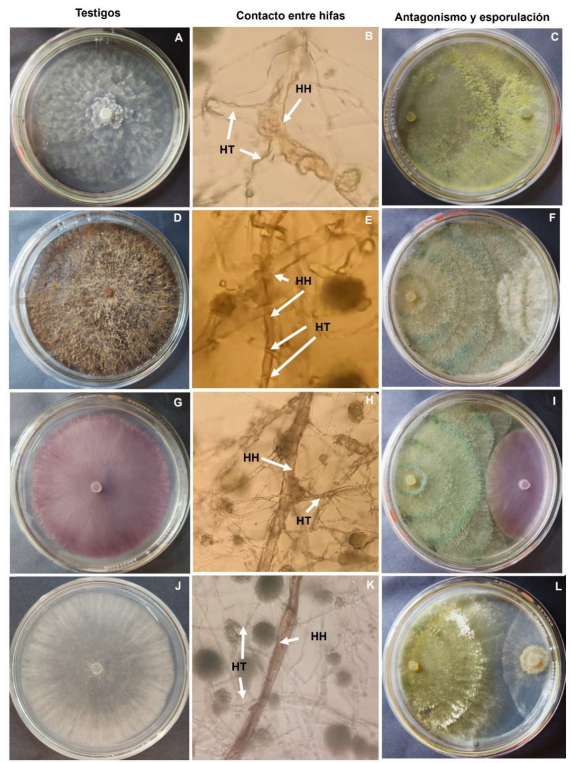
Figure 3. Individual mycelial growth (mm) of controls: <em>P. capsici</em> (A), <em>R. solani</em> (D), <em>F. oxysporum</em> (G) and <em>B. cinerea</em> (J) and antagonism in dual culture at the moment of hyphal contact (B, E, H, K) and sporulation after the controls covered the Petri dish (C, F, I, L). HH: fungal hyphae, HT: <em>T. afroharzianum</em> hyphae.
Figure 3. Individual mycelial growth (mm) of controls: P. capsici (A), R. solani (D), F. oxysporum (G) and B. cinerea (J) and antagonism in dual culture at the moment of hyphal contact (B, E, H, K) and sporulation after the controls covered the Petri dish (C, F, I, L). HH: fungal hyphae, HT: T. afroharzianum hyphae.
Figure 4. Fungal growth dynamics due to the effect of homeopathic substances on<em> B. cinerea</em>, <em>P. capsici</em>, <em>F. oxysporum</em>, <em>R. solani</em>, and <em>T. afroharzianum</em>. CH: centesimal hahnemannian, R: <em>T. remotiflora</em>, L: <em>T. lucida</em>, A: <em>T. arenicola</em>. Mean ± standard deviation (n=4) with different letters are statistically different (Tukey, p ≤ 0.05).
Figure 4. Fungal growth dynamics due to the effect of homeopathic substances on B. cinerea, P. capsici, F. oxysporum, R. solani, and T. afroharzianum. CH: centesimal hahnemannian, R: T. remotiflora, L: T. lucida, A: T. arenicola. Mean ± standard deviation (n=4) with different letters are statistically different (Tukey, p ≤ 0.05).