RMF Logo

Article filters

Search Papers:

For searching before 2024 see Archive (2000-2023)
  • Vol. 2025, 43(4)
  • Scientific Article
  • Special Issue

Evaluation of the ΦXaF18 bacteriophage formulation for the control of Xanthomonas euvesicatoria in chili pepper plants under field conditions

By Gabriel Ibarra Rivera, Evangelina Esmeralda Quiñones Aguilar, Guillermo Alejandro Solís Sánchez, Eristeo García Márquez, Gabriel Rincón Enríquez*

*Corresponding Author.

Received: 20/November/2024 – Published: 08/September/2025
DOI: https://doi.org/10.18781/R.MEX.FIT.2024-12

  • PDF
  • HTML
  • XML

Abstract Background/Objective. Xanthomonas euvesicatoria (Xe) is the causal agent of bacterial spot in chili pepper crops, a disease that is commonly managed with agricultural antibiotics. As a biological alternative, bacterial viruses (bacteriophages) offer a promising approach to the control of plant pathogenic bacteria. The objective of this study was to evaluate the biological effectiveness of the bacteriophage ΦXaF18 formulated with UV radiation protection (Fagolytic) for the control of Xe in chili pepper plants under open field conditions and in commercial field plots.

Materials and Methods. Experiments were conducted in block or completely random arrangement; five treatments were evaluated under open-field and field conditions: 1) Fagolytic, 2) Unformulated ΦXaF18 bacteriophage, 3) LS formulation with ΦXaF18 bacteriophage, 4) Kasumin® agricultural antibiotic, 5) Untreated control. The number of leaves with symptoms, number of chlorotic spots and the severity index were measured with a 6-level ordinal scale (0-5) and viral concentration in foliage. Data were statistically analyzed with an analysis of variance and a Tukey test or a nonparametric Kruskal-Wallis test (p ≤ 0.05).

Results. Fagolytic reduced bacterial spot severity by 32% and chlorotic spots by 57% compared to unformulated bacteriophage ΦXaF18 under open-field conditions. In the field, Fagolytic significantly decreased the severity index in site B of experimental plot 1 (p ≤ 0.05), with an efficacy comparable to the antibiotic Kasumin®. In addition, at site A, Fagolytic showed a significantly higher viral concentration of ΦXaF18 on the foliage at 48 h after the application of the treatments. Whereas at the time of application (preventive, simultaneous or combined) it had no significant effect on the severity of the disease.

Conclusion. Fagolytic proved to be an effective biological alternative for the control of bacterial spots (caused by Xe) in chili pepper plants, by reducing the severity of the disease and maintaining its persistence in the foliage, with comparable results to the Kasumin® antibiotic both under open-field conditions and in commercial plots at the field level.

Keywords: Bacterial spot, Bacteriophages, Fagolytic, Biological control

Table 1. Description of the ordinal severity scale used to evaluate bacterial spot (<em>X. euvesicatoria</em>) in chili pepper plants in commercial field plots located in Mascota, Jalisco.
Table 1. Description of the ordinal severity scale used to evaluate bacterial spot (X. euvesicatoria) in chili pepper plants in commercial field plots located in Mascota, Jalisco.
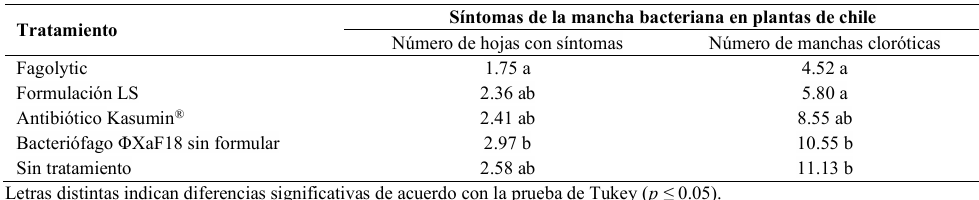
Table 2. Effect of biological treatments for the management of bacterial spot in chili pepper plants under open-field/greenhouse conditions.
Table 3. Effect of application timing of treatments for the management of bacterial spot in chili pepper plants under open-field conditions.
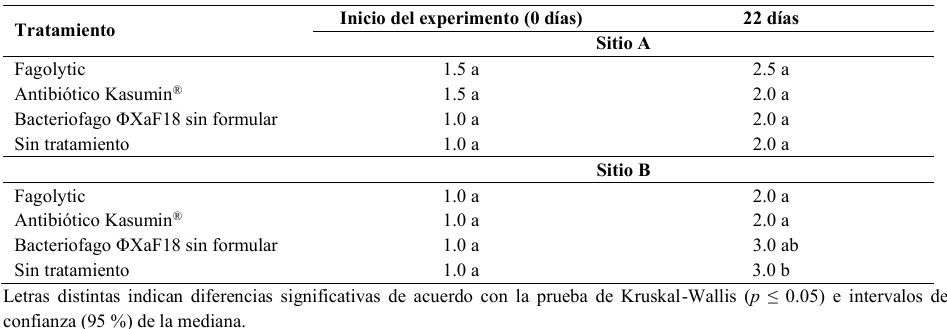
Table 4. Evaluation of bacterial spot severity in chili pepper plants at 0 and 22 days after treatment application for disease control in commercial experimental plot 1 located in Mascota, Jalisco.
Table 5. Effect of treatments for the biological management of bacterial spot in chili pepper plants in commercial experimental plot 1 located in Mascota, Jalisco.
Table 6. Determination of viral concentration on chili pepper foliage at sites A and B of commercial experimental plot 1, located in Mascota, Jalisco, 48 h after application of the ΦXaF18 bacteriophage treatment.
Table 7. Evaluation of bacterial spot severity in chili pepper plants at 0 and 22 days after treatment application in commercial experimental plot 2 located in Mascota, Jalisco.
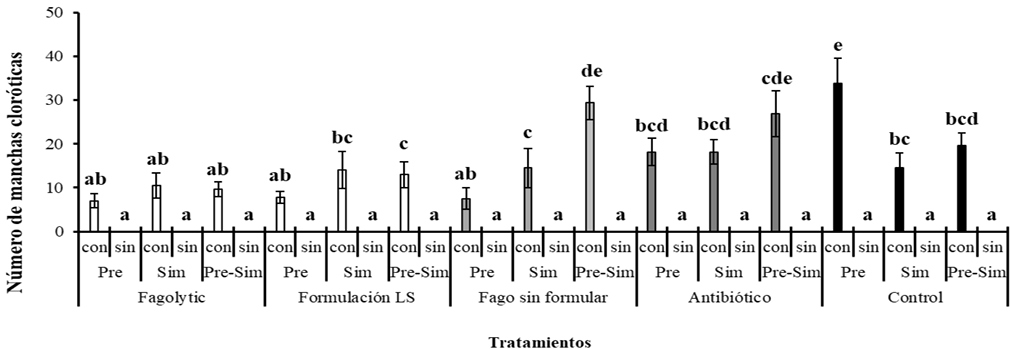
Figure 1. Effect of different treatments on the management of bacterial spot in chili pepper plants under greenhouse and open field conditions. Different letters indicate significant differences according to Tukey’s test (p ≤ 0.05). Bars in each rectangle represent ± standard error. With Xe inoculum (con), without Xe inoculum (sin). Pre: Preventive. Sim: Simultaneous. Pre-Sim: Preventive and Simultaneous.
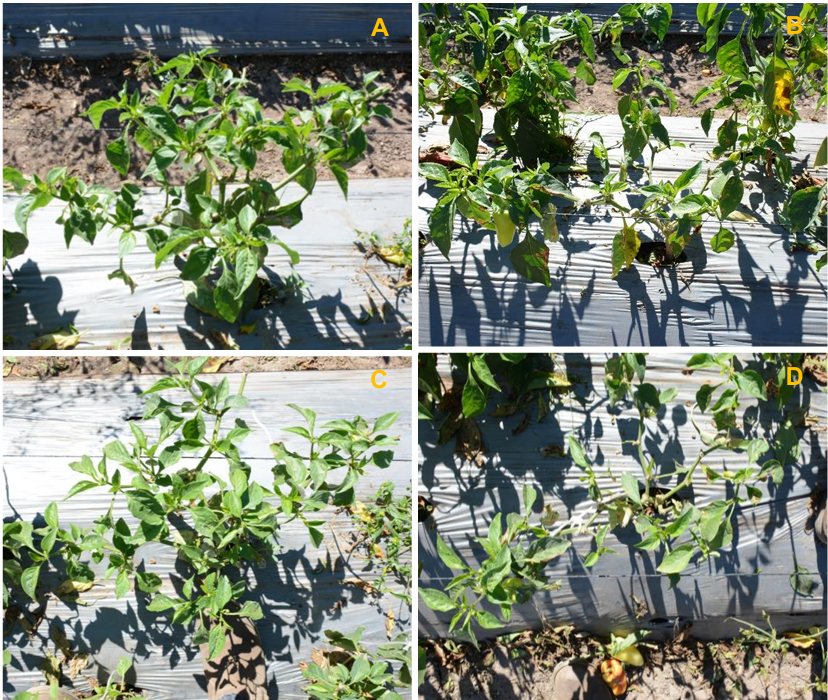
Figure 2. Visual comparison of bacterial spot severity in chili pepper plants treated with Fagolytic (A and C) and untreated control (B and D) at 22 days after the start of the experiment in commercial experimental plot 1 located in Mascota, Jalisco.