Click on the cite to copy
-
Or Copy link



Article filters
Search Papers:
Sensitivity of Sclerotium rolfsii, the causal agent of southern blight in chili pepper, to Trichoderma spp., plant extracts, and fungicides
By José Francisco Díaz Nájera, José Terrones Salgado*, Sergio Ayvar Serna, Mateo Vargas Hernández, Maricela Apáez Barrios, José Luis Arispe Vázquez, José Francisco Adame Bores
*Corresponding Author.
Received: 19/March/2025 – Published:
31/August/2025
DOI:
https://doi.org/10.18781/R.MEX.FIT.2209-1
-
Or Copy link
Abstract Background/Objective. Chili pepper (Capsicum annuum) are widely grown in Mexico. They are affected by facultative soil pathogens, among which the fungus Sclerotium rolfsii can be critical. The objectives of this research were to identify culturally, morphologically, and molecularly the causal agent of southern blight in Guerrero native chili pepper and to evaluate the in vitro antibiosis of Trichoderma spp., as well as the sensitivity of the causal agent to fungicides and plant extracts.
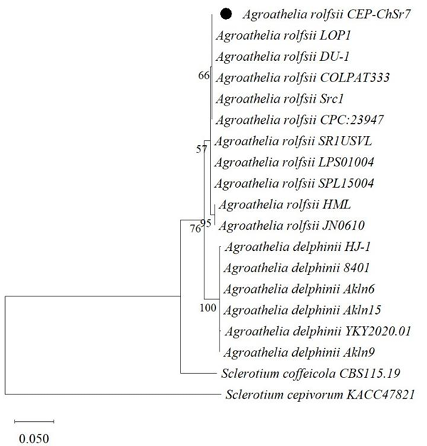
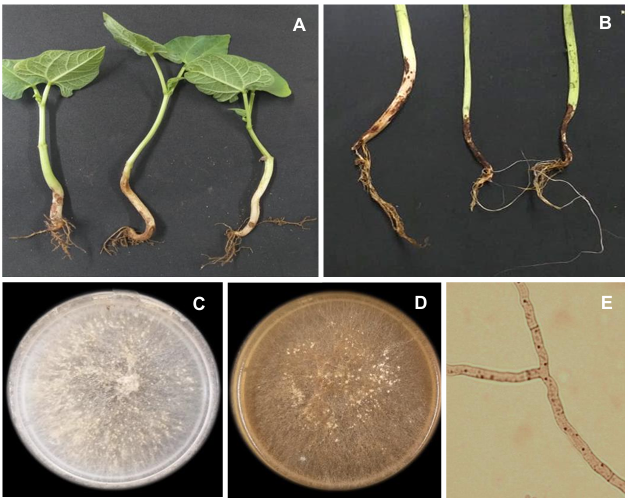
Materials and Methods. At CEP-CSAEGRO, plants of three types of local chili pepper genotypes with symptoms of southern blight were collected from which 20 fungal isolates were isolated, purified, and characterized. One isolate was selected for molecular identification. DNA was extracted using a commercial kit and amplified by PCR, and the internal transcribed spacer (ITS) region was subsequently sequenced. The sequences were edited, and a BLAST analysis and comparison with the NCBI database were performed. To confirm pathogenicity, Koch's postulates were performed in duplicate on chili seedlings of a local genotype. Using a completely randomized experimental design, the in vitro antibiotic activity of Trichoderma spp. against the causal agent was evaluated, as well as its in vitro sensitivity to fungicides and plant extracts.
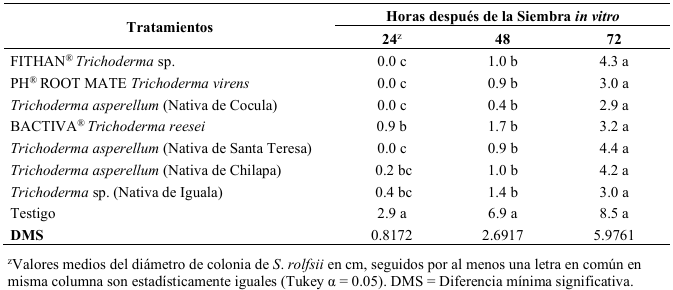
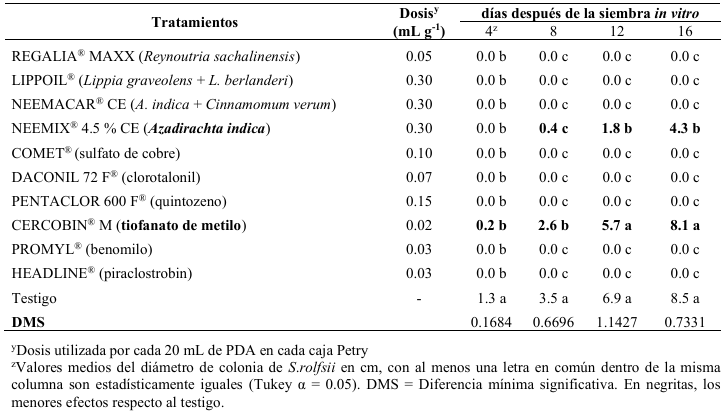
Results. Cultural, morphological, and molecular characterization (PV569903, NCBI accession number) identified Agroathelia rolfsii (S. rolfsii) as the causal agent of southern blight on native chili peppers. Pathogenicity tests showed symptoms identical to those identified in the field. In antibiosis trials, the highest mycelial inhibition of S. rolfsii was obtained with T. virens (65.18%), Trichoderma sp. (65.18%), and T. asperellum (66%). In the in vitro fungicide sensitivity, complete mycelial inhibition (100%) was obtained with copper sulfate, chlorothalonil, quintozene, benomyl, and pyraclostrobin. Commercial plant extracts from Reynoutria sachalinensis, Lippia graveolens + L. berlanderi, and A. indica + Cinnamomum verum completely inhibited the mycelial development of S. rolfsii (100%).
Conclusion. S. rolfsii is the pathogen that causes southern blight in native chili peppers in Guerrero. Trichoderma asperellum (native to Cocula), Trichoderma sp. (native to Iguala), and T. virens (PHC® ROOTMATE) inhibited the growth of S. rolfsii, as did some commercial fungicides and plant extracts. These are suggested as promising alternatives, subject to in vivo validation in the field, for the management of this fungal pathogen under a sustainable integrated approach.
Keywords: Capsicum, Agroathelia rolfsii, T. virens, biorationals, benomyl