RMF Logo

Article filters

Search Papers:

For searching before 2024 see Archive (2000-2023)
  • Vol. 2025, 43(2)
  • Scientific Article

Etiology of the peduncle ringing of avocado (Persea americana) fruits cv. Hass

By María del Carmen Ramírez Mendoza, Rómulo García Velasco*, Juan Carlos Reyes Alemán, Gerardo Justino González Díaz

*Corresponding Author.

Received: 02/October/2024 – Published: 24/April/2025
DOI: https://doi.org/10.18781/R.MEX.FIT.2310-3

  • PDF
  • HTML
  • XML

Abstract Background/Objective. In recent years, a phytopathological problem has manifested itself in avocado cultivation whose etiology is unknown, this disease is known as peduncle ringing, mainly affects fruits of the cv. Hass. The objective of this research was to determine the etiological agent involved in the development of the disease.

Materials and Methods. A collection of avocado fruits was carried out with characteristic symptoms of peduncle ringing: brown peduncle and reddish to purple coloration in the pericarp, the collections were made in the municipalities of Coatepec Harinas, Donato Guerra and Malinalco State of Mexico. In the laboratory, fungi were isolated in PDA medium. Three species of fungi were identified by morphological analysis and confirmed at the DNA level by PCR. Pathogenicity tests were performed on the three species identified individually and in combinations. The variables evaluated were incidence, severity, days at symptom manifestation and percentage of fruits with damaged mesocarp.

Results. Fungi associated with peduncle ringing damage in avocado fruits cv. Hass were identified as Alternaria tenuissima, Cladosporium cladosporioides and Epicoccum nigrum. A. tenuissima showed its high pathogenic capacity to induce peduncle ringing in avocado fruits with 100% incidence and 40% severity. It should be noted that the data on incidence, severity and mesocarp damage are higher in treatments when A. tenuissima, C. cladosporioides and E. nigrum act independently than in consortia.

Conclusion. A. tenuissima, C. cladosporioides and E. nigrum inoculated independently and in consortia were shown to replicate the symptoms of ringing: peduncle in brown-colored fruits and reddish to purple coloration on the pericarp and the mummification of fruits.

Keywords: Pathogenicity, Avocado, Severity, Etiology
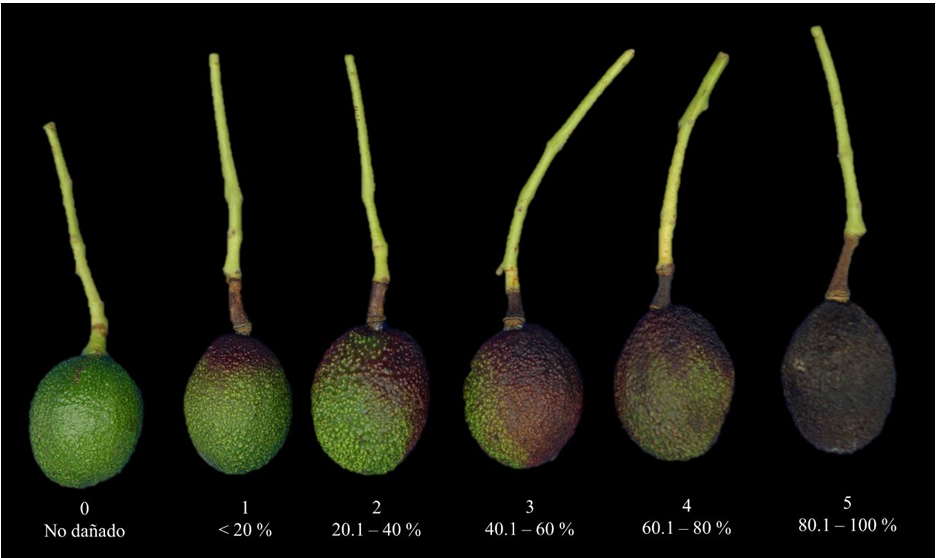
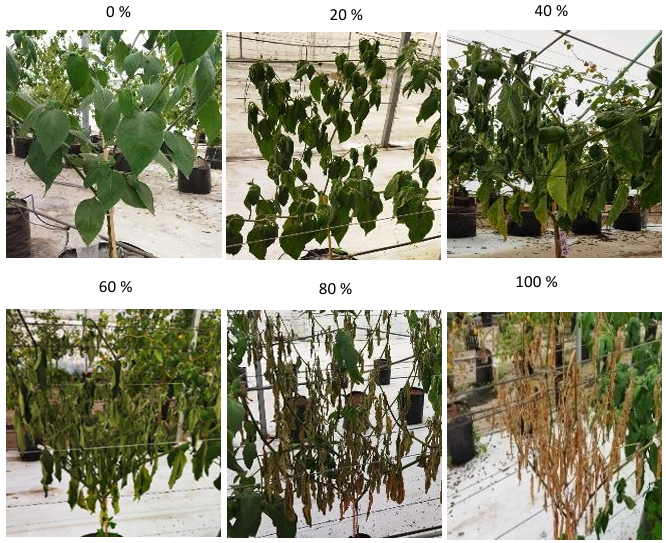
Figure 1. Severity scale for peduncle ringing symptoms in avocado fruits cv. Hass, proposed for assessing lesions in inoculated fruits.
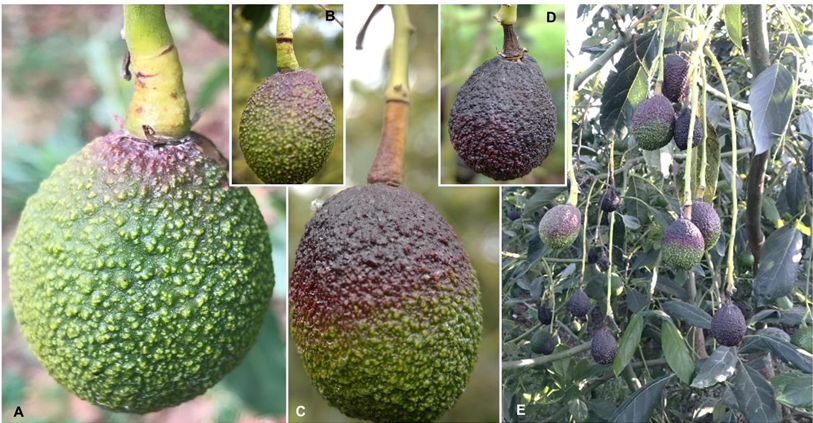
Figure 2. Typical symptoms of peduncle ringing in avocado fruits cv. Hass. A and B) Fruits with dark brown ringing on the peduncle; C) Corky peduncle and fruit with purple coloration on the exocarp; D) Final stage of the ringing symptom, mummified avocado fruit with necrotic peduncle; E) Branch with fruits in different stages of ringing development.
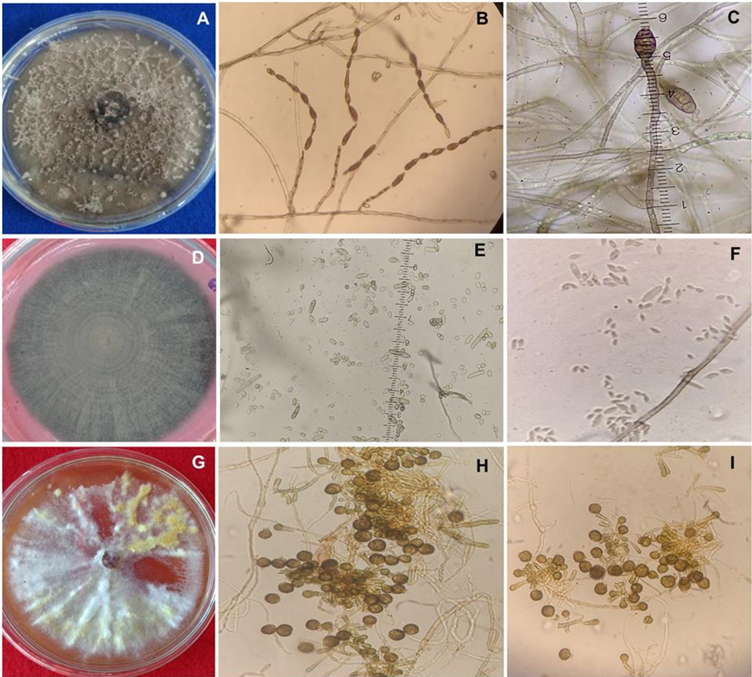
Figure 3. Cultural and morphometric characteristics of <em>Alternaria tenuissima</em>, <em>C. cladosporioides</em> and <em>E. nigrum</em>. A) Colony of <em>A. tenuissima</em> flat growth grown in PCA medium. B) Chain conidia of 4-13 originating from primary conidiophores of erect growth. C) Measurement of muriform conidia with micrometric ruler. D) Colony of <em>C. cladosporioides</em> with flocy micelium grown in PDA medium, front. E) Measurement of unicellular-cell conidia. F) Solitary conidia detached from the conidiophore. G) Colony of <em>Epicoccum nigrum</em> flat growth and development of cottony mycelium in PDA medium. H) Formation of multicelular chlamydospores. I) Septate mycelium and globose chlamydospores of <em>E. nigrum</em>.
Figure 3. Cultural and morphometric characteristics of Alternaria tenuissima, C. cladosporioides and E. nigrum. A) Colony of A. tenuissima flat growth grown in PCA medium. B) Chain conidia of 4-13 originating from primary conidiophores of erect growth. C) Measurement of muriform conidia with micrometric ruler. D) Colony of C. cladosporioides with flocy micelium grown in PDA medium, front. E) Measurement of unicellular-cell conidia. F) Solitary conidia detached from the conidiophore. G) Colony of Epicoccum nigrum flat growth and development of cottony mycelium in PDA medium. H) Formation of multicelular chlamydospores. I) Septate mycelium and globose chlamydospores of E. nigrum.
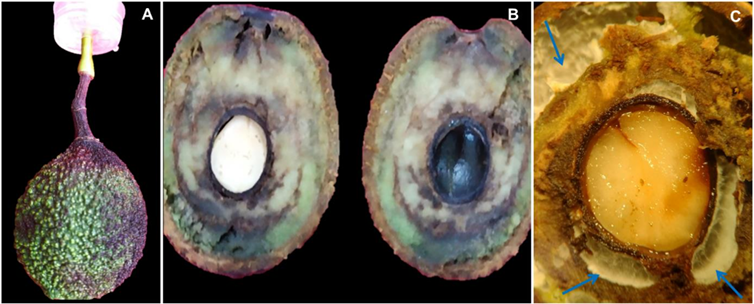
Figure 4. Symptomatology developed in fruits inoculated with <em>Epicoccum nigrum</em>. A) Fruit with peduncle damage and purplish discoloration on the exocarp. B) Longitudinal section of the fruit showing brown to dark lesions in the mesocarp. C) Mycelial growth in the cavities of the fruit mesocarp, observed under a stereoscopic microscope.
Figure 4. Symptomatology developed in fruits inoculated with Epicoccum nigrum. A) Fruit with peduncle damage and purplish discoloration on the exocarp. B) Longitudinal section of the fruit showing brown to dark lesions in the mesocarp. C) Mycelial growth in the cavities of the fruit mesocarp, observed under a stereoscopic microscope.
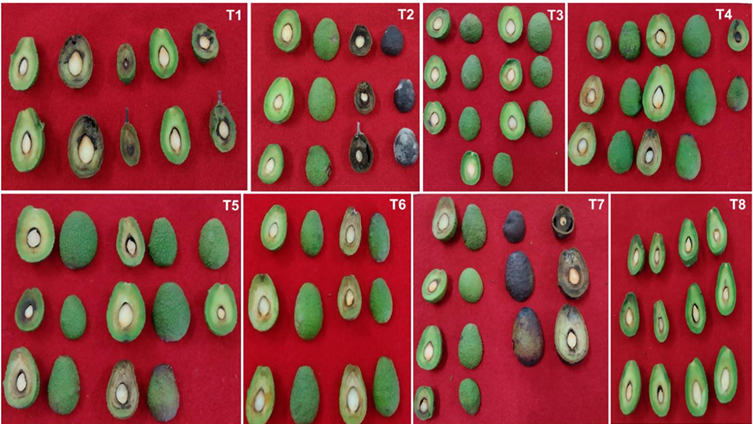
Figure 5. Symptoms observed in fruits inoculated with the different fungi, both in combination and individually: T1) <em>A. tenuissima</em> + <em>E. nigrum</em> + <em>C. cladosporioides</em>. T2) <em>A. tenuissima</em> + <em>E. nigrum</em>. T3) <em>A. tenuissima</em> + <em>C. cladosporioides</em>. T4) <em>E. nigrum</em> + <em>C. cladosporioides</em>. T5) <em>E. nigrum</em>. T6) <em>A. tenuissima</em>. T7) <em>C. cladosporioides</em>. T8) Control.
Figure 5. Symptoms observed in fruits inoculated with the different fungi, both in combination and individually: T1) A. tenuissima + E. nigrum + C. cladosporioides. T2) A. tenuissima + E. nigrum. T3) A. tenuissima + C. cladosporioides. T4) E. nigrum + C. cladosporioides. T5) E. nigrum. T6) A. tenuissima. T7) C. cladosporioides. T8) Control.
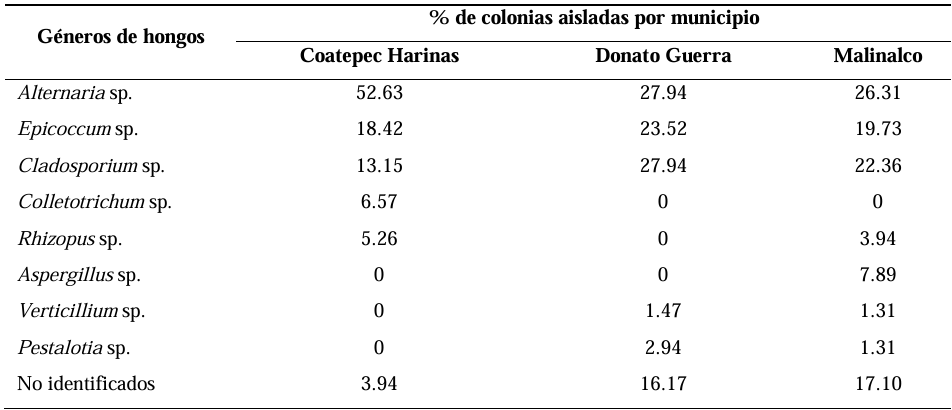
Table 1. Frequency of fungi isolated from peduncles of avocado fruits cv. Hass collected from commercial orchards in the municipalities of Coatepec Harinas, Donato Guerra, and Malinalco, State of Mexico, Mexico.
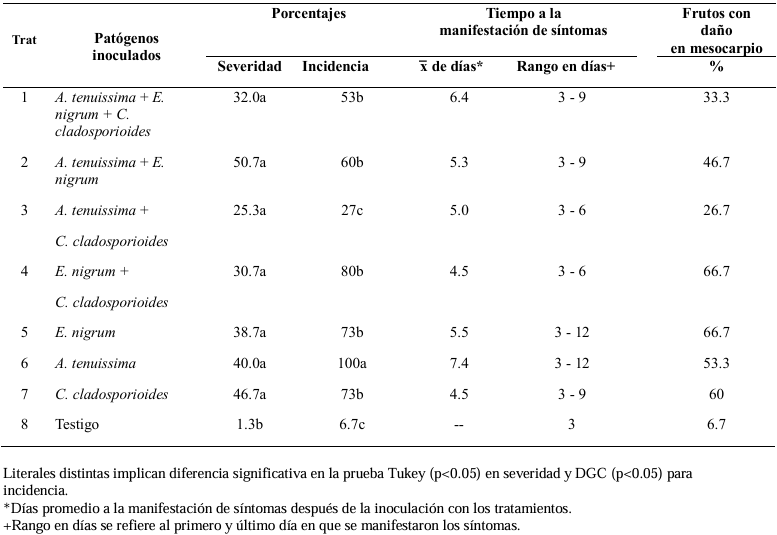
Table 2. Incidence, severity, and time to symptom appearance in avocado fruits cv. Hass inoculated with A. tenuissima, <em>C. cladosporioides</em>, <em>E. nigrum</em>, and their combinations.
Table 2. Incidence, severity, and time to symptom appearance in avocado fruits cv. Hass inoculated with A. tenuissima, C. cladosporioides, E. nigrum, and their combinations.
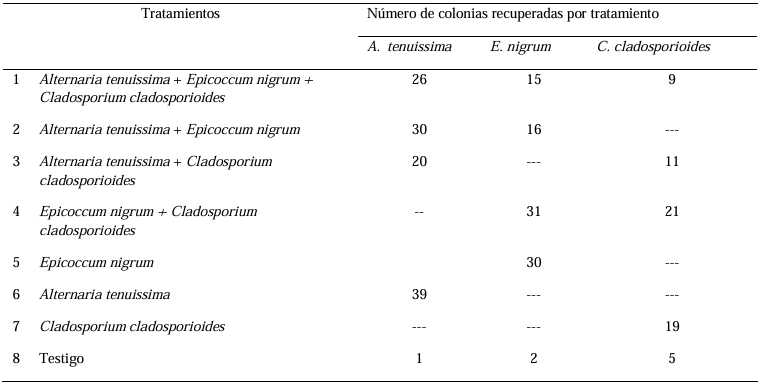
Table 3. Number of colonies and fungal species recovered from <em>in vitro</em> pathogenicity tests on avocado fruits cv. Hass.
Table 3. Number of colonies and fungal species recovered from in vitro pathogenicity tests on avocado fruits cv. Hass.