Click on the cite to copy
-
Or Copy link



Article filters
Search Papers:
Morphological and molecular characterization of Trichoderma strains isolated from the BioHumisol® biofertilizer
By Karla Marina Báez Parra, Edith Salazar Villa, Josefina León Félix, Miguel Ángel Angulo Escalante, Indira Rojo Báez*
*Corresponding Author.
Received: 28/July/2024 – Published:
16/December/2025
DOI:
https://doi.org/10.18781/R.MEX.FIT.2407-3
-
Or Copy link
Abstract Background/Objective. Biofertilizers exist that contain microorganisms beneficial to plants and the environment. However, some commercial products provide little information about the species they use. Therefore, this study aimed to identify, culturally, morphologically, morphometrically, and molecularly, the Trichoderma species present in the BioHumisol® fertilizer used in agriculture in Culiacán and Navolato, Sinaloa, México.
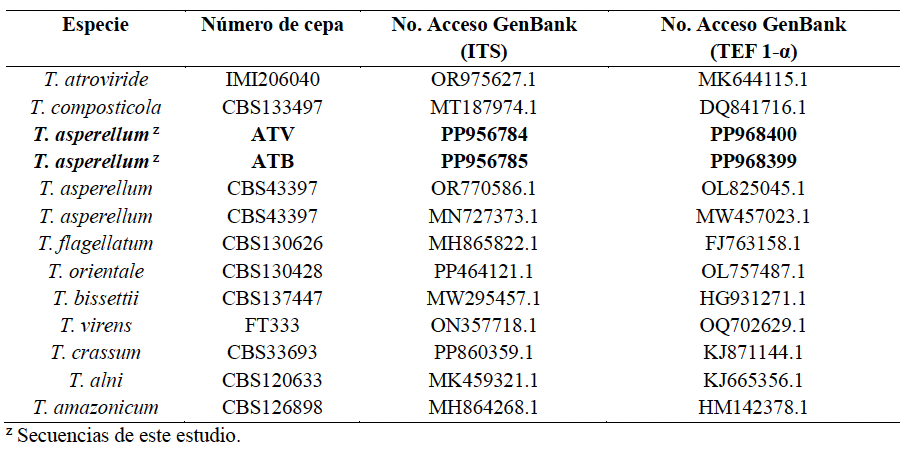
Experimental development. Fungal colonies were isolated and purified from the BioHumisol® liquid biofertilizer. For cultural, morphological, and morphometric identification, three Petri dishes were used, each containing one fungal isolate. The following characteristics were recorded: color, mycelium shape and arrangement in the culture medium, days of sporulation, and the size and shape of conidia, phialides, and chlamydospores. The mycelial growth rate was also recorded. At the molecular level, the ITS region and the TEF-1 α gene were amplified. The sequences were registered in GenBank with the accession numbers: PP956784, PP956785 for ITS; PP968400, PP968399 for TEF-1 α. Phylogenetic analysis of the concatenated sequences was performed using the maximum likelihood and Bayesian inference method with a bootstrap of 1000 replicates.
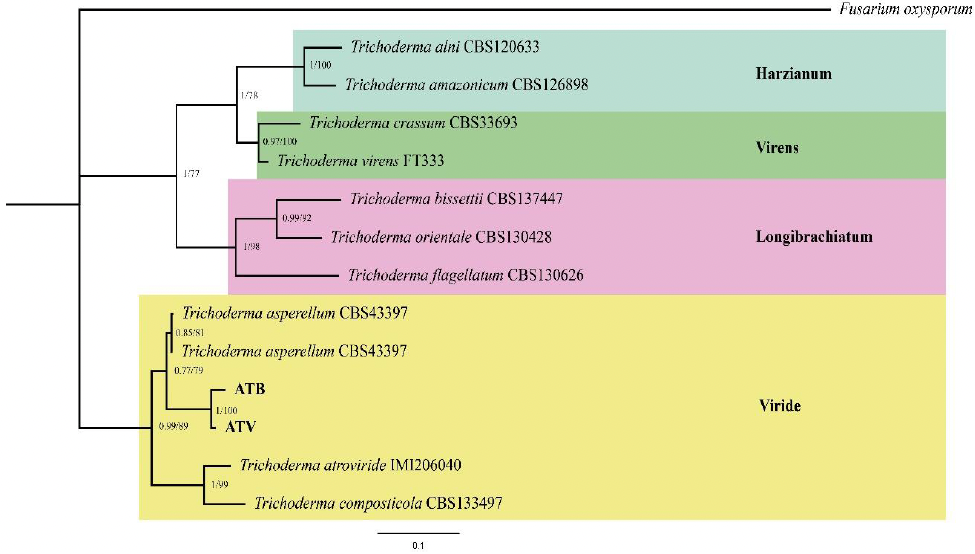
Results. The fungal colonies presented hyaline, branched, non-whorled conidiophores; phialides either single or in groups with terminal branches worth average measurements of 4.1-6.2 × 9.7-15.3 μm; unicellular ovoid conidia with average dimensions of 3.6-5.09 × 3.27-6.41 μm and subglobose intercalary and terminal chlamydospores measuring 21.41 × 21.72 μm consistent with Trichoderma. Currently accurate identification requires cultural, morphological and morphometric characterization, complemented by molecular characterization. BLAST analysis of partial ITS sequences showed 99% homology, and the TEF -1 α gene showed 100% homology with T. asperellum. Phylogenetic analyses confirm genetic proximity to species of the Viride clade.
Conclusion. Based on the cultural, morphological, morphometric and molecular characterization, the species found in the liquid biofertilizer BioHumisol® is Trichoderma asperellum.
Keywords: Trichoderma asperellum, ITS, TEF -1 α, Biocontrol