Click on the cite to copy
-
Or Copy link

Article filters
Search Papers:
Sancassania mycophaga (Acari: Acaridae) as a regulatory agent for Nacobbus aberrans (Tylenchida: Pratylenchidae)
By Olga Gómez Rodríguez, Edgar Villar Luna, Laith Khalil Tawfeeq Al-Ani, Iván Morales Soto, Reyna Vargas Abasolo, Liliana Aguilar Marcelino*
*Corresponding Author.
Received: 28/July/2025 – Published:
09/February/2026
DOI:
https://doi.org/10.18781/R.MEX.FIT.2407-4
-
Or Copy link
Abstract Background/Objective. Nematophagous mites represent a potentially effective tool in integrated management programs for plant-parasitic nematodes. The objective of this study was to evaluate the predatory capacity of the nematophagous mite Sancassania mycophaga against the plant-parasitic nematode Nacobbus aberrans under laboratory conditions.
Experimental development. Two independent experiments were conducted. For this purpose, the experimental unit consisted of a pot with a pepper plant (Capsicum annuum), in which 500 or 1000 J2 juveniles of N. aberrans were inoculated. Four treatments were evaluated: (1) control (nematodes only), (2) simultaneous inoculation of mites and nematodes, (3) inoculation of nematodes five days after mites, and (4) inoculation of nematodes 10 days after mites. In all treatments, five mites were introduced per pot. The variables were: percentage of J2 penetration in roots, number of galls, eggs, and abundance of mites. The data were subjected to ANOVA and comparison of means (LSD, p < 0.05).
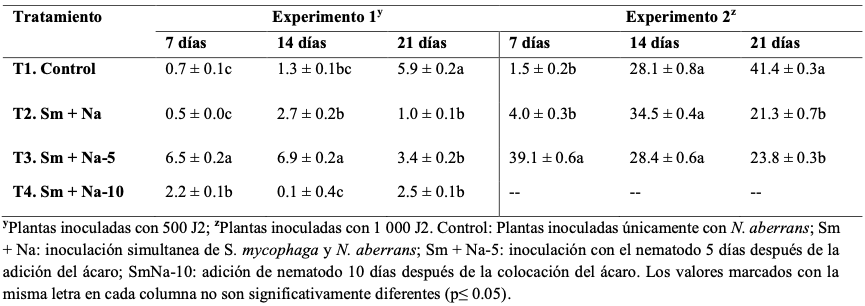
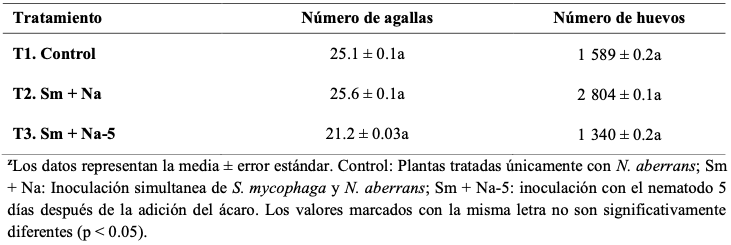
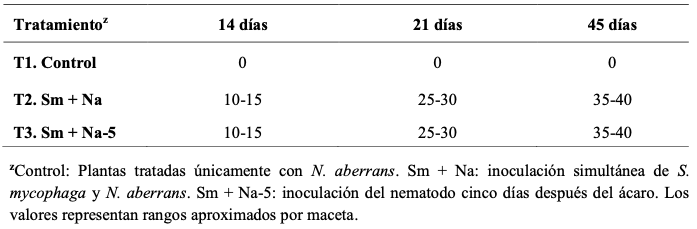
Results. Twenty-one days after the establishment of the trials, a significant reduction in nematode penetration was observed in all treatments with mites, compared to the control. In the experiment with 500 J2, the percentages of root penetration were 1.0, 3.4, and 2.5% for treatments 2, 3, and 4, respectively. In the experiment with 1000 J2, the penetration percentage was 21.3 and 23.8% for treatments 2 and 3. From day 14 onwards, the mite population showed sustained growth, increasing from an initial five individuals to more than 25 at 21 days (>400%) and more than 35 at 45 days (>600%). No significant differences in the number of galls or eggs were detected at 45 days.
Conclusions. S. mycophaga reduced the penetration of N. aberrans into pepper roots. With 500 J2, the relative reduction ranged from 42 to 83%, while with 1 000 J2 it varied between 42 and 49% compared to the control. In addition, the mite managed to establish itself and multiply in the experimental system. These results support its potential as a biocontrol agent for N. aberrans.
Keywords: Mite, Predation, Nematode, Phytoparasite, Biocontrol