RMF Logo

Article filters

Search Papers:

For searching before 2024 see Archive (2000-2023)
  • Vol. 2025, 43(3)
  • Scientific Article

Characterization of Sclerotium rolfsii and species of Trichoderma in commercial crops of potato in Sonora and Sinaloa, Mexico

By María Belén Irazoqui Acosta, Rubén Felix Gastelum*, Karla Yeriana Leyva Madrigal, Rosa Maria Longoria Espinoza, Gabriel Herrera Rodríguez, Sara Elodia Armenta López

*Corresponding Author.

Received: 09/August/2024 – Published: 28/August/2025
DOI: https://doi.org/10.18781/R.MEX.FIT.2408-1

  • PDF
  • HTML
  • XML

Abstract Background/Objective. Sclerotium rolfsii causes losses in potato production up to 20% in the states of Sonora and Sinaloa. No studies exist supported by the scientific method on the identification of the fungus in the crop, neither of the species of Trichoderma present in the soil with potential to control the disease under field conditions. The objectives of the present study were to: a) obtain isolates of S. rolfsii from soil subject to the potato crop in the states of Sonora and Sinaloa, and determine the population density of sclerotia of the fungus; isolate and quantify the population density of Trichoderma spp., in the same soil to use them in subsequent studies for controlling the disease and determine the pathogenicity of S. rolfsii in potato tubers under laboratory conditions.

Materials and Methods. The isolates were collected from 239 commercial potato fields in the states of Sonora and Sinaloa. The population density was determined by counting the sclerotia of S. rolfsii and the colony forming units (CFU g-1) of Trichoderma in soil. The identification of the fungi was performed by morphological studies and molecular techniques including the internal transcribed spacer (ITS) for S. rolfsii and the subunit of RNA polymerase II (RPB2) for Trichoderma spp. The pathogenicity tests of the isolates of S. rolfsii were determined in potato tubers var. Fianna in the laboratory.

Results. Twenty isolates of S. rolfsii were identified whose population density varied from 2 to 24 sclerotia kg-1 of soil. On the other hand, 26 isolates of Trichoderma spp. were identified; 16 of them corresponded to T. asperellum, five to T. asperelloides, four to T. afroharzianum and one to T. azevedoi with a population density from 2 to 8 CFU g-1 of soil. The isolates of S. rolfsii resulted pathogenic to potato tubers var. Fianna, with different levels of aggressiveness.

Conclusion. The results obtained in the present study indicate the presence of S. rolfsii in 8.4% of the 239 potato growing fields included in the study sampled in the growing cycles 2019-2022 con population densities from 2 to 24 sclerotia g-1 of soil. The pathogen confirmation by conventional and molecular techniques, as well as its capability to induce soft rot of potato tubers var. Fianna, provides evidence of its potential impact on potato production. Variable aggressiveness was detected among isolates, highlighting the Scr4 isolate as the most aggressive with penetration up to 16.9 mm and soft rotting of 10.5%. In parallel, 26 isolates of Trichoderma spp. were identified in 10.9% of the fields, with population densities from 2 to 8 CFU g-1 of soil. These findings highlight the importance of incorporating sustainable strategies for disease management, considering both the variability of the pathogen and the possible application of native antagonists; also, it is stressed the necessity to investigate the population dynamics of the pathogen and agricultural practices to minimize its survival.

Keywords: Fungi, Identification, Population density, Pathogenicity, Virulence
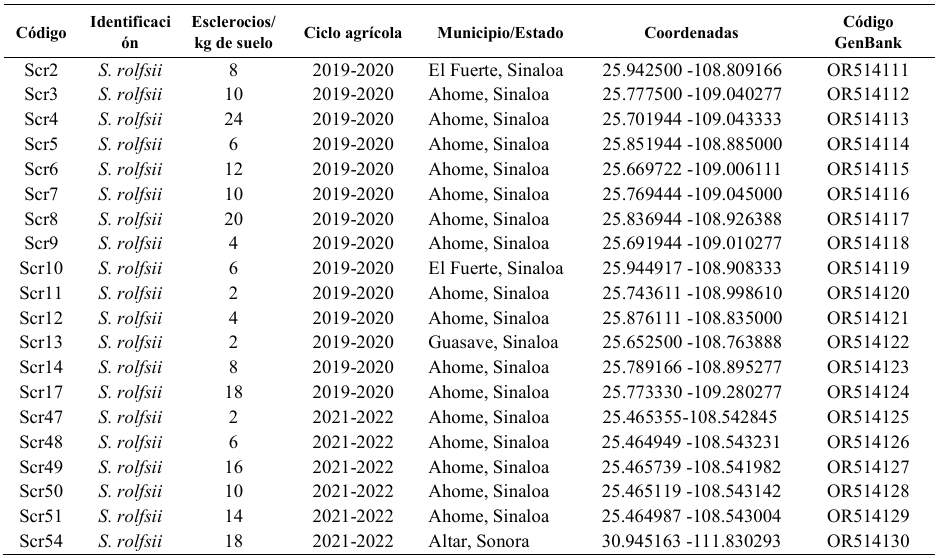
Table 1. Identification, population density and origin of 20 <em>S. rolfsii</em> isolates obtained from soils in which potato is grown in Sonora and Sinaloa.
Table 1. Identification, population density and origin of 20 S. rolfsii isolates obtained from soils in which potato is grown in Sonora and Sinaloa.
Table 2. Identification ID, population density (CFU) and origin of 26 <em>Trichoderma</em> isolates sampled from soil of potato (<em>S. tuberosum</em>) commercial fields in Sonora and Sinaloa.
Table 2. Identification ID, population density (CFU) and origin of 26 Trichoderma isolates sampled from soil of potato (S. tuberosum) commercial fields in Sonora and Sinaloa.
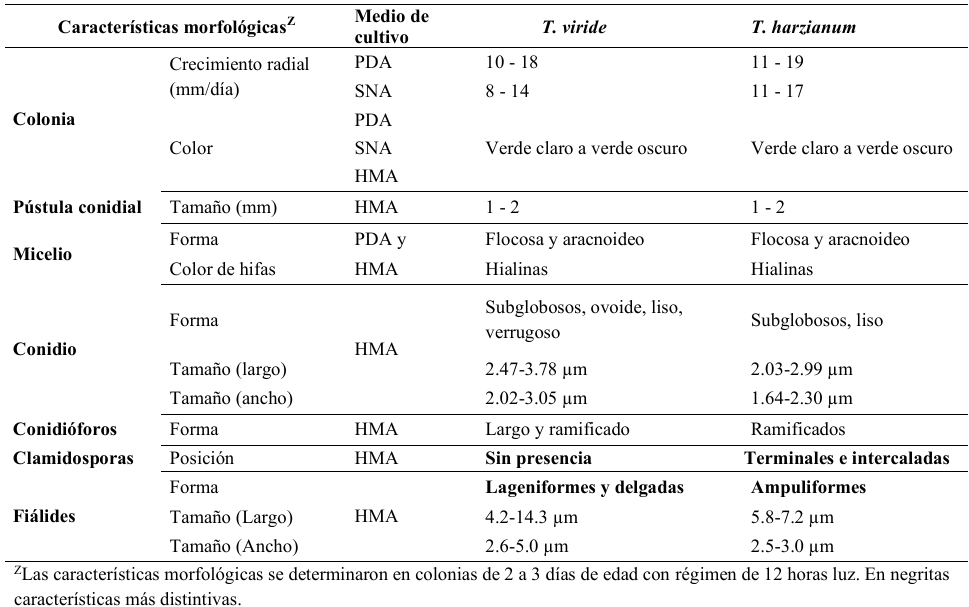
Table 3. Morphological characteristics of isolates of the <em>Trichoderma viride</em> and <em>Trichoderma harzianum</em> species complexes in three culture media.
Table 3. Morphological characteristics of isolates of the Trichoderma viride and Trichoderma harzianum species complexes in three culture media.
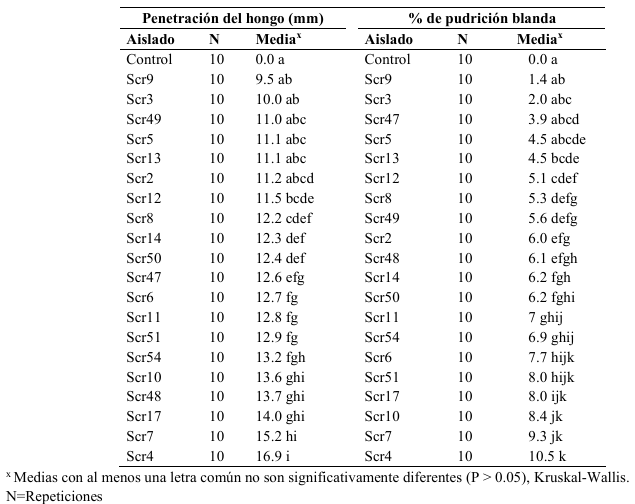
Table 4. Penetration of the pathogen and percentage of soft rot in potato tubers var. Fianna with artificial inoculation.
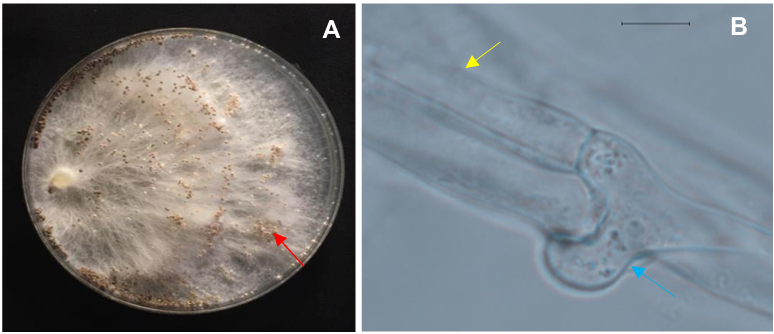
Figure 1. Morphological characteristics of <em>Sclerotium rolfsii</em> (Scr17). (A) Colony morphology in PDA medium, and sclerotia (red arrow); (B) Hyphal hyalin (yellow arrow) and fíbulae (blue arrow) (100x). Scale: (B= 50 µm).
Figure 1. Morphological characteristics of Sclerotium rolfsii (Scr17). (A) Colony morphology in PDA medium, and sclerotia (red arrow); (B) Hyphal hyalin (yellow arrow) and fíbulae (blue arrow) (100x). Scale: (B= 50 µm).
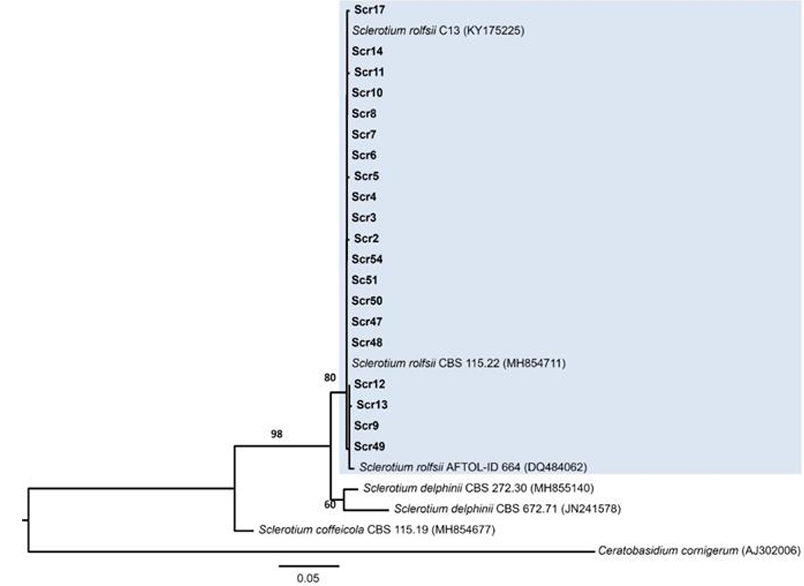
Figure 2. Phylogenetic analysis of <em>Sclerotium rolfsii</em> from Sonora and Sinaloa. Maximum likelihood tree based on the Internal Transcribed Spacer (ITS) of 20 <em>S. rolfsii</em> isolates. The isolates characterized in this study appear in bold letters. The bootstrap values over 50 are shown as percentages. The scale bar indicates the expected number of nucleotide substitutions.
Figure 2. Phylogenetic analysis of Sclerotium rolfsii from Sonora and Sinaloa. Maximum likelihood tree based on the Internal Transcribed Spacer (ITS) of 20 S. rolfsii isolates. The isolates characterized in this study appear in bold letters. The bootstrap values over 50 are shown as percentages. The scale bar indicates the expected number of nucleotide substitutions.
Figure 3. Colony and microscopic morphology of <em>Trichoderma asperellum</em> (TES19). (A) colony in PDA culture medium. (B) colony in SNA culture medium. (C) conidial pustules. (D and E) conidiophores and (F) conidia (100x). (C-F) in HMA medium. Scale: (C= 2 mm) (D= 10 µm) (E and F= 5 µm). This species belongs to <em>T. viride</em> complex.
Figure 3. Colony and microscopic morphology of Trichoderma asperellum (TES19). (A) colony in PDA culture medium. (B) colony in SNA culture medium. (C) conidial pustules. (D and E) conidiophores and (F) conidia (100x). (C-F) in HMA medium. Scale: (C= 2 mm) (D= 10 µm) (E and F= 5 µm). This species belongs to T. viride complex.
Figure 4. Colony and microscopic morphology of <em>Trichoderma afroharzianum</em> (TAF33). (A) colony in PDA culture medium. (B) colony in SNA culture medium. (C) conidial pustules. (D and E) chlamidospores and (F and G) conidiophores (H) conidia (100x). (C-H) in HMA medium. Scale: (C= 2 mm) (D and H= 5 µm) (E, F and G= 10 µm). This species belongs to <em>T. harzianum</em> complex.
Figure 4. Colony and microscopic morphology of Trichoderma afroharzianum (TAF33). (A) colony in PDA culture medium. (B) colony in SNA culture medium. (C) conidial pustules. (D and E) chlamidospores and (F and G) conidiophores (H) conidia (100x). (C-H) in HMA medium. Scale: (C= 2 mm) (D and H= 5 µm) (E, F and G= 10 µm). This species belongs to T. harzianum complex.
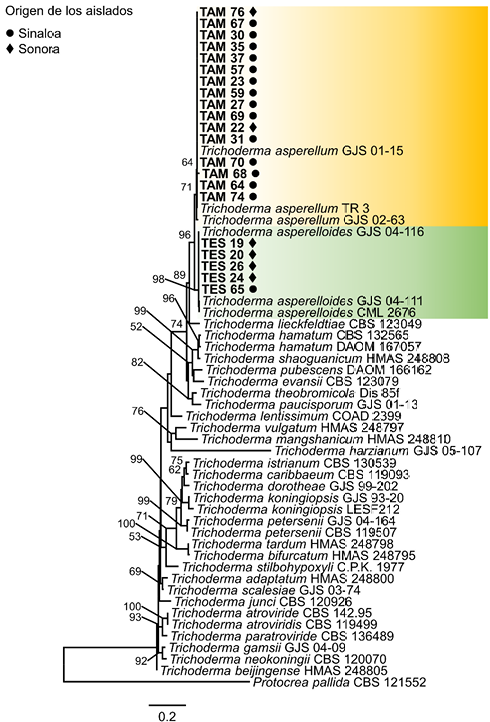
Figure 5. Maximum Likelihood phylogram of the <em>Trichoderma viride</em> species complex, based on the RNA polymerase II subunit (RPB2). The 21 <em>Trichoderma</em> isolates, obtained from potato plantations in Sonora and Sinaloa characterized in this study, appear in bold and highlighted in color. The bootstrap values >50 and the posterior probability values >0.5 are shown in the nodes. The scale bar indicates the expected number of nucleotide substitutions.
Figure 5. Maximum Likelihood phylogram of the Trichoderma viride species complex, based on the RNA polymerase II subunit (RPB2). The 21 Trichoderma isolates, obtained from potato plantations in Sonora and Sinaloa characterized in this study, appear in bold and highlighted in color. The bootstrap values >50 and the posterior probability values >0.5 are shown in the nodes. The scale bar indicates the expected number of nucleotide substitutions.
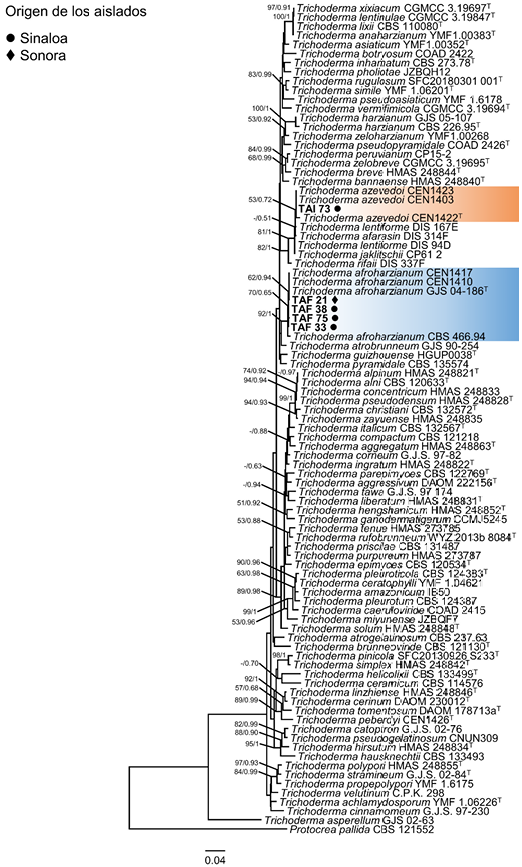
Figure 6. Maximum Likelihood phylogram of the <em>Trichoderma harzianum</em> species complex, based on the RNA polymerase II subunit (RPB2). The five <em>Trichoderma</em> isolates obtained from potato plantations in Sonora and Sinaloa characterized in this study, appear in bold and highlighted in color. The bootstrap values >50 and the posterior probability values >0.5 are shown in the nodes. The scale bar indicates the expected number of nucleotide substitutions.
Figure 6. Maximum Likelihood phylogram of the Trichoderma harzianum species complex, based on the RNA polymerase II subunit (RPB2). The five Trichoderma isolates obtained from potato plantations in Sonora and Sinaloa characterized in this study, appear in bold and highlighted in color. The bootstrap values >50 and the posterior probability values >0.5 are shown in the nodes. The scale bar indicates the expected number of nucleotide substitutions.
Figure 7. Symptoms of soft rot in Fianna variety potato tubers, caused by the isolate Scr17 of <em>S. rolfsii</em> by artificial inoculation. (A) Tubers with symptoms of <em>S. rolfsii</em> in a moist chamber. (B and C) lesions with cottonlike mycelium caused by the fungus. (D) Transverse cut of potato tuber with soft rot.
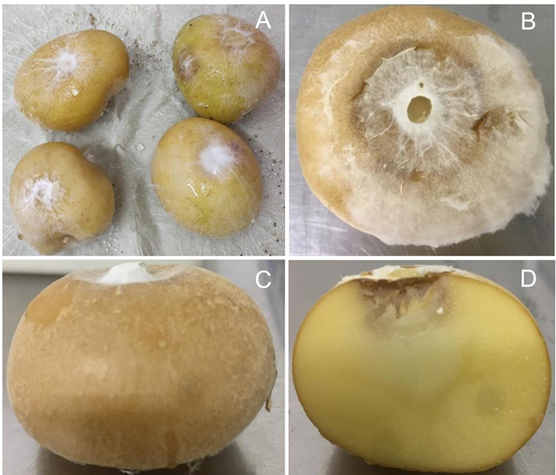
Figure 7. Symptoms of soft rot in Fianna variety potato tubers, caused by the isolate Scr17 of S. rolfsii by artificial inoculation. (A) Tubers with symptoms of S. rolfsii in a moist chamber. (B and C) lesions with cottonlike mycelium caused by the fungus. (D) Transverse cut of potato tuber with soft rot.