Click on the cite to copy
-
Or Copy link

Article filters
Search Papers:
Diversity of endophytic bacteria in strawberry plants (Fragaria sp.) in Sinaloa
By Rosa M Longoria Espinoza*, Rubén Félix Gastélum, Dulce R Hernández Luna
*Corresponding Author.
Received: 09/August/2024 – Published:
30/August/2025
DOI:
https://doi.org/10.18781/R.MEX.FIT.2408-2
-
Or Copy link
Abstract Background/Objective. Currently, agricultural systems require management strategies based on crop sustainability. Plant growth-promoting bacteria are an environmentally friendly option to reduce the use of chemicals in agriculture and promote sustainable agricultural practices. The objective of this research was to isolate and identify endophytic bacteria in strawberry plants (Fragaria x ananassa) cv Chanler, grown under organic conditions and to evaluate in vitro their ability to produce metabolites related to plant growth promotion.
Materials and Methods. Twenty-five healthy-looking strawberry plants of the Chanler variety were collected during the fall-winter 2023-2024 cycle. Genomic DNA was isolated from samples composed of root, stem, and leaf tissue, and the 16S rDNA gene was amplified.
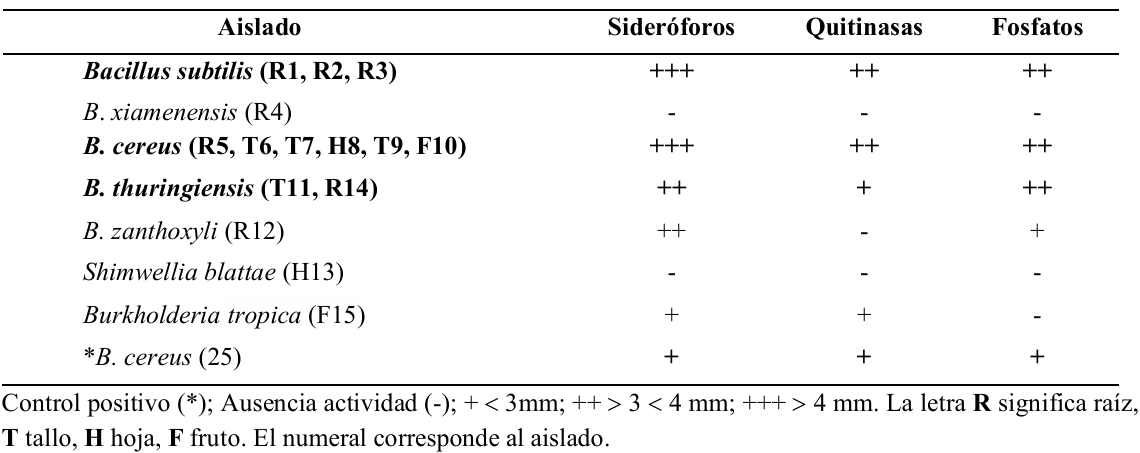
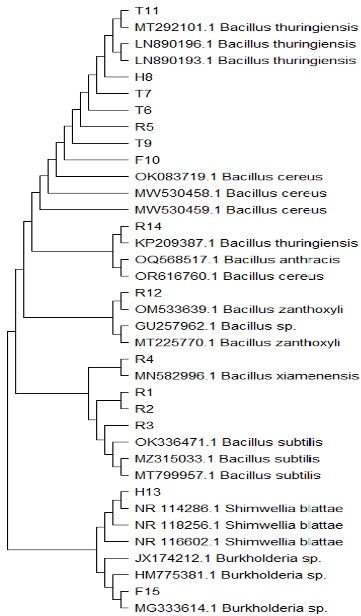
Results. Analysis of genomic sequences identified bacterial genera associated with the phylum Firmicutes, with the genus Bacillus predominating, along with the species B. cereus; B. subtilis, B. thuringiensis, B. xiamenensis, and B. zanthoxyli. Shimwellia blattae and Burkholderia tropica were detected in smaller numbers. Of these isolates, B. cereus, B. subtilis, and B. thuringiensis, in that order, showed the ability to produce siderophores, chitinase, and solubilize phosphorus in vitro.
Conclusion. B. cereus, B. subtilis, and B. thuringiensis exhibited metabolic characteristics related to plant growth promotion in vitro. These results in the existence of a diversity of endophytic bacteria in commercial strawberries. This provides information for understanding the endophytic bacteria-plant interaction in the specific environment of strawberry cultivation in the northern state of Sinaloa.
Keywords: Siderophores, Phosphates, Chitinase, B. cereus.