Click on the cite to copy
-
Or Copy link


Article filters
Search Papers:
Fusariosis level (Fusarium oxysporum) in tomato plants (Solanum lycopersicum) treated with Trichoderma asperellum Jc01 and Bacillus subtilis ANT01
By Miguel Salvador Figueroa, José Fernando Gómez López, Miguel Salvador Adriano, María de Lourdes Adriano Anaya, Isidro Ovando Medina, Benjamín Moreno Castillo*
*Corresponding Author.
Received: 26/August/2025 – Published:
11/March/2026
DOI:
https://doi.org/10.18781/R.MEX.FIT.2408-4
-
Or Copy link
Abstract Background/Objective. The production and quality of tomato (Solanum lycopersicum) crops are severely reduced by the fungus Fusarium oxysporum, the causal agent of fusarium wilt. Chemical fungicides are conventionally applied, although in cases of severe infection, the entire harvest is lost. Favorable environmental conditions increase the incidence, infection rate, and spread of this pathogen. Biological control is a useful strategy for combating this type of pathogen. The objective of this research was to determine the incidence of fusarium wilt (Fusarium oxysporum) in field-grown tomato plants treated with Trichoderma asperellum Jc01 and Bacillus subtilis ANT01.
Experimental development. Trichoderma asperellum Jc01 and Bacillus subtilis ANT01 either alone or in combination, were weekly applied to the drip zone of tomato plants (Solanum lycopersicum). Disease incidence was periodically sampled in both treated and untreated plants to monitor its progression over 15 weeks. Additionally, the number of flowers and fruits produced on the experimental plants was recorded.
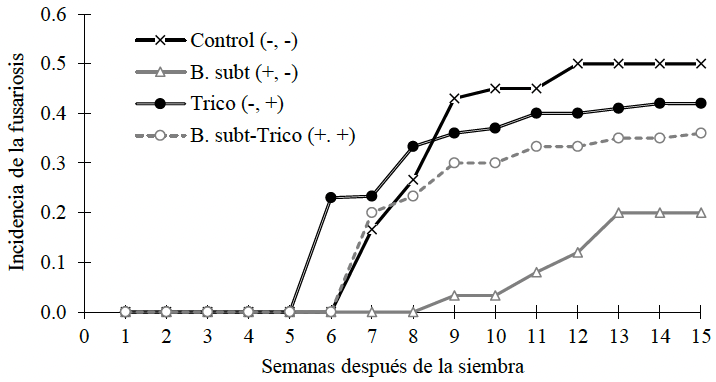
Results. At the end of the field trial, plants treated with B. subtilis ANT01 showed 60% less incidence compared to the control and a total of 47.9 fruits produced per plant, while plants treated with Trichoderma asperellum Jc01 or the combination of both microorganisms showed 16 and 28% less incidence than the control, and 18.0 and 27.3 fruits produced per plant, respectively.
Conclusion. The results show at least partial evidence of the potential of the ANT01 strain as a biocontrol agent of F. oxysporum in tomato plants.
Keywords: Biocontrol, Incidence, Phytopathogen, Microorganisms