Click on the cite to copy
-
Or Copy link



Article filters
Search Papers:
First record of Rhizoctonia solani AG-7 causing root rot of common bean in Mexico
By Karen Rabago Zavala, Blanca Elvira López Valenzuela, Fernando Alberto Valenzuela Escoboza*, Glenda Judith Lizárraga Sánchez
*Corresponding Author.
Received: 18/September/2024 – Published:
26/August/2025
DOI:
https://doi.org/10.18781/R.MEX.FIT.2409-1
-
Or Copy link
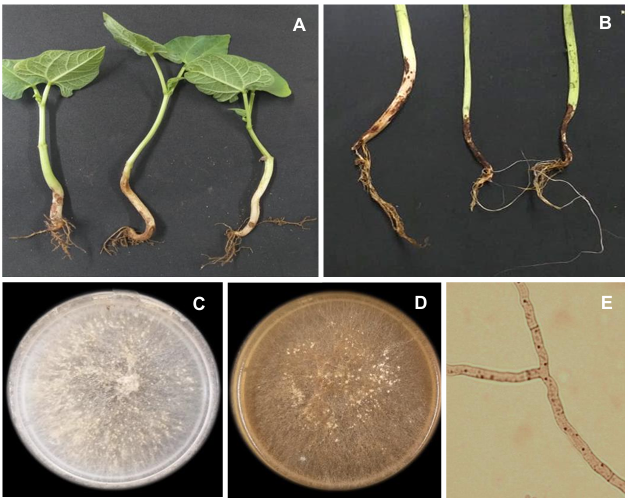
Abstract Background/Objective. In November 2020, in two bean (Phaseolus vulgaris) plantations in northern Sinaloa, symptoms of root rot and plant dieback were observed, with an incidence of up to 35% per plot. The present study was established with the aim of identifying, through the sequencing of ITS and RPB2, the pathogens associated with root rot in beans.
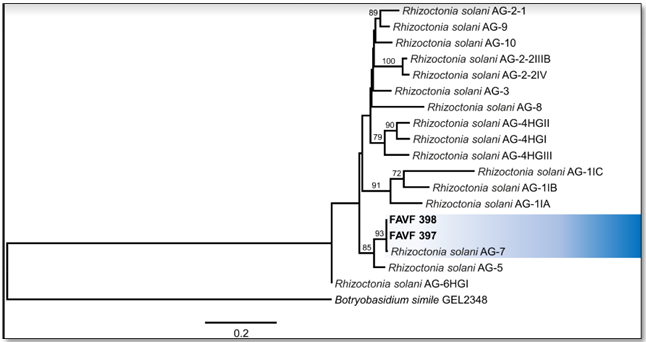
Materials and Methods. Plants with symptoms were selected from bean crops in Ahome, Sinaloa, Mexico. Samples of the lesion advances of the roots of the plants were taken, and fungi with typical morphological characteristics of Rhizoctonia spp. were isolated, which presented septate, hyaline mycelium, forming a right angle and constriction of the basal cell, did not produce spores, and formed sclerotia. Koch's postulates were performed in pots, the inoculum was placed alongside the seed at the time of planting to evaluate the effect on germination and severity in seedlings. Once its pathogenicity was demonstrated, the isolates FAVF397 and FAVF398 were identified molecularly.
Results. The isolates FAVF397 and FAVF398 were molecularly identified as Rhizoctonia solani AG-7 and are responsible for the root rot of common bean.
Conclusion. The AG7 anastomosis group is reported for the first time in beans in Sinaloa. These findings represent a scientific contribution for the benefit of producers of this crop by allowing the design of relevant and effective management strategies.
Keywords: Phaseolus vulgaris, ITS, RNA polymerase II RPB2