Click on the cite to copy
-
Or Copy link

Article filters
Search Papers:
Antimicrobial activity and ricinine quantification in Ricinus communis against phytopathogenic bacteria
By Miguel Angel Angulo Escalante, Isabel Cruz Lachica, Edith Salazar Villa, Indira Rojo Báez, Federico Soto Landeros, Isidro Márquez Zequera, Karla Marina Báez Parra*
*Corresponding Author.
Received: 16/October/2024 – Published:
22/December/2025
DOI:
https://doi.org/10.18781/R.MEX.FIT.2410-3
-
Or Copy link
Abstract Background/Objective. Metabolites of castor bean (Ricinus communis), such as the alkaloid ricinine, have antibacterial properties with the potential to combat phytopathogenic bacteria such as Xanthomonas perforans, Acidovorax citrulli, Clavibacter michiganensis, and Ralstonia solanacearum, making it a natural alternative to conventional chemicals. Therefore, the objective of this study was to evaluate the antimicrobial activity of methanolic extracts from castor bean leaf accessions and quantify ricinine using HPTLC to determine its effectiveness as a bactericidal agent.
Experimental development. The leaves of nine castor bean accessions were ground and sieved to prepare methanolic extracts coded as: 1+, 2+, 4+, 5+, 6+, 7+, 8+, 9+, and 10+. Ricinine in the extracts was quantified by HPTLC. To determine antibacterial activity, the phytopathogenic bacteria Xanthomonas perforans, Acidovorax citrulli, Clavibacter michiganensis subsp. michiganensis, and Ralstonia solanacearum were reactivated and cultured in selective medium with concentrations of the extracts at 100, 75, 50, and 25% and a chemical control Finalbacter® (Gentamicin Sulfate and Oxytetracycline Hydrochloride). The analysis was performed in triplicate.
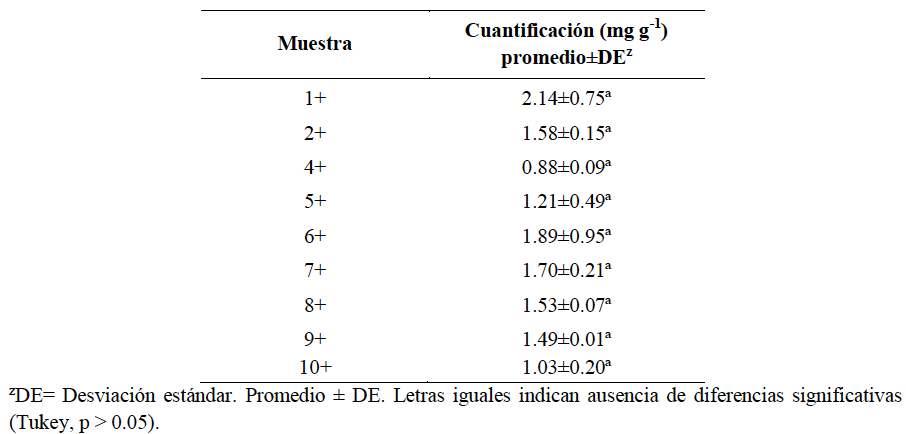
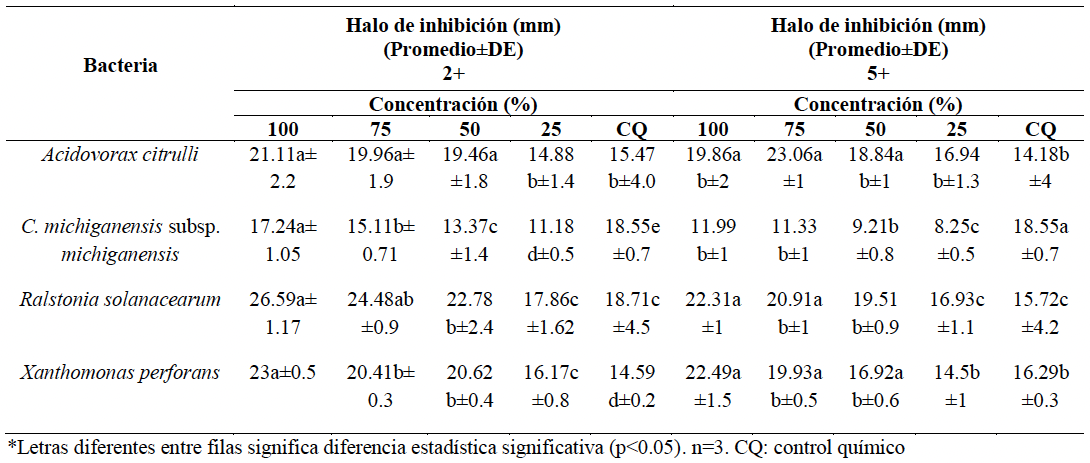
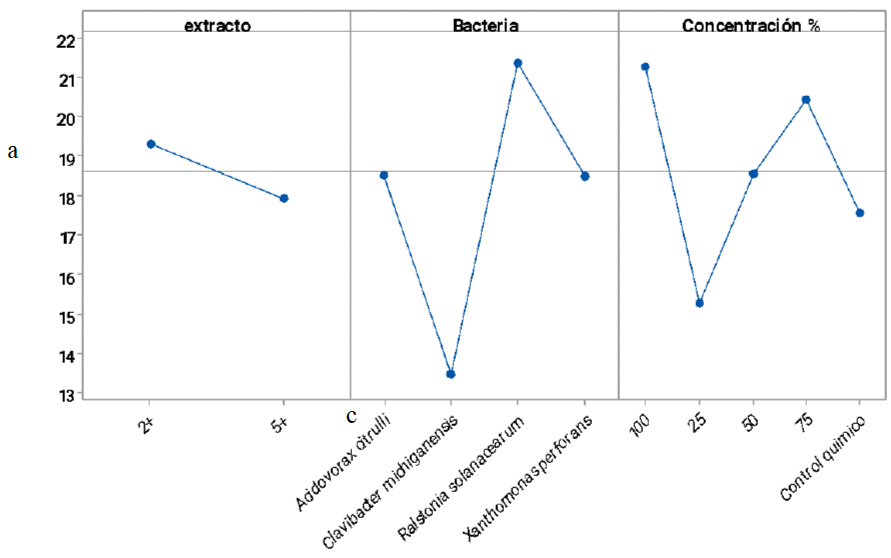
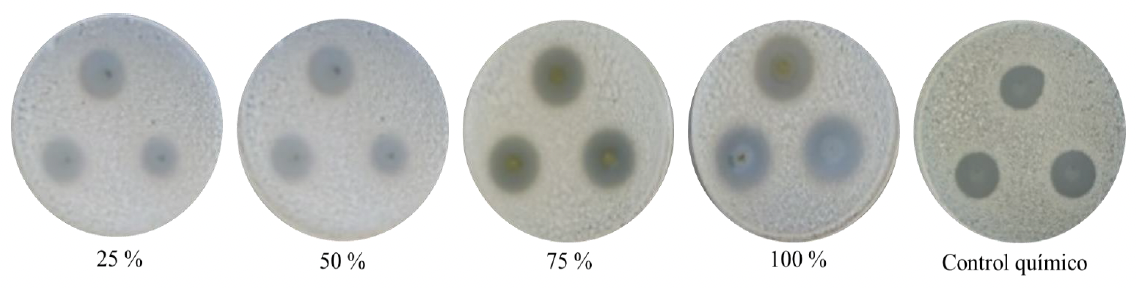
Results. The extracts identified as 2+ and 5+ proved to be the most effective, with inhibition halos of 18.94 mm and 17.23 mm, respectively. Ralstonia solanacearum showed the greatest inhibition (21.6 mm), followed by A. citrulli and X. perforans (19.26 mm each) and C. michiganensis subsp. michiganensis (12.21 mm). The 100% and 75% concentrations showed the largest inhibition halos (20.6 mm and 19.8 mm), compared to the lower concentrations and the chemical control. Ricinine concentrations ranging from 0.88 to 2.14 mg g⁻¹ were quantified.
Conclusion. Accessions 2+ and 5+ of Ricinus communis showed potential as a natural option for controlling phytopathogenic bacteria, with an average inhibition zone of 19.31 mm and 17.92 mm, respectively.
Keywords: Castor bean, Bioactive compounds, Plant pathology, Methanolic extracts