RMF Logo

Article filters

Search Papers:

For searching before 2024 see Archive (2000-2023)
  • Vol. 2026, 44(1)
  • Scientific Article

Etiology of trunk rot in the Enano Verde del Brasil coconut and in vitro efficacy of fungicides in Tabasco, Mexico

By Nitzarindany Acencio Castillo, Magdiel Torres-de la Cruz*, Carlos F Ortiz García, Cristian Nava Díaz, Ángel F Huamán Pilco, Manuel Pérez-de la Cruz, Lenin Arias Rodríguez, Ramón A Castillo González

*Corresponding Author.

Received: 16/December/2024 – Published: 11/December/2025
DOI: https://doi.org/10.18781/R.MEX.FIT.2412-1

  • PDF
  • HTML
  • XML

Abstract Background/Objective. Coconut palm (Cocos nucifera) is an important crop in Mexico. In Tabasco, the “Enano Verde del Brasil” (CEVB) variety has been introduced to produce green fruit for coconut water; however, pathological problems of unknown etiology have been observed. The objective of this study was to identify the fungi associated with trunk rot of CEVB coconut in Tabasco, Mexico, and to conduct a comparative in vitro evaluation of the efficacy of systemic and contact fungicides.

Materials and Methods. Fungal isolation in PDA medium was carried out from trunk, spear, and inflorescence samples showing necrosis. The isolates were initially characterized by morphological analysis. Two of them were selected for pathogenicity tests on CEVB seedlings and identified molecularly through the analysis of partial sequences of the ITS gene (ITS1-5.8S-ITS2 of nuclear rDNA). In addition, in vitro bioassays were conducted to compare the efficacy of 10 systemic and contact fungicides. Each fungicide was evaluated at three concentrations (high, recommended, and low), estimating their effect on spore germination (SG) and mycelial growth (MG).

Results. The isolates were identified as Thielaviopsis paradoxa. The pathogenicity tests confirmed T. paradoxa as the causal agent of necrosis in seedlings. The systemic fungicides propiconazole, carbendazim, and tebuconazole showed complete inhibition of MG and SG starting from the lowest dose evaluated (0.45×10³, 1×10³, and 0.5×10³ ppm, respectively). The protectant fungicides copper hydroxide and captan completely inhibited SG at the lowest dose (1×10³ and 1.5×10³ ppm, respectively), although they only reached 80% inhibition of MG.

Conclusion. T. paradoxa is reported for the first time on CEVB in Mexico. This study expands the knowledge on fungi affecting CEVB in Tabasco and provides a basis for the selection of promising fungicides, whose efficacy should be validated in subsequent field studies.

Keywords: Carbendazim, Cocos nucifera, Propiconazole, Tebuconazole, Thielaviopsis paradoxa
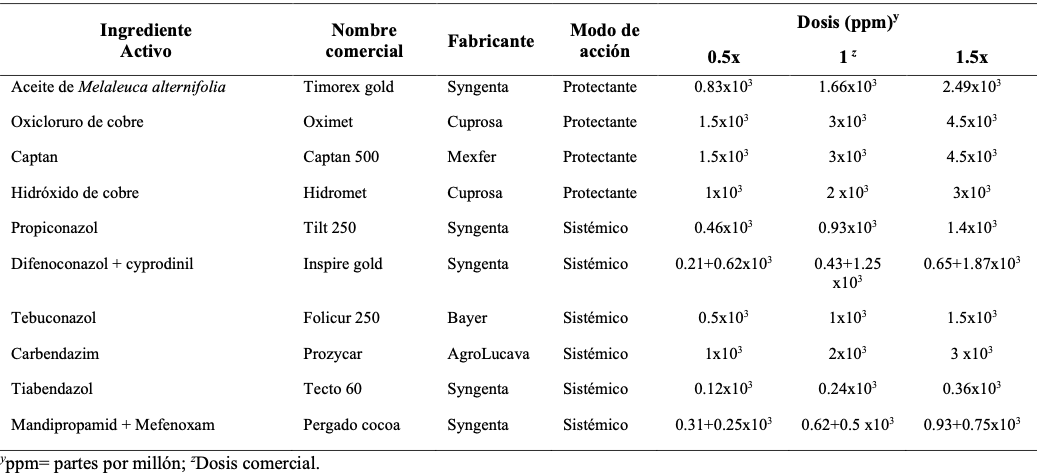
Table 1. Fungicides and doses evaluated <em>in vitro</em> against <em>Thielaviopsis paradoxa.</em>
Table 1. Fungicides and doses evaluated in vitro against Thielaviopsis paradoxa.
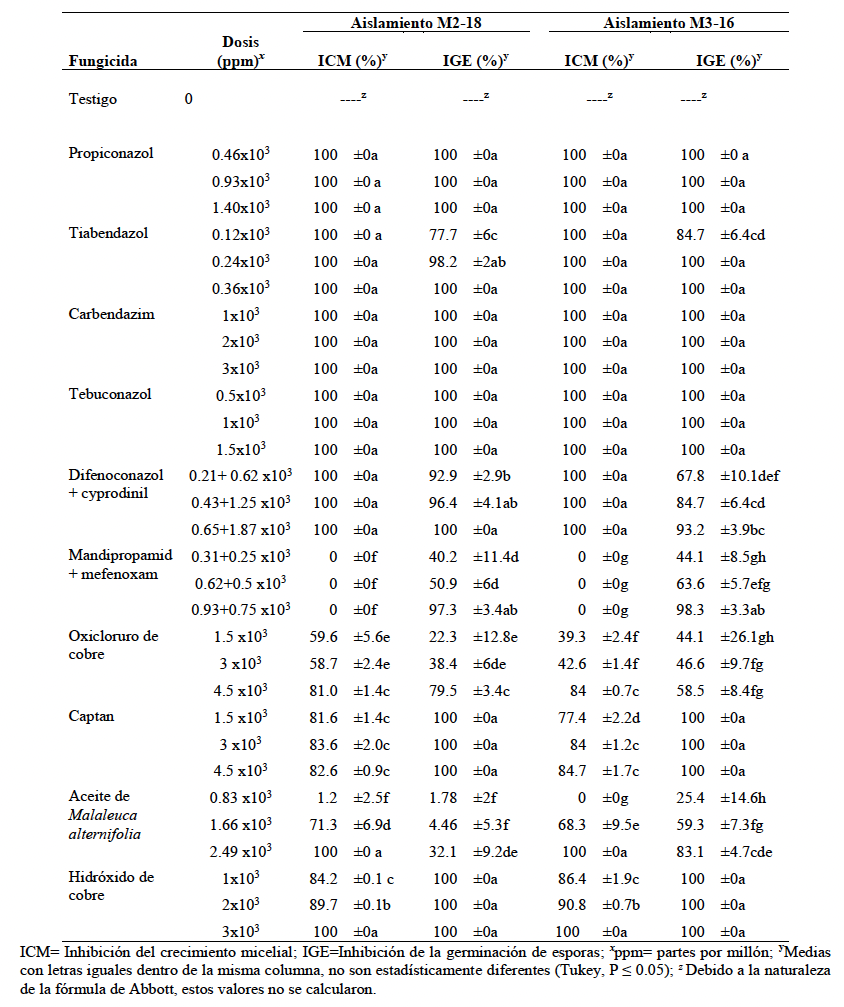
Table 2. Effectiveness of systemic and contact fungicides on mycelial growth and conidial germination of two <em>Thielaviopsis paradoxa</em> strains (M2-18 and M3-16) isolated from <em>Cocos nucifera</em>, var. Enano Verde del Brasil, on the coast of Tabasco, Mexico.
Table 2. Effectiveness of systemic and contact fungicides on mycelial growth and conidial germination of two Thielaviopsis paradoxa strains (M2-18 and M3-16) isolated from Cocos nucifera, var. Enano Verde del Brasil, on the coast of Tabasco, Mexico.
Figure 1. Symptoms associated with trunk rot of <em>Cocos nucifera</em> “Enano Verde del Brasil” on the coast of Tabasco, Mexico. <strong>A</strong>) Necrosis on the sheath of basal leaves at the point of attachment to the trunk; <strong>B</strong>) Necrosis at the leaf insertion point on the stipe; <strong>C</strong>) Progression of necrosis toward the interior of the trunk; <strong>D</strong>) Necrosis of the spear leaf; <strong>E</strong>) Necrosis on spathes and inflorescences; <strong>F</strong>) Wilted leaves and “skirt” of leaves attached to the trunk; <strong>G</strong>) Crown collapse with terminal leaves still green; <strong>H</strong>) Downward trunk rot.
Figure 1. Symptoms associated with trunk rot of Cocos nucifera “Enano Verde del Brasil” on the coast of Tabasco, Mexico. A) Necrosis on the sheath of basal leaves at the point of attachment to the trunk; B) Necrosis at the leaf insertion point on the stipe; C) Progression of necrosis toward the interior of the trunk; D) Necrosis of the spear leaf; E) Necrosis on spathes and inflorescences; F) Wilted leaves and “skirt” of leaves attached to the trunk; G) Crown collapse with terminal leaves still green; H) Downward trunk rot.
Figure 2. Morphological characteristics of <em>Thielaviopsis paradoxa</em>. <strong>A</strong>) Fifteen-day-old colony grown on PDA medium; <strong>B</strong>) Conidiophores; <strong>C</strong>) Primary phialoconidia in chains; <strong>D</strong>, <strong>E</strong>) Primary and secondary phialoconidia in chains; <strong>F</strong>, <strong>G</strong>) Aleuroconidia. Scale bars: <strong>B</strong> = 20 μm; <strong>C</strong>, <strong>D</strong>, <strong>E</strong>, <strong>F</strong>, <strong>G</strong> = 10 μm.
Figure 2. Morphological characteristics of Thielaviopsis paradoxa. A) Fifteen-day-old colony grown on PDA medium; B) Conidiophores; C) Primary phialoconidia in chains; D, E) Primary and secondary phialoconidia in chains; F, G) Aleuroconidia. Scale bars: B = 20 μm; C, D, E, F, G = 10 μm.
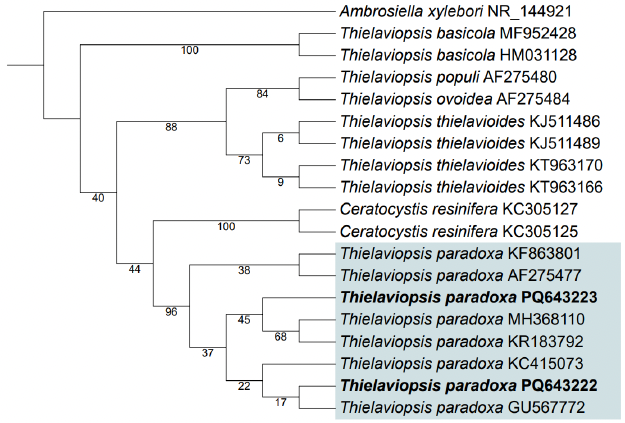
Figure 3. Maximum-likelihood phylogenetic tree constructed using a dataset of partial sequences of the internal transcribed spacer regions 1 and 2 (ITS1 and ITS2) and the intervening 5.8S rDNA subunit for isolates M2-18 (GenBank accession number: PQ643222) and M3-16 (GenBank accession number: PQ643223) of <em>Thielaviopsis paradoxa</em>, obtained from trunk and bud samples of <em>Cocos nucifera</em> “Enano Verde del Brasil” exhibiting trunk rot on the coast of Tabasco, Mexico. Sequence data for other <em>Thielaviopsis</em> (<em>Ceratocystis</em>) strains and species were obtained from GenBank.
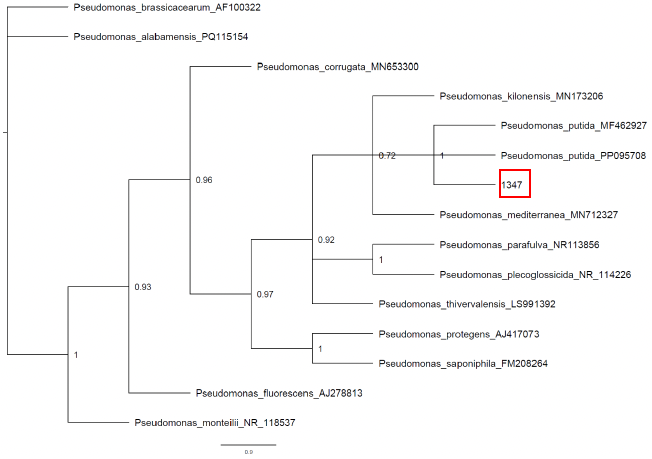
Figure 3. Maximum-likelihood phylogenetic tree constructed using a dataset of partial sequences of the internal transcribed spacer regions 1 and 2 (ITS1 and ITS2) and the intervening 5.8S rDNA subunit for isolates M2-18 (GenBank accession number: PQ643222) and M3-16 (GenBank accession number: PQ643223) of Thielaviopsis paradoxa, obtained from trunk and bud samples of Cocos nucifera “Enano Verde del Brasil” exhibiting trunk rot on the coast of Tabasco, Mexico. Sequence data for other Thielaviopsis (Ceratocystis) strains and species were obtained from GenBank.
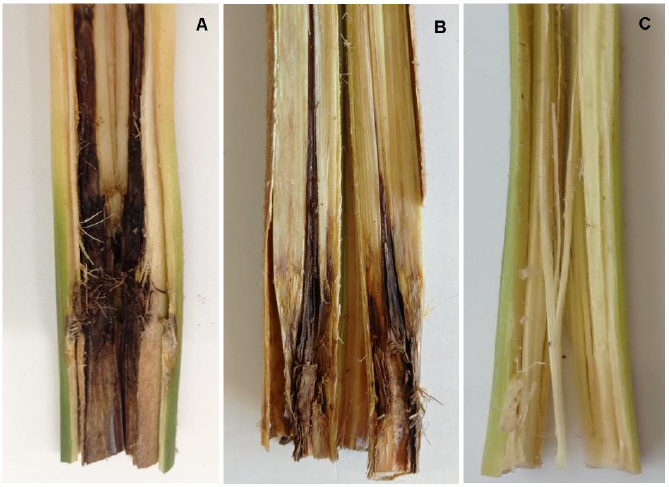
Figure 4. Pathogenicity tests on coconut seedlings “Enano Verde del Brasil”. <strong>A</strong>, <strong>B</strong>) Necrosis caused by <em>Thielaviopsis paradoxa</em>, strains M2-18 and M3-16, respectively. <strong>C</strong>) Control.
Figure 4. Pathogenicity tests on coconut seedlings “Enano Verde del Brasil”. A, B) Necrosis caused by Thielaviopsis paradoxa, strains M2-18 and M3-16, respectively. C) Control.
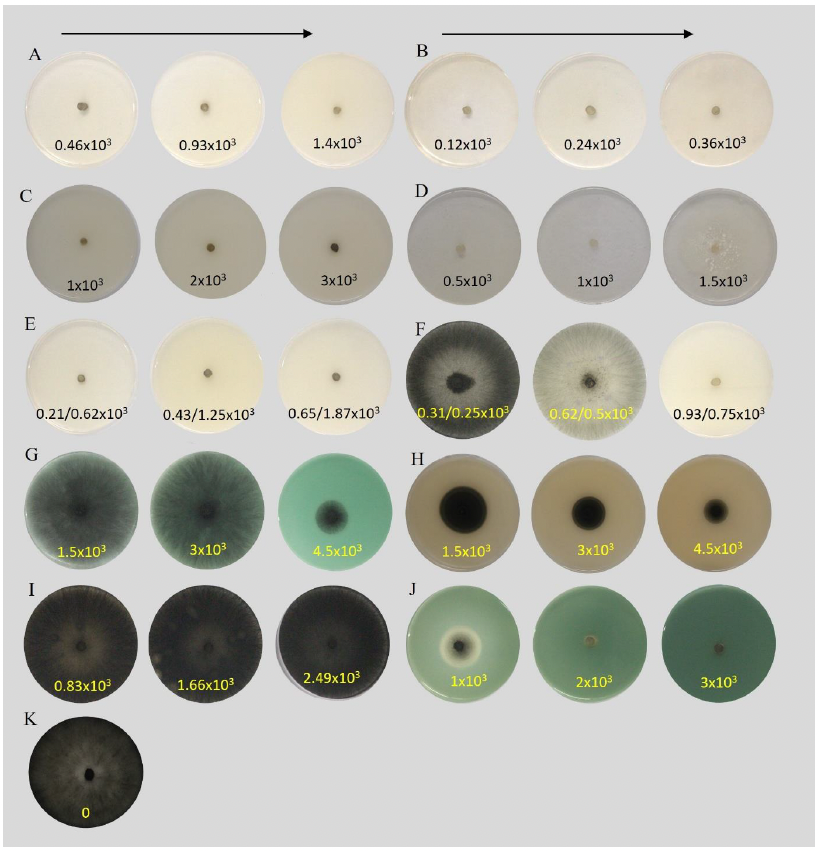
Figure 5. <em>In vitro</em> effect of systemic and contact fungicides on<em> Thielaviopsis paradoxa.</em> <strong>A</strong>) Medium with propiconazole; <strong>B</strong>) Medium with thiabendazole; <strong>C</strong>) Medium with carbendazim; <strong>D</strong>) Medium with tebuconazole; <strong>E</strong>) Medium with difenoconazole + cyprodinil; <strong>F</strong>) Medium with mandipropamid + mefenoxam; <strong>G</strong>) Medium with copper oxychloride; <strong>H</strong>) Medium with captan; <strong>I</strong>) Medium with <em>Melaleuca alternifolia</em> oil; <strong>J</strong>) Copper hydroxide; <strong>K</strong>) Control. Numbers within each image indicate the dose in parts per million (ppm). All doses are expressed in units of ×10³.
Figure 5. In vitro effect of systemic and contact fungicides on Thielaviopsis paradoxa. A) Medium with propiconazole; B) Medium with thiabendazole; C) Medium with carbendazim; D) Medium with tebuconazole; E) Medium with difenoconazole + cyprodinil; F) Medium with mandipropamid + mefenoxam; G) Medium with copper oxychloride; H) Medium with captan; I) Medium with Melaleuca alternifolia oil; J) Copper hydroxide; K) Control. Numbers within each image indicate the dose in parts per million (ppm). All doses are expressed in units of ×10³.