RMF Logo

Article filters

Search Papers:

For searching before 2024 see Archive (2000-2023)
  • Vol. 2025, 43(3)
  • Scientific Article

Uromyces viciae-fabae inoculation under controlled conditions

By Jorge Pérez Cárcamo*, José Sergio Sandoval Islas, María Florencia Rodríguez García, Serafín Cruz Izquierdo, Cristian Nava Díaz, Olga Gómez Rodríguez

*Corresponding Author.

Received: 14/May/2025 – Published: 01/August/2025
DOI: https://doi.org/10.18781/R.MEX.FIT.2505-4

  • PDF
  • HTML
  • XML

Abstract Background/Objective. The objective was to evaluate incubation and post incubation temperatures, inoculum concentrations, and maleic acid effect to develop an efficient and reproducible method for U. viciae-fabae inoculation in broad bean genotypes.

Materials and methods. The evaluated factors were inoculum concentration, incubation and post-incubation temperatures, maleic acid concentration, and the inoculation method validation. The variables evaluated were type of infection, number of pustules, percentage of severity, pustule size, and latency period. Analysis of variance and comparison of means were performed using the Tukey test (p ≤ 0.05).

Results. Incubation temperatures of 7 and 18 °C showed no significant differences. A urediniospore concentration of 3 x 10⁶ showed significant differences in the number of pustules and severity. No symptoms were observed in the uncontrolled environment, averaging 24 °C. U. viciae-fabae was able to develop at controlled temperatures of 18 and 22 °C, and at uncontrolled temperatures averaging 20 °C.

Conclusions. Efficient inoculation was achieved with a concentration of 3 × 10⁶ urediniospores per mL-1 at an incubation and post-incubation temperature of 18 °C.

Keywords: Vicia faba, Optimal conditions, Sporulation, Infection type
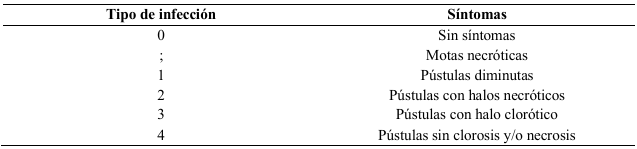
Table 1. Infection type scale proposed by Stakman <em>et al</em>. (1962), adapted to broad bean by Sillero<em> et al</em>. (2000).
Table 1. Infection type scale proposed by Stakman et al. (1962), adapted to broad bean by Sillero et al. (2000).
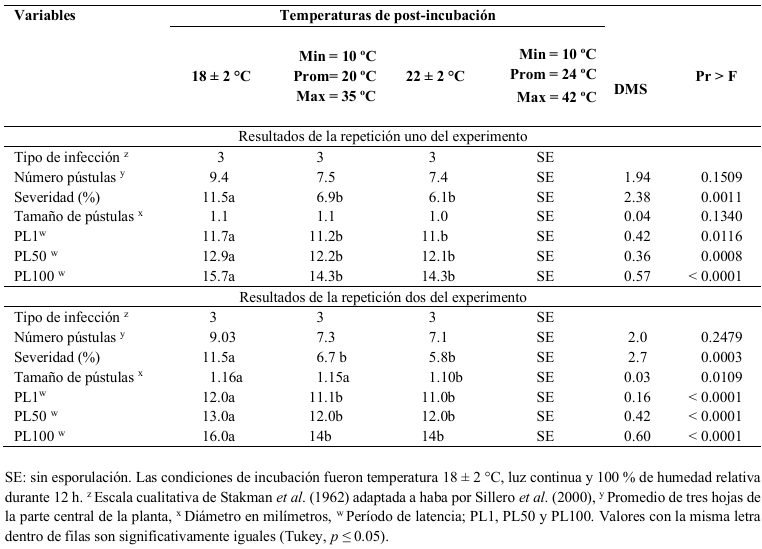
Table 2. Means of seven variables of the monocycle of the infection and values of p obtained from ICAMEX line 5 broad bean seedlings inoculated with 3 × 10<sup>6</sup> urediniospores mL<sup>-1</sup> of <em>Uromyces viciae-fabae</em> and placed under four post incubation temperatures of two experiments.
Table 2. Means of seven variables of the monocycle of the infection and values of p obtained from ICAMEX line 5 broad bean seedlings inoculated with 3 × 10⁶ urediniospores mL-1 of Uromyces viciae-fabae and placed under four post incubation temperatures of two experiments.
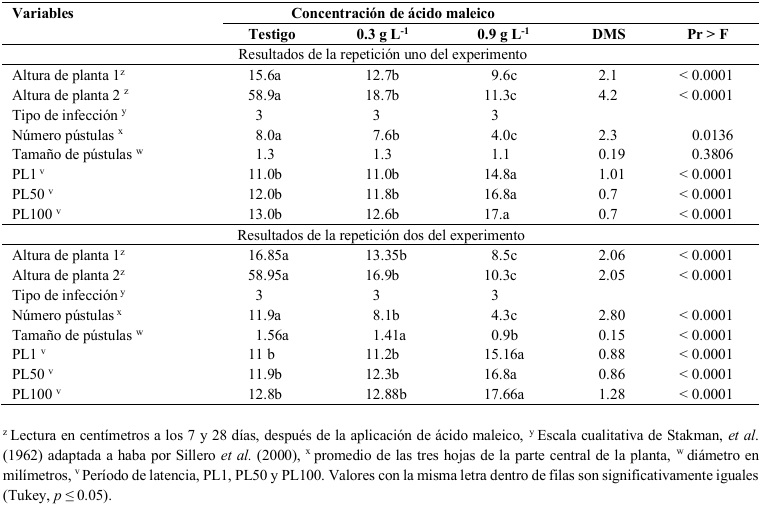
Table 3. Effect of applying maleic acid on the height of broad bean plants from ICAMEX line 5 and six variables of the monocycle of the infection of <em>Uromyces viciae-fabae</em> on two experiments.
Table 3. Effect of applying maleic acid on the height of broad bean plants from ICAMEX line 5 and six variables of the monocycle of the infection of Uromyces viciae-fabae on two experiments.
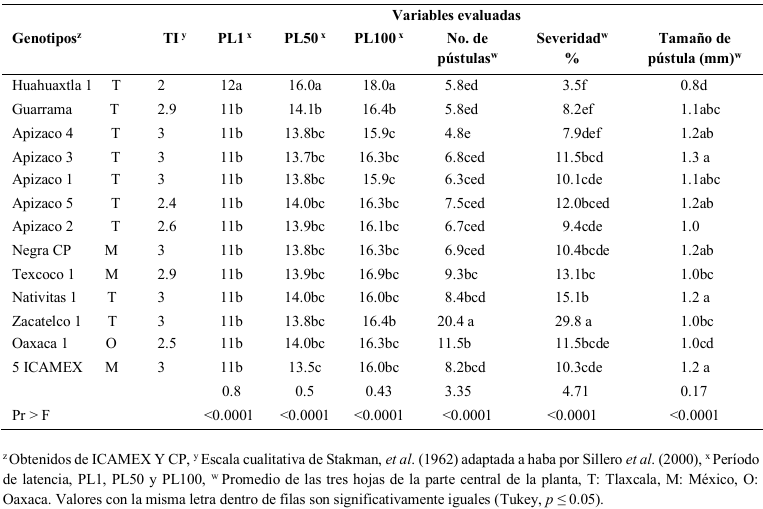
Table 4. Means of seven variables of the monocycle of the infection obtained in seedlings of 13 broad bean genotypes inoculated with <em>Uromyces viciae-fabae</em> urediniospores to know their level of resistance.
Table 4. Means of seven variables of the monocycle of the infection obtained in seedlings of 13 broad bean genotypes inoculated with Uromyces viciae-fabae urediniospores to know their level of resistance.
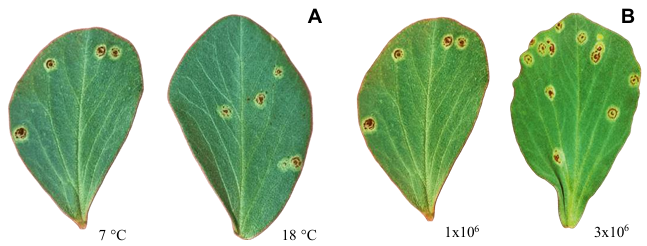
Figure 1. ICAMEX line 5 broad bean leaves with <em>Uromyces viciae-fabae</em> sporulation isolate CP21 28 days after inoculation. A) Leaves inoculated at a concentration of 1 × 10<sup>6</sup> and exposed to two post inoculation temperatures, B) Leaves inoculated with two inoculant concentrations and exposed at 18 °C in post-incubation.
Figure 1. ICAMEX line 5 broad bean leaves with Uromyces viciae-fabae sporulation isolate CP21 28 days after inoculation. A) Leaves inoculated at a concentration of 1 × 10⁶ and exposed to two post inoculation temperatures, B) Leaves inoculated with two inoculant concentrations and exposed at 18 °C in post-incubation.
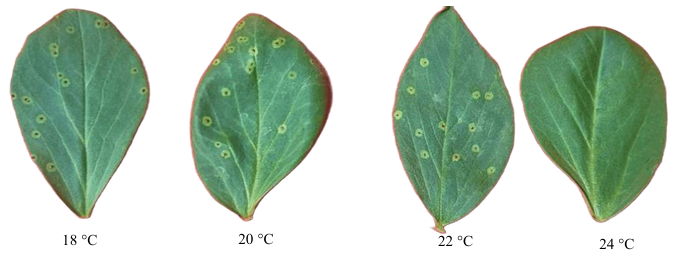
Figure 2. Broad bean leaves from ICAMEX line 5 showing the beginning of sporulation 13 days after being inoculated with 3 × 10<sup>6</sup> urediniospores mL<sup>-1</sup> of the CP21 isolate of de <em>Uromyces viciae-fabae</em> and kept in a greenhouse under four post-incubation temperatures.
Figure 2. Broad bean leaves from ICAMEX line 5 showing the beginning of sporulation 13 days after being inoculated with 3 × 10⁶ urediniospores mL-1 of the CP21 isolate of de Uromyces viciae-fabae and kept in a greenhouse under four post-incubation temperatures.
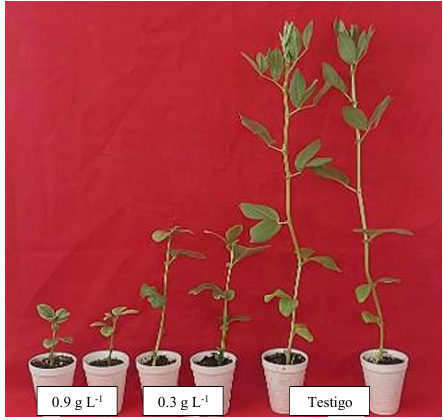
Figure 3. Differences in the growth of broad bean plants from ICAMEX line 5 treated with two maleic acid concentrations.
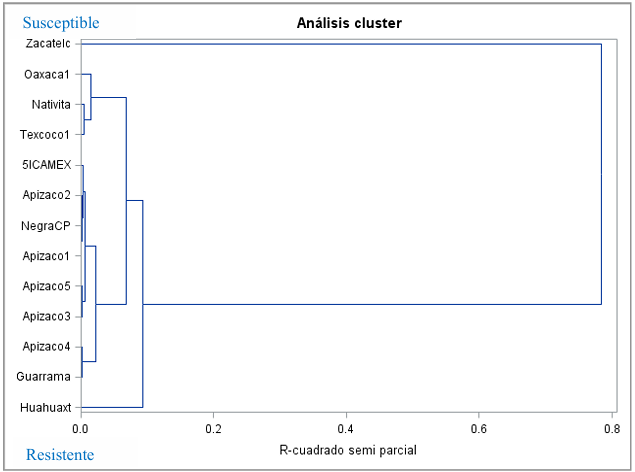
Figure 4. Dendrogram of the resistance and susceptibility of 13 broad bean genotypes to <em>U. viciae-fabae</em> under controlled conditions, created from the multivariate analysis of all the variables evaluated.
Figure 4. Dendrogram of the resistance and susceptibility of 13 broad bean genotypes to U. viciae-fabae under controlled conditions, created from the multivariate analysis of all the variables evaluated.