Click on the cite to copy
-
Or Copy link


Article filters
Search Papers:
Detection of Begomovirus capsicummusive (PepGMV) and associated damage in habanero pepper (Capsicum chinense) in Tabasco
By Miguel Arturo Buitron Broca, Carlos Fredy Ortíz García*, Pedro Antonio Moscoso Ramírez, Eder Ramos Hernández, José Hipólito Rodolfo Mendoza Hernández
*Corresponding Author.
Received: 18/June/2025 – Published:
01/December/2025
DOI:
https://doi.org/10.18781/R.MEX.FIT.2506-1
-
Or Copy link
Abstract Background/Objective. This study aimed to detect viral agents in four Capsicum chinense cultivars in Tabasco, Mexico; determine disease incidence across five developmental stages; and quantify habanero pepper yield.
Experimental development. A field bioassay was established using the cultivars Palenque F1, Jaguar, Orange, and PX-11459057 in a completely randomized design. ImmunoStrips® (Agdia Inc.) were used to detect Orthotospovirus tomatomaculae (tomato spotted wilt virus, TSWV), Cucumber mosaic virus (CMV), Alfalfa mosaic virus (AMV), and Orthotospovirus iridimaculaflavi (iris yellow spot virus, IYSV). PCR was employed for Begomovirus detection. Viral incidence was evaluated at five time points during the crop cycle, and fruit yield (kg plant-1 y t ha-1) and quality were assessed. ANOVA with Tukey’s test (p ≤ 0.05) was applied.
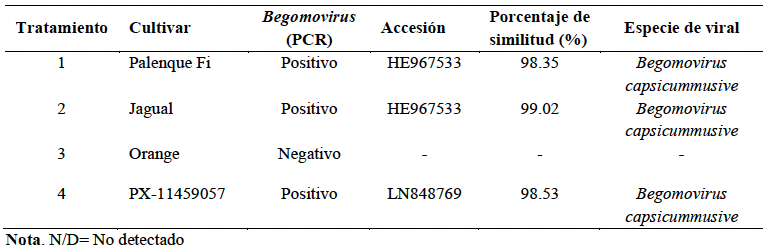
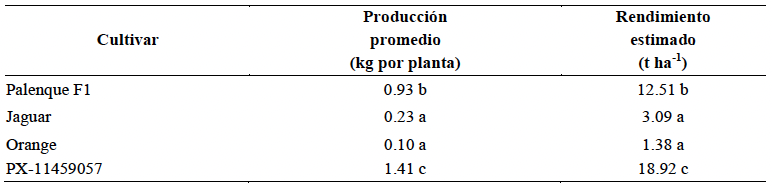
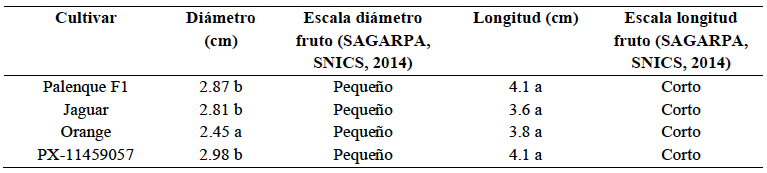
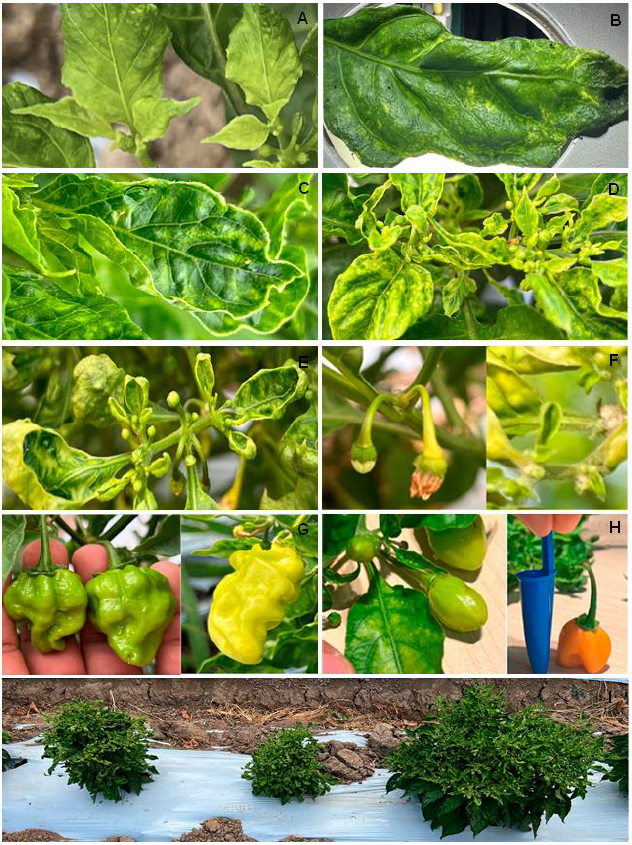
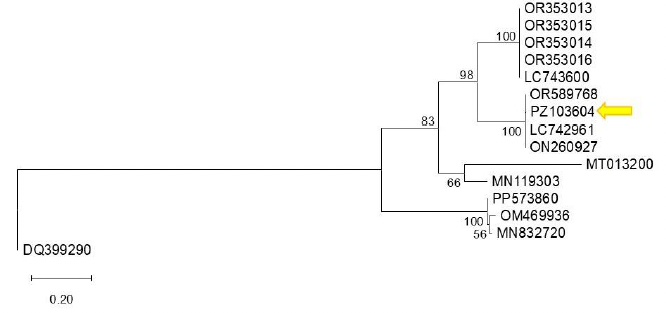
Results. ImmunoStrips® tests were negative for all four analyzed viruses. Begomovirus capsicummusive (pepper golden mosaic virus, PepGMV) tested positive by PCR in cultivars Palenque F1, Jaguar, and PX-11459057, with genetic similarity exceeding 98%. Viral symptoms included interveinal chlorosis, mosaic, leaf deformation, and dwarfing. Incidence surpassed 95% at 113 days after transplanting (dat). Fruit production was negatively affected in both quantity and quality.
Conclusion. The presence of Begomovirus capsicummusive (PepGMV) was confirmed in habanero pepper in Tabasco, associated with interveinal chlorosis, leaf deformation, and dwarfing, with incidence exceeding 95 % at 113 ddt. Fruit production ranged from 0.1 to 1.41kg ha-1.
Keywords: PepGMV, Begomovirus capsicummusive, Habanero pepper, Yield