Click on the cite to copy
-
Or Copy link

Article filters
Search Papers:
Comparative in vitro and in vivo study of anthracnose in papaya (Carica papaya) caused by Colletotrichum gloeosporioides and Colletotrichum truncatum
By Yuridia Rodríguez González, Ernesto Castañeda Hidalgo*, Celerino Robles, Gisela Margarita Santiago Martínez, Verónica Martínez Gallegos, Salvador Lozano Trejo
*Corresponding Author.
Received: 23/September/2025 – Published:
16/December/2025
DOI:
https://doi.org/10.18781/R.MEX.FIT.2509-3
-
Or Copy link
Abstract Background/Objective. Globally, Mexico is the leading exporter of fresh papaya, with Oaxaca being the largest national producer. However, anthracnose, a disease caused by species of the Colletotrichum spp. complex, can affect up to 40% of production. The objective of the research was to identify the causal agent of anthracnose in producing localities of Oaxaca and to evaluate the effectiveness of different products (chemical and biological) in reducing the severity of this disease under in vitro and in vivo conditions.
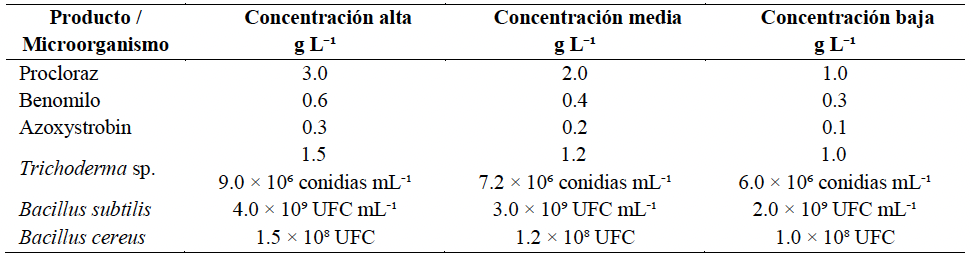
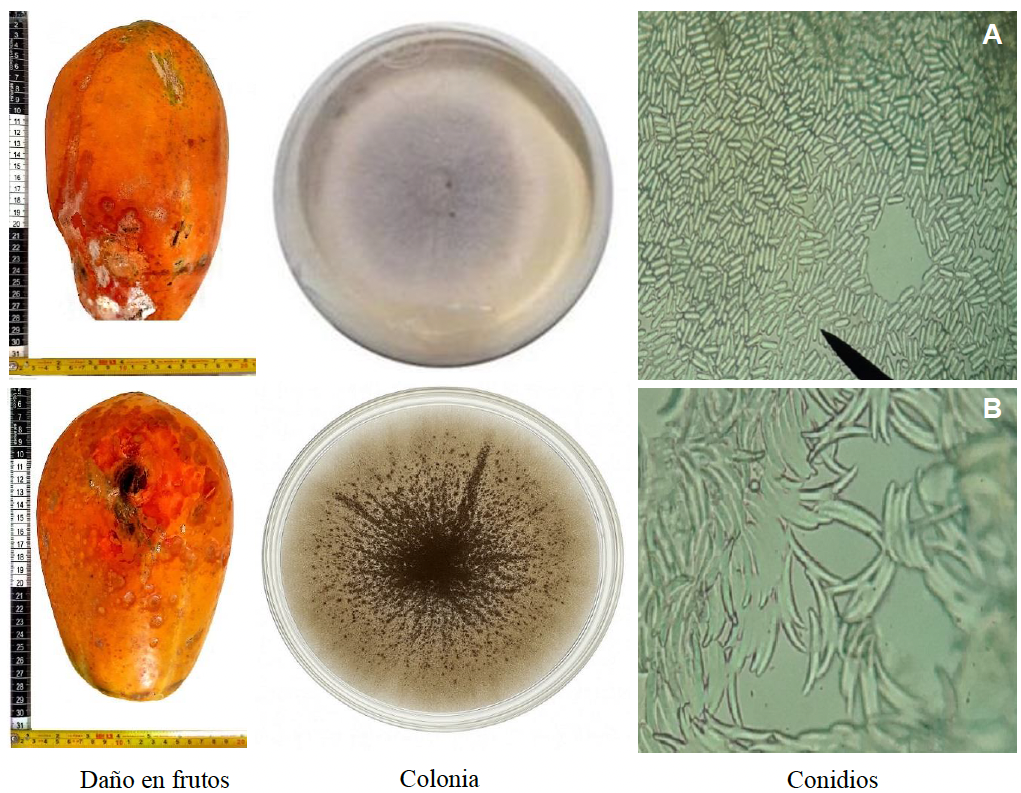
Experimental Development. A sampling of fruits with anthracnose lesions was carried out at 12 sites in the municipalities of Villa de Tututepec de Melchor Ocampo and Santa María Huazolotitlán, Costa de Oaxaca. The isolates were identified by morphological analysis and microcultures. Three chemical fungicides (prochloraz, benomyl and azoxystrobin) and three biological fungicides (Bacillus subtilis, Trichoderma sp. and Bacillus cereus) were evaluated in vitro and in vivo, with a completely randomized design, with Duncan's mean comparison (p ≤ 0.005).
Results. Colletotrichum gloeosporioides and C. truncatum were identified as being associated with anthracnose. In in vitro tests, prochloraz was the most effective treatment, with inhibition values of 86.42% against C. truncatum and 48.66% against C. gloeosporioides, achieving an overall effectiveness of 75%. Likewise, B. subtilis and Trichoderma sp. showed high in vitro efficacy (≥ 70%), demonstrating a potential for biological control under laboratory conditions.
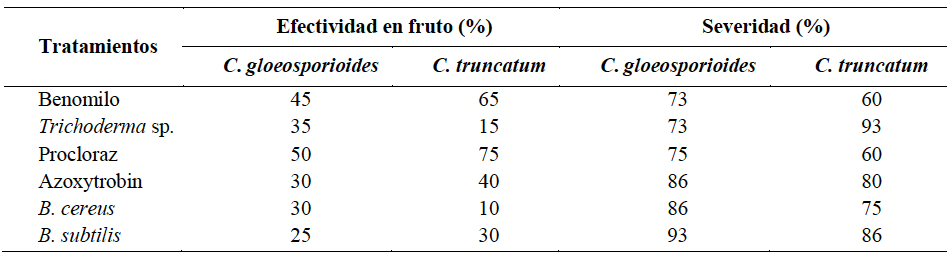
Conclusions. Colletotrichum gloeosporioides (in 66.7% of the sampled sites) and C. truncatum (in 33.3% of the sampled sites) were confirmed as the cause of anthracnose in papaya in the Costa region of Oaxaca. In in vivo tests, prochloraz was the most effective treatment with 75% effectiveness against C. truncatum and 50% against C. gloeosporioides. Benomyl showed intermediate effectiveness, with 65% against C. truncatum and 45% against C. gloeosporioides, with severities of 60-73%. Biological treatments showed low effectiveness: Trichoderma sp. (35 and 15%) and B. subtilis (25 and 30%) for C. gloeosporioides and C. truncatum, respectively, with high severities between 73 and 93%. B. cereus and azoxystrobin showed intermediate behavior, with 30-40% effectiveness and severities of 75-86%. Overall, the results indicate that systemic fungicides outperformed biological agents by more than 30-40% in effectiveness, while biological agents showed less than 35% control and greater than 80% severity, confirming their limited performance in post-harvest.
Keywords: Biocontrol, Carica papaya, Colletotrichum spp., Synthetic pesticide