Click on the cite to copy
-
Or Copy link


Article filters
Search Papers:
Strategies to reduce losses from Fusarium graminearum head blight in bread wheat
By Víctor Manuel Arzola Mora, Héctor Eduardo Villaseñor Mir, Salvador Carranza González*, Carlos Sánchez Abarca, René Hortelano Santa Rosa, Julio Huerta Espino, María Elsa Rodríguez Contreras, Pawan Kumar Singh, Xinyao He
*Corresponding Author.
Received: 14/October/2025 – Published:
02/March/2026
DOI:
https://doi.org/10.18781/R.MEX.FIT.2510-3
-
Or Copy link
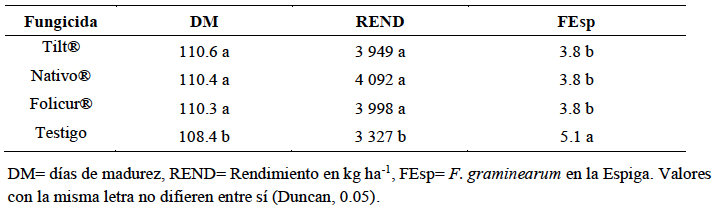
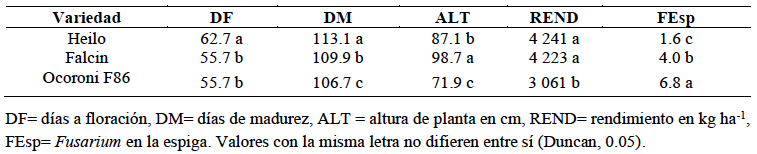
Abstract Background/Objective. Head blight (fusarium), caused by Fusarium graminearum in bread wheat, reduces crop yield and contaminates the grain with mycotoxins such as deoxynivalenol (DON), which affects the quality and safety of the product. Its severity increases in warm and humid areas during flowering, which highlights the need for integrated management strategies. The present study aimed to evaluate the interaction between three wheat genotypes (Heilo, Falcin and Ocoroni F86) and three fungicides Tilt® 250 EC (25% propiconazole), Nativo® 300 SC [trifloxistrobin (20%) + tebuconazole (10%)); and Folicur® 250 EW (tebuconazole (25%)], in order to reduce the severity of F. graminearum and improve yield under field conditions during two production cycles.
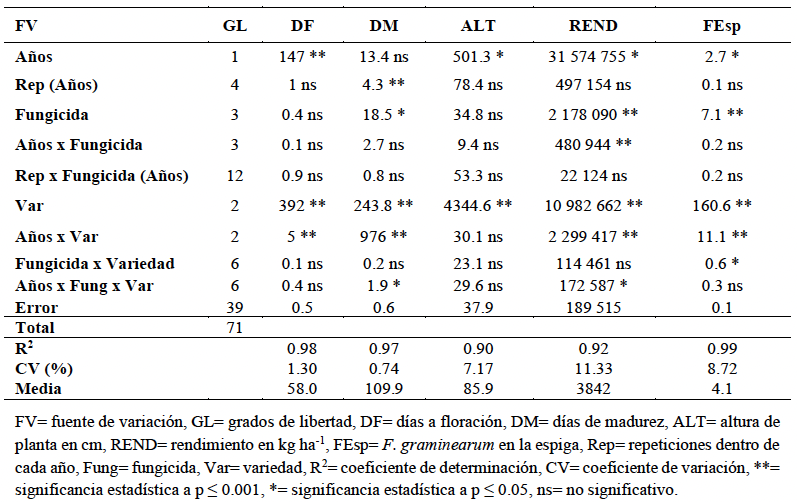
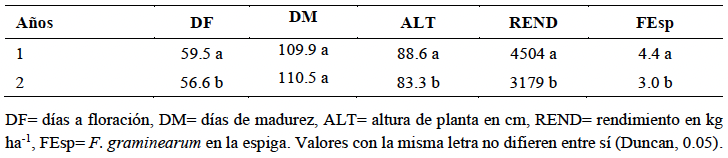
Experimental development. The experiment was carried out at the INIFAP Valley of Mexico Experimental Field during the spring-summer 2022 and 2023 cycles, a split plot design with three replications was used. Agronomic variables such as days to flowering (DF), days to maturity (DM), plant height (ALT), grain yield (REND) and severity of F. graminearum in the head (FEsp) were recorded. Statistical analysis was carried out using ANOVA, Duncan´s test (p<0.05) and Pearson´s correlations.
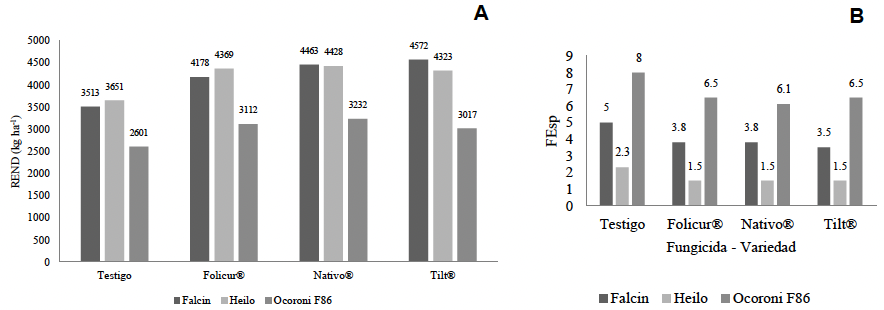
Results. The Heilo variety, when propiconazole (25%) or trifloxistrobin (20%) + tebuconazole (10%) was applied, showed the highest yield (>4 000 kg ha⁻¹) and the lowest severity of fusarium head scab (FEsp ≤1.5). In contrast, Ocoroni F86 was susceptible, even under chemical treatment. Climatic conditions had a significant effect on the severity of the disease.
Conclusion. The combines use of varieties with genetic resistance and triazole fungicides is a feasible agronomic strategy to mitigate fusarium head scab. It is recommended to validate these results in different environments to expand their applicability.
Keywords: Fusarium head scab, Triazoles, Yield, Resistant varieties, Diseases