Click on the cite to copy
-
Or Copy link



Article filters
Search Papers:
In vitro evaluation of the antagonistic potential of Bacillus zhangzhouensis JJR198 against Phytophthora capsici
By Darío Franco Romo, Norma Angélica Chávez Vela, José de Jesús Luna Ruiz*, Sylvia Patricia Fernández Pavía, José Francisco Morales Domínguez, Susana de la Torre Zavala
*Corresponding Author.
Received: 20/November/2025 – Published:
25/February/2026
DOI:
https://doi.org/10.18781/R.MEX.FIT.2511-2
-
Or Copy link
Abstract Background/Objective. Phytophthora capsici represents one of the most significant threats to pepper production worldwide, and its control relies predominantly on fungicide applications, which entail considerable environmental concerns. Therefore, exploring biological control strategies has become a relevant alternative. This study aimed to assess the potential of a bacterial isolate as a biocontrol agent against six P. capsici and one P. cinnamomi isolates.
Materials and Methods. Biocontrol effects were assessed in vitro using dual-culture assays between the bacterial isolate JJR198 and Phytophthora isolates to evaluate inhibition of mycelial growth, sporangia formation, and zoospore release, with additional observations by scanning electron microscopy. The efficacy of JJR198 in suppressing Phytophthora root rot was evaluated in pepper plants under greenhouse conditions by measuring disease severity in inoculated plants. In addition, salt tolerance and persistence of the bacterium in the rhizosphere and rhizoplane were determined. All data were subjected to ANOVA followed by Tukey’s test (p ≤ 0.05).
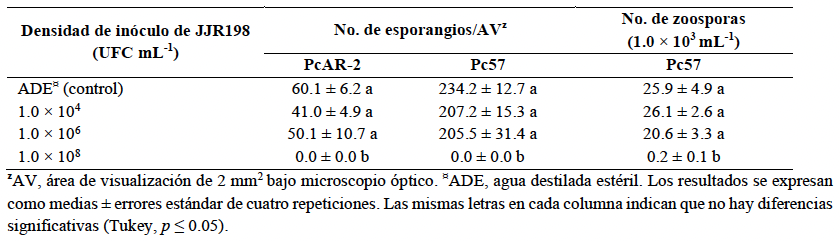
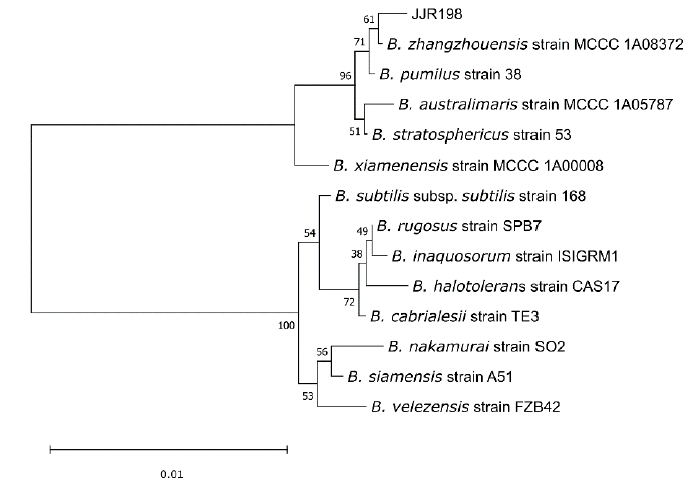
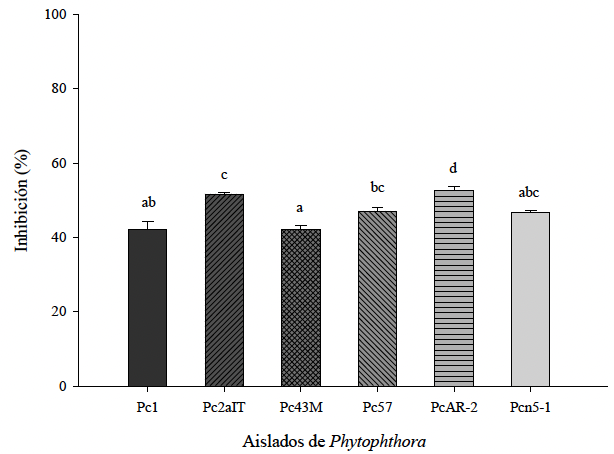
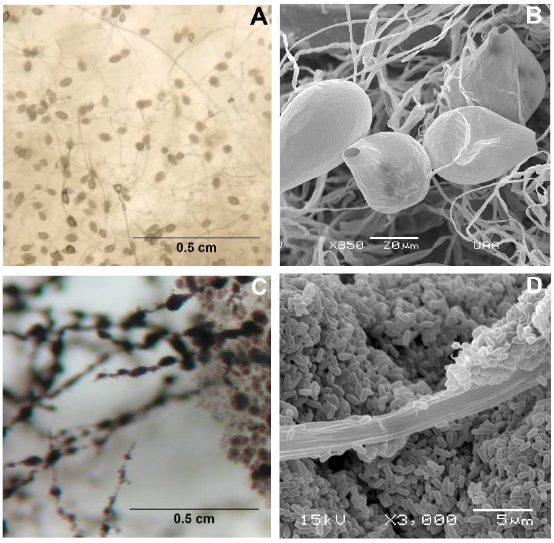
Results. Identified as Bacillus zhangzhouensis through 16S rRNA sequencing, the bacterial isolate JJR198, exhibited antagonistic activity. In vitro assays showed that strain JJR198 reduced mycelial growth by 42.0 to 52.7% across six tested Phytophthora isolates. The biocontrol activity depended on the initial bacterial concentration, as sporangia formation and zoospore release in the tested Phytophthora capsici isolates were completely suppressed at 1.0 × 10⁸ CFU mL-1, whereas no effect was observed at lower concentrations (1.0 × 10⁴ and 1.0 × 10⁶ CFU mL-1). Using optical and electron microscopy, it was observed that the hyphae and mycelia were covered by bacterial cells. However, in the in vivo evaluation, pretreatment of pepper plants with JJR198 (1.0 × 10⁸ CFU mL-1) at 7, 3, or 0 days before oomycete inoculation did not reduce disease severity caused by Phytophthora capsici. JJR198 also showed the ability to grow under high-salinity conditions, as it developed on NA medium containing 7.5% NaCl after 48 h of incubation at 30 °C. Additionally, the presence of the bacterial inoculum was confirmed in pepper roots: colonies with morphological characteristics identical to JJR198 were recovered from rhizosphere and rhizoplane samples, with counts of 1.6 × 10⁶ and 0.19 × 10⁶ CFU mL-1, respectively.
Conclusion. The results indicate that Bacillus zhangzhouensis JJR198 exhibits in vitro antagonistic activity against multiple Phytophthora isolates, achieving mycelial growth inhibition ranging from 42.0 to 52.7%, as well as inhibition of sporangia formation and zoospore release at a concentration of 1.0 × 10⁸ CFU mL⁻¹. However, its effectiveness in planta remained limited under the conditions tested.
Keywords: Biological control, Pepper plant, Plant–pathogen interaction, Soil bacterium, Zoospore inhibition