Click on the cite to copy
-
Or Copy link



Article filters
Search Papers:
Peracetic acid for powdery mildew (Erysiphe vaccinii) management in blueberry (Vaccinium corymbosum) under commercial condition in Peru
By Sebastian Iglesias Osores*, Luis A Alvarez
*Corresponding Author.
Received: 08/December/2025 – Published:
23/April/2026
DOI:
https://doi.org/10.18781/R.MEX.FIT.2512-2
-
Or Copy link
Abstract Background/Objective. Blueberry powdery mildew, associated with Erysiphe vaccinii, is a foliar disease that may cause defoliation and affect crop performance. In Peru, information on the foliar use of peracetic acid for its field management is limited. The objective of this study was to evaluate the effect of foliar applications of 15% peracetic acid on powdery mildew incidence in blueberry under field conditions in Ica, Peru.
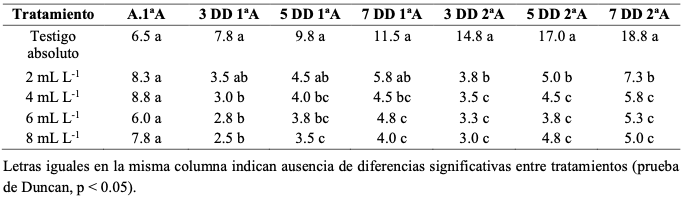
Experimental development. The trial was conducted in a commercial field of blueberry cv. Biloxi in Ica, Peru, using a randomized complete block design with five treatments: an untreated control and 15% peracetic acid at 2, 4, 6, and 8 mL L-1, with four replicates. Treatments were applied as foliar sprays twice, seven days apart, at a spray volume of 600 L ha-1. The response variable was the incidence of leaves with powdery mildew symptoms (under natural infection), assessed on seven dates from the first application onward. The presence of phytotoxicity symptoms was also visually recorded.
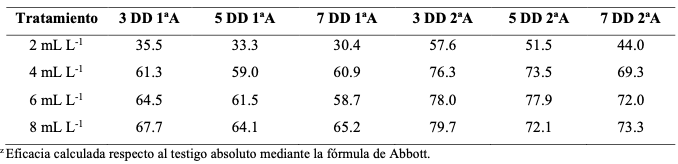
Results. Before the first application, no differences were detected among treatments. After the first application, peracetic acid reduced powdery mildew incidence compared with the control, with initial efficacy of up to 67.7%. After the second application, the 4, 6, and 8 mL L-1 doses showed the best response, with maximum efficacies of 69.3, 78.0, and 79.7%, respectively. The 2 mL L-1 dose showed a lower effect. No visible phytotoxicity symptoms were observed at any of the evaluated doses.
Conclusion. Under the conditions of this trial, 15% peracetic acid reduced foliar powdery mildew incidence in blueberry, with the best response at 4, 6, and 8 mL L-1 (69.3, 78.0, and 79.7%). These results indicate a favorable effect of the product under field conditions, although further evaluation in additional locations or growing seasons is needed for validation.
Keywords: cv. Biloxi, Foliar incidence, Phytotoxicity, Agricultural oxidant, Foliar spray