RMF Logo

Article filters

Search Papers:

For searching before 2024 see Archive (2000-2023)
  • Vol. 2026, 44(2)
  • Phytopathological Note

Potential transmission of grapevine red blotch virus (Grablovirus vitis, Geminiviridae) by Nearctic treehopper (Tortistilus wickhami) in Baja California, Mexico

By Cynthia Ford Villalón, David Schneider, Idalia Montesinos Solano, Jimena Carrillo Tripp*

*Corresponding Author.

Received: 13/December/2025 – Published: 23/April/2026
DOI: https://doi.org/10.18781/R.MEX.FIT.2512-4

  • PDF
  • HTML
  • XML

Abstract Background/Objective. Grapevine red blotch virus, GRBV (Grablovirus vitis) affects grapevine plants (Vitis vinifera) causing significant economic losses in vineyards. In Mexico, where GRBV has been reported in wine-producing regions such as Baja California, information on potential GRBV vectors remains limited. Although the three-cornered alfalfa hopper (Spissistilus festinus) is a confirmed vector in the USA, the role of other membracids in vineyards around the globe is still unclear. Recently, the Nearctic treehopper (Tortistilus wickhami) has been reported in Baja California, prompting this study to evaluate its potential for GRBV acquisition and transmission.

Experimental development. Adult Nearctic treehoppers were collected from February to November 2023 in 20 vineyards in Valle de Guadalupe, Baja California. A total of 30 individuals were screened to detect GRBV by real-time PCR. In May 2024, 17 additional individuals were collected and used in transmission assays, with an acquisition access period of up to 4 days on GRBV-infected grapevine cv. Cabernet Sauvignon leaves, followed by an inoculation access period of up to 9 days on virus-free leaves. Both insects and recipient leaves were tested for GRBV by real-time PCR.

Results. GRBV was detected in 6.7% (2/30) of the individuals collected in 2023, with positive insects only originating from vineyards confirmed as GRBV-positive. In the transmission assays, 53% (9/17) of the insects acquired viral particles after feeding on infected leaves; however, none of the recipient leaves showed detectable infection.

Conclusion. This study demonstrates that the Nearctic treehopper, an insect phylogenetically close to, and morphologically resemblant of the three-cornered alfalfa treehopper (a confirmed GRBV vector), was able to acquire the virus in the field and in laboratory settings, but no transmission to recipient plants was proved under the tested experimental conditions in the laboratory.

Keywords: GRBV, Transmission, Membracid, Vector
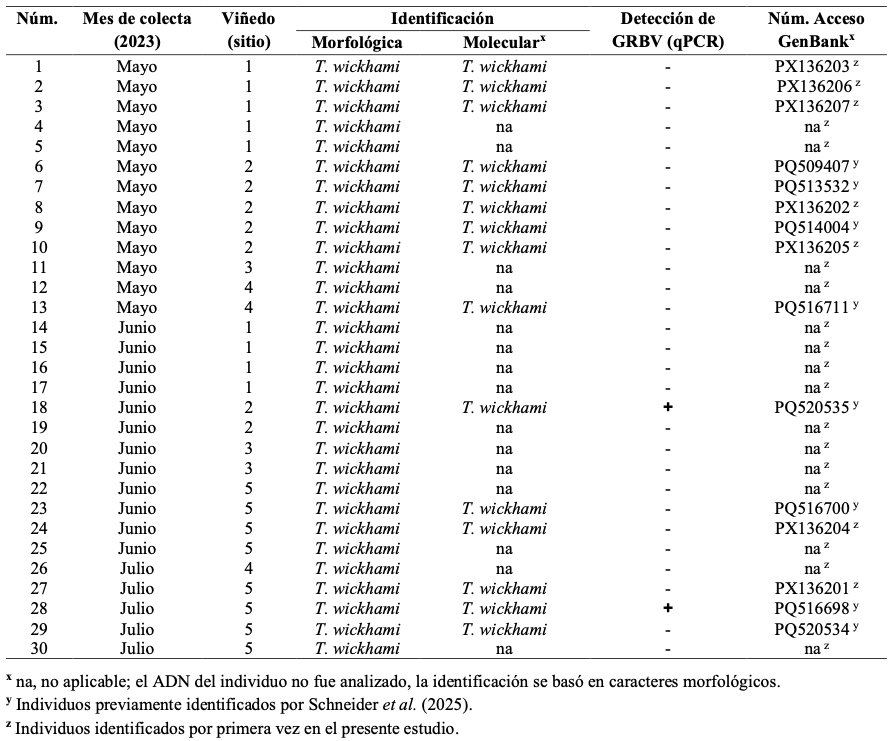
Table 1. Taxonomic identification of treehoppers collected at survey sites, and GRBV molecular detection.
Table 2. Results of the transmission assay for GRBV (<em>Grablovirus vitis</em>) by adult Nearctic leafhoppers.
Table 2. Results of the transmission assay for GRBV (Grablovirus vitis) by adult Nearctic leafhoppers.
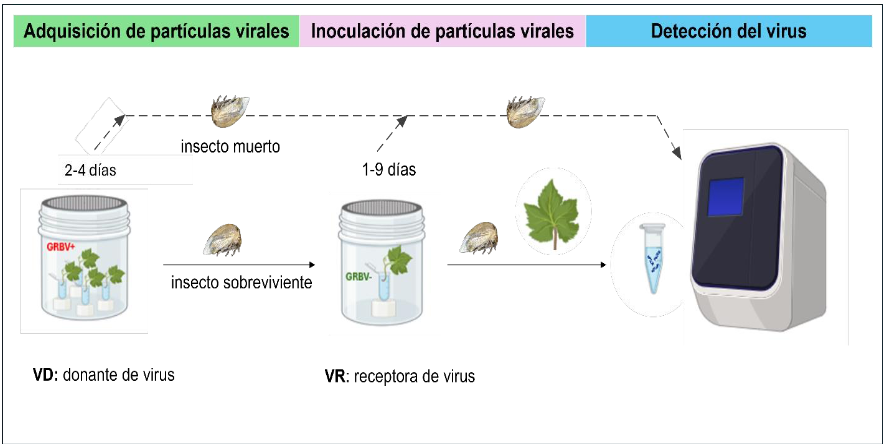
Figure 1. Schematic representation of the GRBV transmission assay. Insects were first allowed to feed on excised leaves from a GRBV-donor grapevine, then transferred to recipient excised leaves from GRBV-free grapevines to assess potential virus transmission. Individual leaves were maintained in water. Dashed lines indicate the removal of dead insects from inside the cage for GRBV detection at the end of the assay. The schematic diagram was constructed using some elements from BioRender.
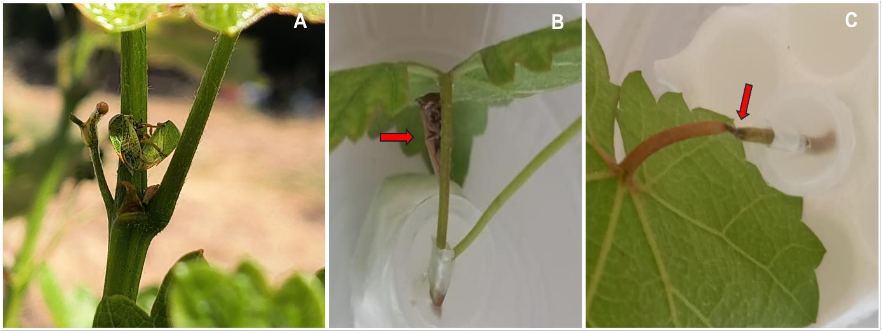
Figure 2. Transmission assay. A) Example of adult Nearctic treehoppers manually collected from a vineyard, used in the transmission assay. Photo credit: Kyara Acosta Ramos. B) interior view of a cage during the viral particle acquisition phase. The cage design facilitated insect–leaf interaction. A portion of the petioles were submerged in sterile water inside 2 mL vials sealed with parafilm, keeping the leaf in a vertical position. C) Ringing mark on the petiole of a recipient leaf caused by mechanical damage after feeding by a Nearctic treehopper.