Click on the cite to copy
-
Or Copy link



Article filters
Search Papers:
Natural co-infection of Pospiviroid machoplantae and Begomovirus solanumseveri in tomato
By María del Carmen Zuñiga Romano, Daniel Leobardo Ochoa Martínez*, Reyna Isabel Rojas Martínez, Sergio Aranda Ocampo, Candelario Ortega Acosta, Erika Janet Zamora Macorra
*Corresponding Author.
Received: 08/March/2026 – Published:
27/July/2026
DOI:
https://doi.org/10.18781/R.MEX.FIT.2603-1
-
Or Copy link
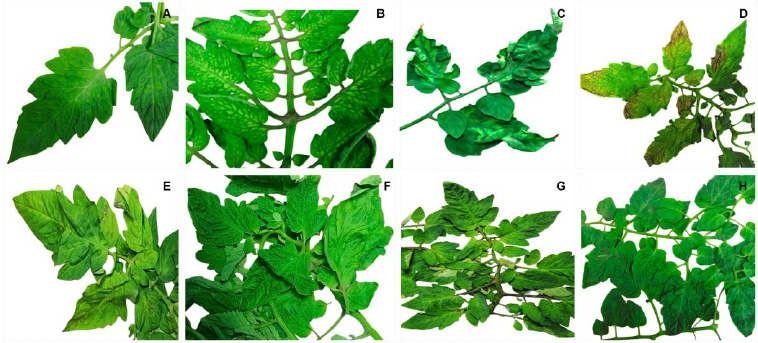
Abstract Background/Objective. High whitefly populations and incidence of up to 90% of tomato plants showing mosaic, intervenial chlorosis, deformation, rugosity and leaf necrosis, associated with virus and viroids, were observed at a high-tech greenhouse in Atlacomulco, State of Mexico. To identify the viruses or viroids associated with these symptoms, the withefly species, as well as to determine if the insects were carrying any of these pathogens, monthly sampling was conducted over a two-year period, collecting plant leaf tissue and adult whiteflies.
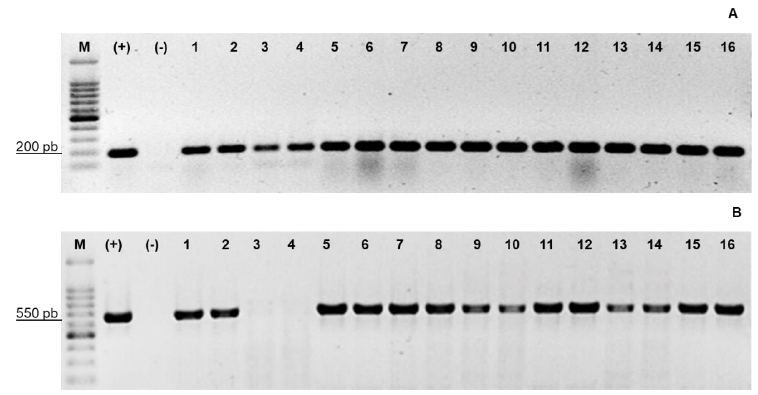
Materials y Methods. A total of 347 plants (211 symptomatic and 136 asymptomatic) were analyzed using immunostrips for impatiens necrotic spot virus (Orthotospovirus impatiensnecromaculae), tomato spotted wilt virus (O. tomatomaculae), tobacco mosaic virus (Tobamovirus tabaci), tomato mosaic virus (T. tomatotessellati), pepino mosaic virus (Potexvirus pepini) and cucumber mosaic virus (Cucumovirus CMV), as well as by RT-PCR and PCR using universal primers for viroids and viruses of the genera Pospiviroid and Begomovirus, respectively. DNA was extracted from the insects and analyzed by PCR with specific primers that amplify a fragment of the mitocondrial gene (mtCOI) to identify the whitefly species, as well as universal primers for begomoviruses to determine if the insects were carriers of these viruses.
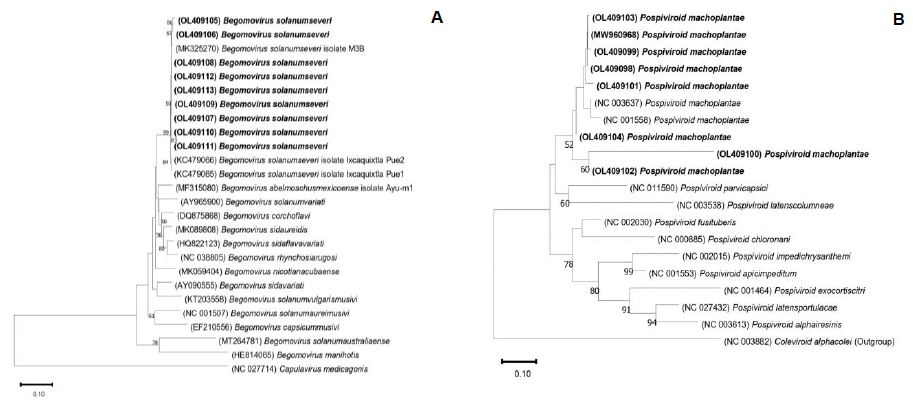
Results. The results obtained using immunostrips were negative. The fragments amplified by RT-PCR and PCR were sequenced and corresponded to tomato planta macho viroid (Pospiviroid machoplantae) and tomato severe leaf curl virus (Begomovirus solanumseveri). Of the plants analyzed, 49.56% tested positive for the pospiviroid, 23.9% for the begomovirus, and 8.93% for both. Infection caused solely by the viroid was the only one that resulted in an asymptomatic condition. Bemisia tabaci was identified as the whitefly species and was determined to be a carrier of B. solanumseveri.
Conclusions. Symptoms of mosaic, intervenial chlorosis, leaf deformation and necrosis, blistering, and rugosity observed in tomato plants were associated with individual infection by tomato planta macho viroid (Pospiviroid machoplantae), and tomato severe leaf curl virus (Begomovirus solanumseveri), as well as co-infection by both. This is the first report of natural co-infection of tomato planta macho viroid and tomato leaf curl virus. The presence of asymptomatic plants is a key factor to consider when carrying out cultural practices to minimize mechanical transmission of the viroid.
Keywords: Mixed infection, Viral-viroidal, Pospiviroids, Whitefly, Solanum lycopersicum