RMF Logo

Article filters

Search Papers:

For searching before 2024 see Archive (2000-2023)
  • Vol. 2026, 44(3)
  • Phytopathological Note

First report of Pseudomonas putida affecting Eryngium spp., case study in Ixtapan de la Sal, State of Mexico

By Santiago Vergara Pineda, Paola S Puga Guzmán, Daniel Mendoza Jiménez, José Antonio Cervantes Chávez*

*Corresponding Author.

Received: 09/March/2026 – Published: 22/June/2026
DOI: https://doi.org/10.18781/R.MEX.FIT.2603-2

  • PDF
  • HTML
  • XML

Abstract Background/Objective. Plant species of the genus Eryngium are native to Mexico; their cultivation as ornamental cut flowers is a recent development, so the pathogens that affect them are largely unknown. In this context, a grower set out to innovate by using this plant as a cut flower but encountered a rot disease that decimated his field; therefore, the objective of this study was to isolate, identify, and characterize the causal agent of soft rot in the stems of Eryngium spp.

Experimental development. Plants exhibiting rot symptoms were collected from a cultivated plot in the municipality of Ixtapan de la Sal, State of Mexico. From ten symptomatic plants kept in a humid chamber, a bacterium was isolated and identified using biochemical analysis. For molecular identification, DNA was extracted, and the 16S ribosomal gene was amplified with primers 27F and 1492R. PCR products were sent to the Advanced Genomics Laboratory at LANGEBIO, CINVESTAV Irapuato, Guanajuato. Koch’s postulates were also performed on twenty asymptomatic Eryngium spp. seedlings, which were inoculated by introducing a bacterial mass at the leaf base, the distal petiole, and the basal vein region.

Results. Based on biochemical analysis, the bacterium was identified as belonging to the genus Pseudomonas; molecular analysis revealed that the bacterium was Pseudomonas putida. According to Koch’s postulates, 100% of the symptoms associated with soft rot were observed.

Conclusion. Pseudomonas putida was confirmed as the causal agent of soft rot in Eryngium spp. Its pathogenicity was confirmed in Eryngium spp. seedlings according to Koch's postulates. This is the first report of P. putida causing this disease in these plants.

Keywords: Soft rot, Toad herb, Koch’s postulates, Sequencing
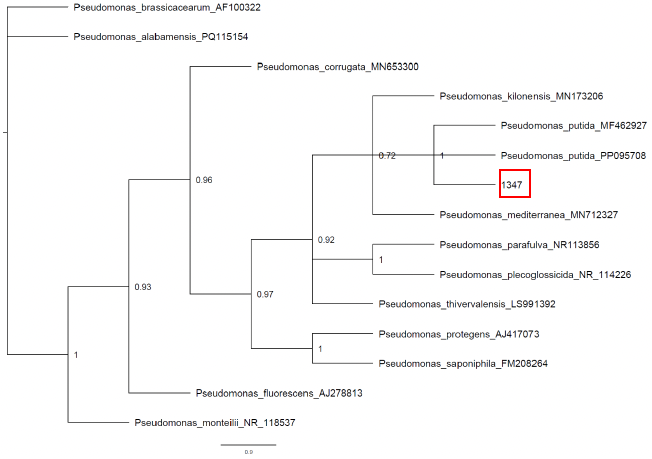
Figure 1. Phylogenetic relationship of bacterial strain 1347 and reference species from the genus <em>Pseudomonas</em>. The strain shows a correlation with <em>Pseudomonas putida</em> (MF462927, PP095708). The phylogenetic tree was constructed by the Maximum Likelihood method using 16S ribosomal DNA gene sequences. Bootstrap values at internal nodes represent support from 100,000 replicates. <em>P. brassicacearum</em> AF100322 and <em>P. alabamensis</em> PQ115154 served as the outgroup.
Figure 1. Phylogenetic relationship of bacterial strain 1347 and reference species from the genus Pseudomonas. The strain shows a correlation with Pseudomonas putida (MF462927, PP095708). The phylogenetic tree was constructed by the Maximum Likelihood method using 16S ribosomal DNA gene sequences. Bootstrap values at internal nodes represent support from 100,000 replicates. P. brassicacearum AF100322 and P. alabamensis PQ115154 served as the outgroup.
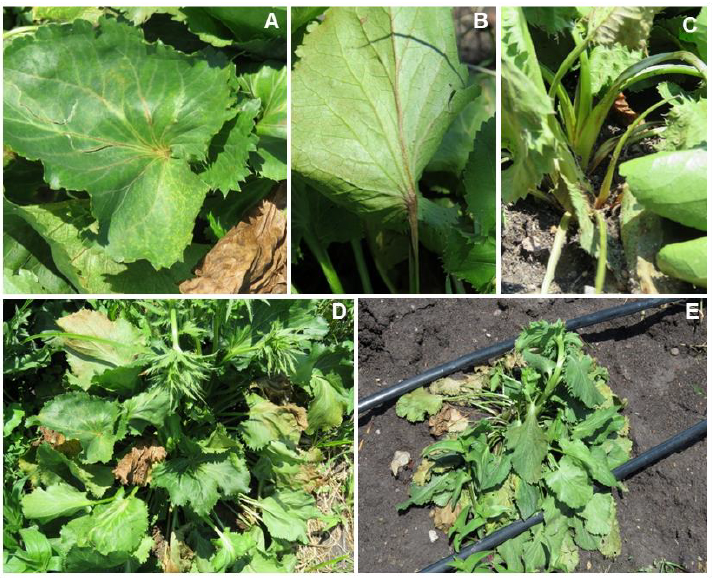
Figure 2. Stages of soft rot development in <em>Eryngium</em> sp. under field cultivation; A) Leaf blade showing necrosis along the main veins; B) Underside of the same leaf with severe necrosis; C) Leaf petioles with necrotic streaks; D) Wilting and death of leaves; E) Wilting of the entire plant.
Figure 2. Stages of soft rot development in Eryngium sp. under field cultivation; A) Leaf blade showing necrosis along the main veins; B) Underside of the same leaf with severe necrosis; C) Leaf petioles with necrotic streaks; D) Wilting and death of leaves; E) Wilting of the entire plant.
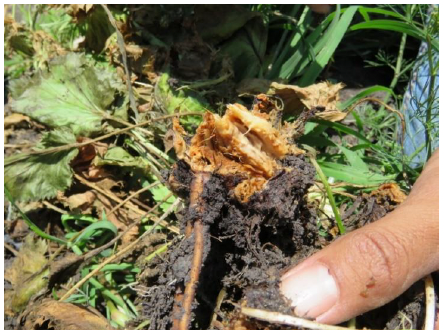
Figure 3. Soft rot in the stem and main root of <em>Eryngium</em> spp. associated with bacteria.
Figure 3. Soft rot in the stem and main root of Eryngium spp. associated with bacteria.
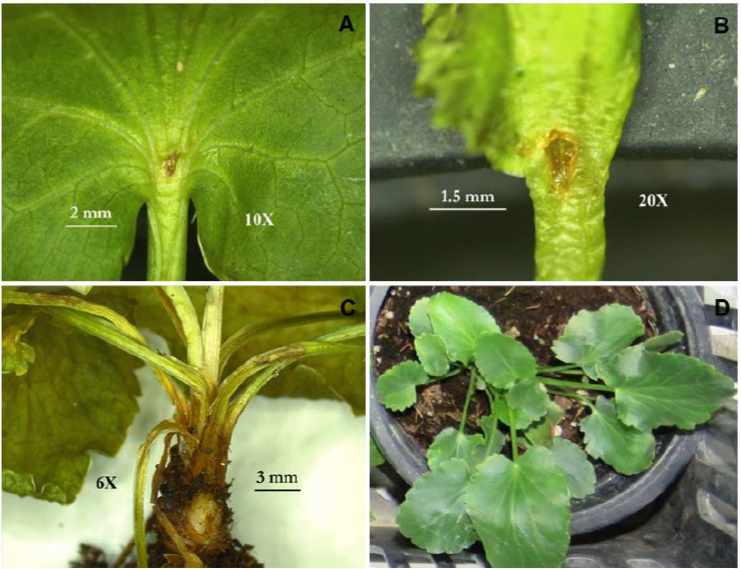
Figure 4. Koch’s postulates in <em>Eryngium</em> spp. seedlings inoculated with bacterial strain 1347; A) Water-soaked lesions at the site of puncture inoculation on the leaf with infectious process the following day; B) Progression of severity on the second day; C) Dead plant on the tenth day; D) Control plant.
Figure 4. Koch’s postulates in Eryngium spp. seedlings inoculated with bacterial strain 1347; A) Water-soaked lesions at the site of puncture inoculation on the leaf with infectious process the following day; B) Progression of severity on the second day; C) Dead plant on the tenth day; D) Control plant.