RMF Logo

Article filters

Search Papers:

For searching before 2024 see Archive (2000-2023)
  • Vol. 2026, 44(3)
  • Phytopathological Note

Epidemiology of coffee leaf rust under the effect of fungicides in the Northern and Northeastern Sierra of Puebla state

By Miguel José Luna Alvarez, Martin Aguilar Tlatelpa, Marja Liza Fajardo Franco*

*Corresponding Author.

Received: 13/March/2026 – Published: 21/August/2026
DOI: https://doi.org/10.18781/R.MEX.FIT.2603-3

  • PDF
  • HTML
  • XML

Abstract Background/Objective. Coffee leaf rust is the primary disease affecting this crop. The objective was to evaluate the incidence and severity of coffee leaf rust under the influence of a systemic fungicide and two biofungicides on varieties cultivated in the Northern and Northeastern Sierra regions of Puebla.

Experimental development. The effects of Azoxystrobin, Melaleuca alternifolia, and Bacillus subtilis were evaluated across six shade-grown plots featuring the Typica, Costa Rica 95, Garnica, Marsellesa, and Oro Azteca varieties, located in Huehuetla, Ixtepec, and Zongozotla. Sixteen sampling events were conducted, for each, of evaluation rust incidence and severity, shade percentage, the weight of 100 ripe cherries, and altitude were assessed. Additionally, temperature and relative humidity were recorded in Huehuetla. Incidence and severity were compared using the Kruskal-Wallis test and the Dwass-Steel-Critchlow-Fligner (DSCF) method. Furthermore, the correlation of these variables with altitude and shade percentage was analyzed. Cherry weight data underwent analysis of variance and mean comparison, while a risk analysis was performed using the climatic variables.

Results. Rust reached maximum severity and incidence (19.9 and 100%, respectively) in the Typica variety (March 2025). Azoxystrobin significantly reduced the disease, followed by M. alternifolia and B. subtilis. No influence of shade on incidence (r=0.33360) or severity (r=0.30735) was identified. In contrast, altitude showed a moderate negative correlation with incidence (r=-0.4632, p<0.0001) and with severity (r=-0.57433, p<0.0001). The Typica and Garnica varieties were the most susceptible.

Conclusion. The fungicides demonstrated control of the disease compared to the control treatment; therefore, they could be considered for the management of H. vastatrix.

Keywords: Hemileia vastatrix, Epidemiology, Azoxystrobin, Biofungicides, Varieties

Table 1. Characteristics of experimental plots for the evaluation of incidence, severity, and the effect of fungicides on coffee leaf rust (<em>H. vastatrix</em>) in the Northern and Northeastern Sierra regions of the state of Puebla.
Table 1. Characteristics of experimental plots for the evaluation of incidence, severity, and the effect of fungicides on coffee leaf rust (H. vastatrix) in the Northern and Northeastern Sierra regions of the state of Puebla.
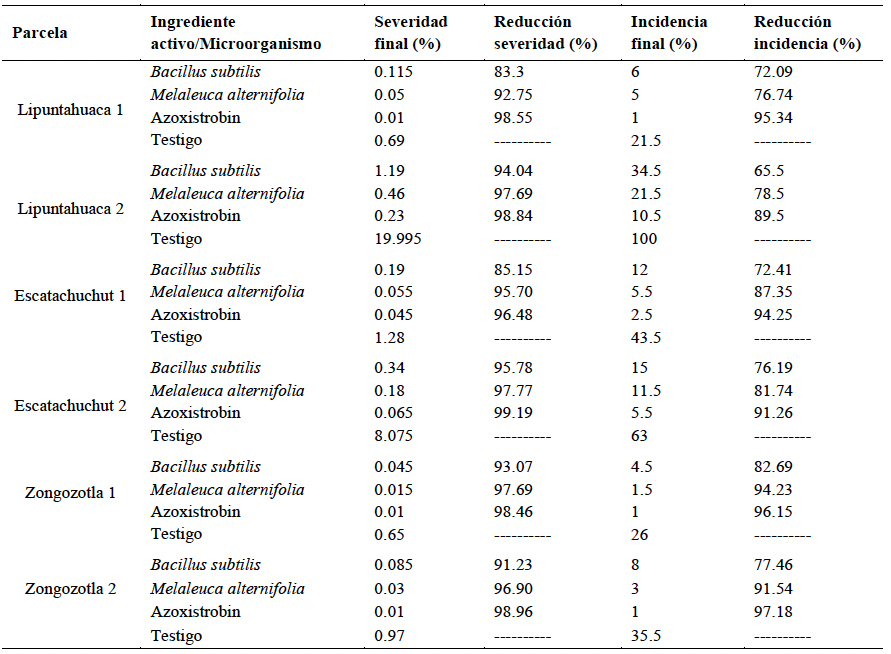
Table 2. Reduction of coffee leaf rust (<em>H. vastatrix</em>) through the use of fungicides in the Northern and Northeastern Sierra of Puebla state.
Table 2. Reduction of coffee leaf rust (H. vastatrix) through the use of fungicides in the Northern and Northeastern Sierra of Puebla state.
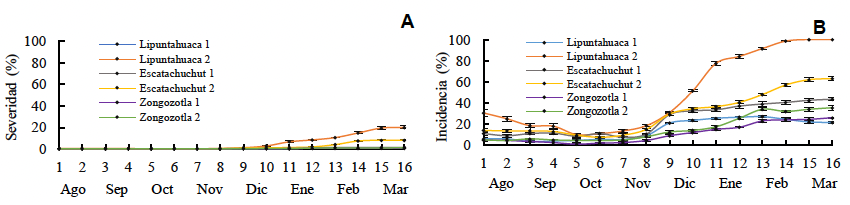
Figure 1. Temporal dynamics of rust (<em>H. vastatrix</em>) severity on coffee plants grown in Huehuetla, Ixtepec, and Zongozotla, Puebla, without fungicide application. A) Severity, B) Incidence. The lines represent disease progression over time: Costa Rica 95 (blue), Typica (orange), Costa Rica 95 (gray), Garnica (yellow), Marsellesa (purple), and Oro Azteca (green).
Figure 1. Temporal dynamics of rust (H. vastatrix) severity on coffee plants grown in Huehuetla, Ixtepec, and Zongozotla, Puebla, without fungicide application. A) Severity, B) Incidence. The lines represent disease progression over time: Costa Rica 95 (blue), Typica (orange), Costa Rica 95 (gray), Garnica (yellow), Marsellesa (purple), and Oro Azteca (green).
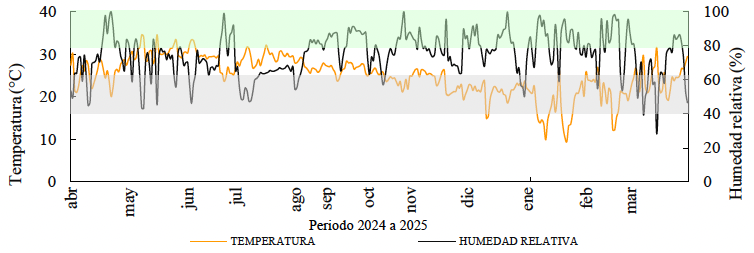
Figure 2. Temperature and relative humidity in Huehuetla, Puebla. Period: April 2024 to March 2025. The gray band indicates the optimal temperature range for coffee leaf rust (17 to 26°C), and the green band indicates the optimal relative humidity range (80–100%) reported by SENASICA (2019) and Parada-Molina <em>et al</em>. (2020).
Figure 2. Temperature and relative humidity in Huehuetla, Puebla. Period: April 2024 to March 2025. The gray band indicates the optimal temperature range for coffee leaf rust (17 to 26°C), and the green band indicates the optimal relative humidity range (80–100%) reported by SENASICA (2019) and Parada-Molina et al. (2020).
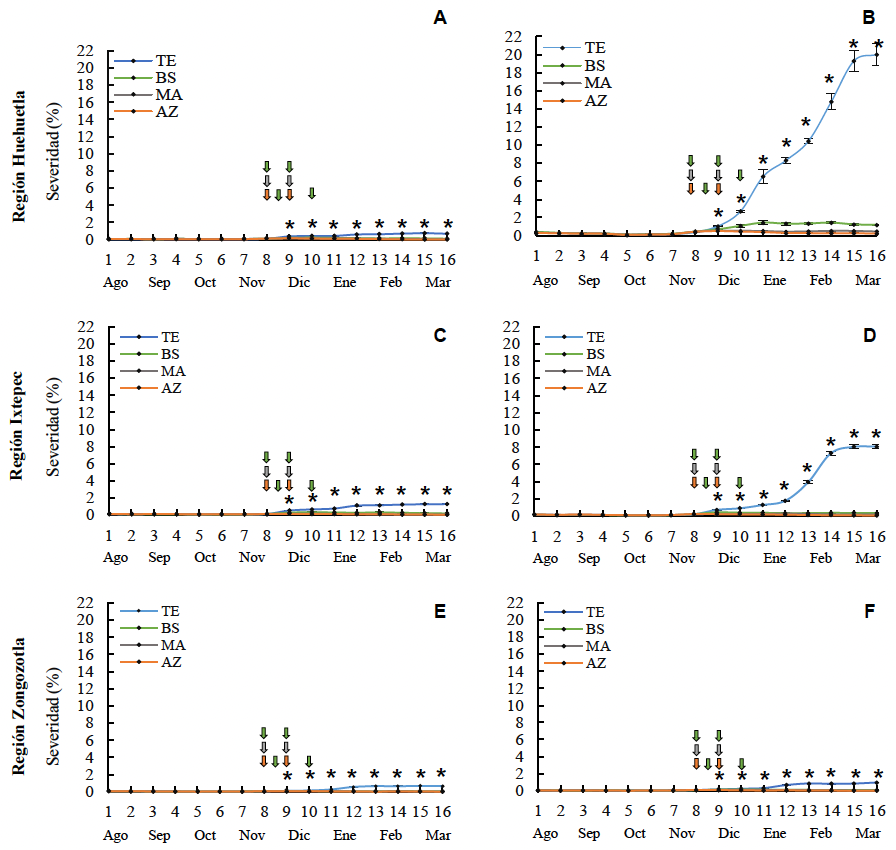
Figure 3. Effect of fungicides on the dynamics of rust (<em>H. vastatrix</em>) severity in coffee plants grown in Huehuetla, Ixtepec, and Zongozotla, Puebla. A) Lipuntahuaca 1 (Costa Rica 95), B) Lipuntahuaca 2 (Typica), C) Escatachuchut 1 (Costa Rica 95), D) Escatachuchut 2 (Garnica), E) Zongozotla 1 (Marsellesa), and F) Zongozotla 2 (Oro Azteca). Arrows indicate the timing of fungicide application: orange: Azoxystrobin, gray: <em>M. alternifolia</em>, and green: <em>B. subtilis</em>. The asterisk (*) indicates significant differences between treatments at each sampling point, according to Tukey's mean comparison test.
Figure 3. Effect of fungicides on the dynamics of rust (H. vastatrix) severity in coffee plants grown in Huehuetla, Ixtepec, and Zongozotla, Puebla. A) Lipuntahuaca 1 (Costa Rica 95), B) Lipuntahuaca 2 (Typica), C) Escatachuchut 1 (Costa Rica 95), D) Escatachuchut 2 (Garnica), E) Zongozotla 1 (Marsellesa), and F) Zongozotla 2 (Oro Azteca). Arrows indicate the timing of fungicide application: orange: Azoxystrobin, gray: M. alternifolia, and green: B. subtilis. The asterisk (*) indicates significant differences between treatments at each sampling point, according to Tukey's mean comparison test.
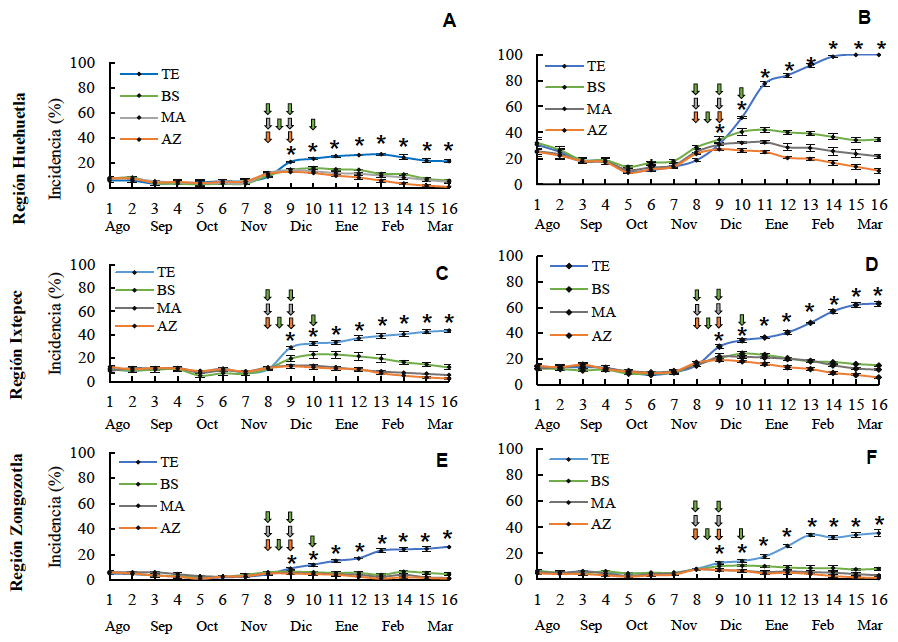
Figure 4. Effect of fungicides on the incidence dynamics of rust (<em>H. vastatrix</em>) in coffee plants grown in Huehuetla, Ixtepec, and Zongozotla, Puebla. A) Lipuntahuaca 1 (Costa Rica 95), B) Lipuntahuaca 2 (Typica), C) Escatachuchut 1 (Costa Rica 95), D) Escatachuchut 2 (Garnica), E) Zongozotla 1 (Marsellesa), and F) Zongozotla 2 (Oro Azteca). Arrows indicate the timing of fungicide application: orange: Azoxystrobin, gray: <em>M. alternifolia</em>, and green: <em>B. subtilis</em>. The asterisk (*) indicates significant differences between treatments at each sampling point, according to Tukey's mean comparison test.
Figure 4. Effect of fungicides on the incidence dynamics of rust (H. vastatrix) in coffee plants grown in Huehuetla, Ixtepec, and Zongozotla, Puebla. A) Lipuntahuaca 1 (Costa Rica 95), B) Lipuntahuaca 2 (Typica), C) Escatachuchut 1 (Costa Rica 95), D) Escatachuchut 2 (Garnica), E) Zongozotla 1 (Marsellesa), and F) Zongozotla 2 (Oro Azteca). Arrows indicate the timing of fungicide application: orange: Azoxystrobin, gray: M. alternifolia, and green: B. subtilis. The asterisk (*) indicates significant differences between treatments at each sampling point, according to Tukey's mean comparison test.
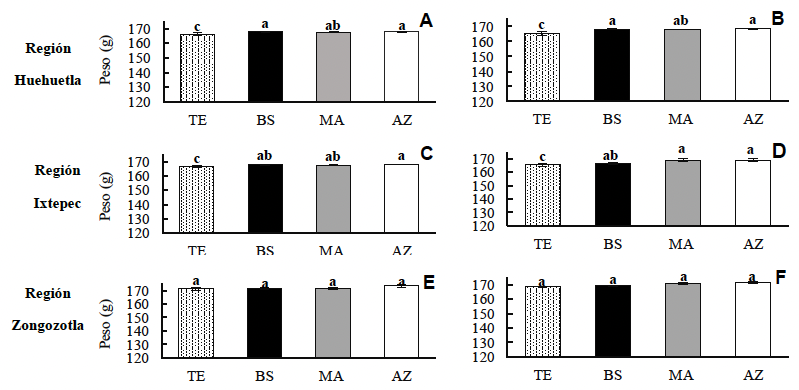
Figure 5. Effect of fungicides on the yield of coffee grown in Huehuetla, Ixtepec, and Zongozotla, Puebla. A) Lipuntahuaca 1: Costa Rica 95, B) Lipuntahuaca 2: Typica, C) Escatachuchut 1: Costa Rica 95, D) Escatachuchut 2: Garnica, E) Zongozotla 1: Marsellesa, and F) Zongozotla 2: Oro Azteca. The bars indicate the treatments: TE = Control, BS = <em>Bacillus subtilis</em>, MA = <em>Melaleuca alternifolia</em>, and AZ = Azoxystrobin. Bars with the same letter are statistically equal (Tukey, p≤0.05).
Figure 5. Effect of fungicides on the yield of coffee grown in Huehuetla, Ixtepec, and Zongozotla, Puebla. A) Lipuntahuaca 1: Costa Rica 95, B) Lipuntahuaca 2: Typica, C) Escatachuchut 1: Costa Rica 95, D) Escatachuchut 2: Garnica, E) Zongozotla 1: Marsellesa, and F) Zongozotla 2: Oro Azteca. The bars indicate the treatments: TE = Control, BS = Bacillus subtilis, MA = Melaleuca alternifolia, and AZ = Azoxystrobin. Bars with the same letter are statistically equal (Tukey, p≤0.05).