Click on the cite to copy
-
Or Copy link

Article filters
Search Papers:
Isolation and molecular characterization of native Trichoderma species in sites with different management practices in Chilpancingo, Guerrero, Mexico
By Jatsiris A Meza Silva, Jeiry Toribio Jiménez, Renato León Rodríguez, Nelda Xanath Martínez Galero, Erubiel Toledo Hernández, Roxana Reyes Ríos, Alberto Patricio Hernández*
*Corresponding Author.
Received: 15/May/2026 – Published:
29/July/2026
DOI:
https://doi.org/10.18781/R.MEX.FIT.2605-2
-
Or Copy link
Abstract Background/Objective. The genus Trichoderma comprises fungi widely recognized for their capacity as biological control agents and plant growth promoters; however, information on their molecular diversity in agricultural systems in Guerrero, Mexico, is limited. The objective of this study was to isolate and molecularly identify native Trichoderma species present in different sites within the municipality of Chilpancingo de los Bravo, Guerrero, and to analyze their distribution in relation to management conditions.
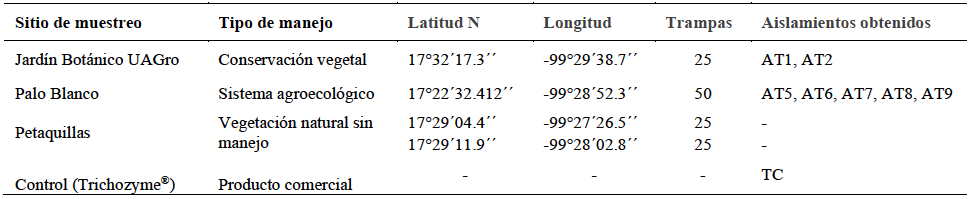
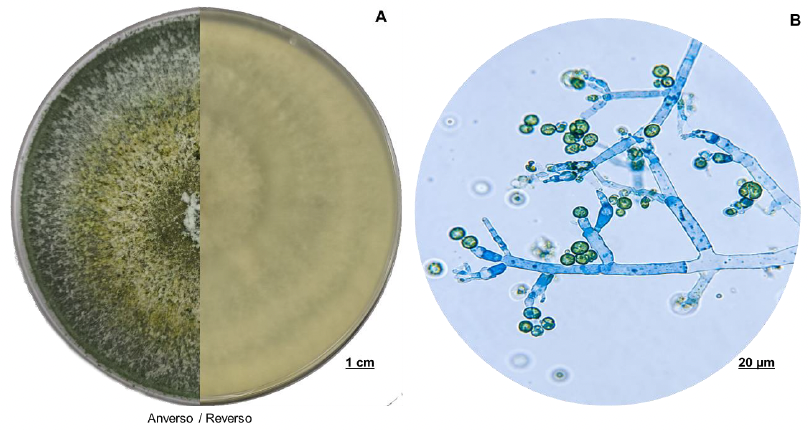
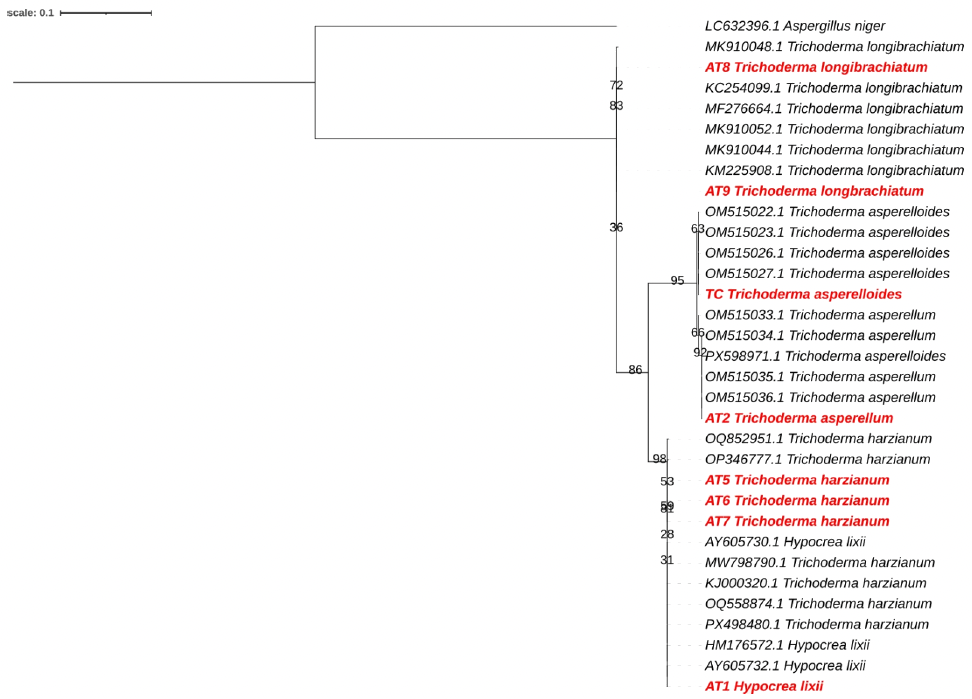
Experimental development. During August and September 2025, 125 traps with sterile rice were installed at four sampling points: Palo Blanco (Agroecological system), the Botanical Garden of the Universidad Autónoma de Guerrero (Plant conservation), and two areas of Petaquillas (Unmanaged natural vegetation). Isolates were purified by monosporic culture, morphologically characterized, and identified by ITS region sequencing and maximum likelihood phylogenetic analysis with 1,000 bootstrap replicates.
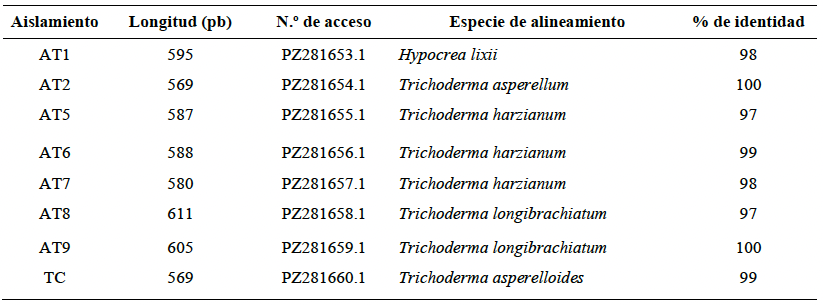
Results. Seven Trichoderma isolates were obtained, recovered only from the Palo Blanco agroecological plot and the Botanical Garden of the Universidad Autónoma de Guerrero. Phylogenetic analysis identified T. harzianum/Hypocrea lixii, T. asperellum, and T. longibrachiatum. Representatives of T. harzianum/H. lixii and T. longibrachiatum were identified at Palo Blanco, while T. harzianum/H. lixii and T. asperellum were identified at the Botanical Garden. The T. harzianum/H. lixii complex was the predominant taxon, representing 57.1% of the isolates obtained.
Conclusion. Three Trichoderma taxa were identified, with the T. harzianum/Hypocrea lixii complex predominating (57.1%), present in Palo Blanco and the Botanical Garden. The results expand our knowledge of its diversity and distribution in Guerrero, although its biotechnological potential should be confirmed through functional evaluations.
Keywords: Phylogeny, Rhizosphere, Microbiota, Taxonomy, Soil