Click on the cite to copy
-
Or Copy link

Article filters
Search Papers:
Tobamovirus fructirugosum an emerging disease: review and current situation in Mexico
By Ubilfrido Vásquez Gutiérrez, Juan Carlos Delgado Ortiz*, Gustavo Alberto Frías Treviño, Luis Alberto Aguirre Uribe, Alberto Flores Olivas
*Corresponding Author.
Received: 28/January/2024 – Published:
15/October/2024
DOI:
https://doi.org/10.18781/R.MEX.FIT.2401-7
-
Or Copy link
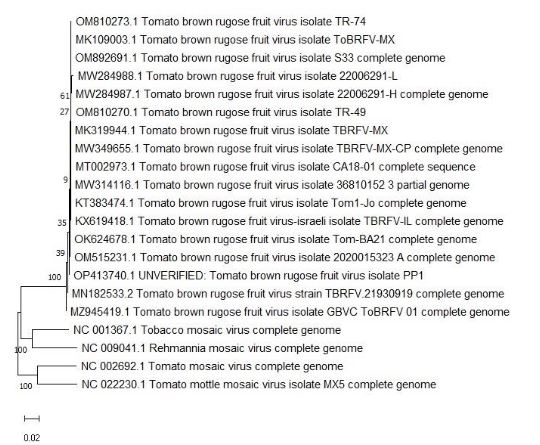
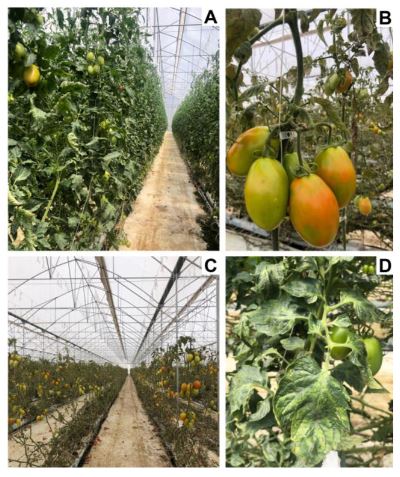
Abstract Background/Objective. Tobamovirus fructirugosum species (ToBRFV) is considered a worldwide quarantine pest that limits the production of Solanum lycopersicum and Capsicum annum, currently present in three countries of the American continent. The objective of this work was to deepen in the genetic variability of ToBRFV with respect to the different isolates, the physico-molecular and symptomatic characterization, the traditional and more current methods implemented for diagnosis, the range of virus reservoir hosts, and the epidemiology. Results. ToBRFV was generated from a mutation resulting from genetic recombination with TMV, considered the main progenitor and ToMMV secondary progenitor. Phylogenetic analyses report the existence of five clades with respect to the genetic diversity of ToBRFV. The first primers for detection were designed in 2015 that encode replication, movement and capsid proteins. Serological methods can be used for preventive diagnosis, while molecular and NGS can confirm virus infection even at low concentrations in the plant. Sixteen weed families and host crops are reported from 47 countries. To achieve an effective strategy, it is necessary to reduce inoculum sources, develop compounds that inhibit mechanical transmission and develop tolerant genotypes. Conclusion. ToBRFV is distributed nationally and represents a phytosanitary risk for Mexico; the exhaustive analysis of the study of diagnostic techniques, host range, dissemination, epidemiology and control strategies, contributes to the knowledge of ToBRFV.
Keywords: Diagnosis, epidemiology, ToBRFV, virus progression, genetic variability.