RMF Logo

Article filters

Search Papers:

For searching before 2024 see Archive (2000-2023)
  • Vol. 2024, 42(3)
  • Review Article

Mixed viral infections in vegetable crops: biochemical and molecular aspects

By Mario Sánchez Sánchez, Irasema Vargas Arispuro, Juan Manuel Tovar Pedraza, Cristóbal González Pérez Pedraza, Emmanuel Aispuro Hernández, Eber Addí Quintana Obregón, Miguel Ángel Martínez Téllez*

*Corresponding Author.

Received: 05/April/2024 – Published: 06/August/2024
DOI: https://doi.org/10.18781/R.MEX.FIT.2404-3

  • PDF
  • HTML
  • XML

Abstract Mixed viral infections refer to the coinfection of two or more viruses in the plant, which regularly lead to exacerbated symptoms on leaves and fruits. The dynamics of coinfections may follow either a synergistic, antagonistic, or neutral interaction that impacts the severity of the symptoms and infection. Mixed viral infections occur due to the convergence of fundamental characteristics reviewed in this manuscript. The virus‒host plant interrelationship influences the establishment and spread patterns of mixed viral infections. Attention should be drawn to potential changes in the dynamics of transmission and prevalence of plant viral diseases due to the effect of anthropogenic and natural alterations to complex agroecological systems or their components, including hosts, reservoirs, vectors, ecological niches, and the emergence of new virus strains

Keywords: antagonism, coinfection, synergism, virus, virus-host interactions
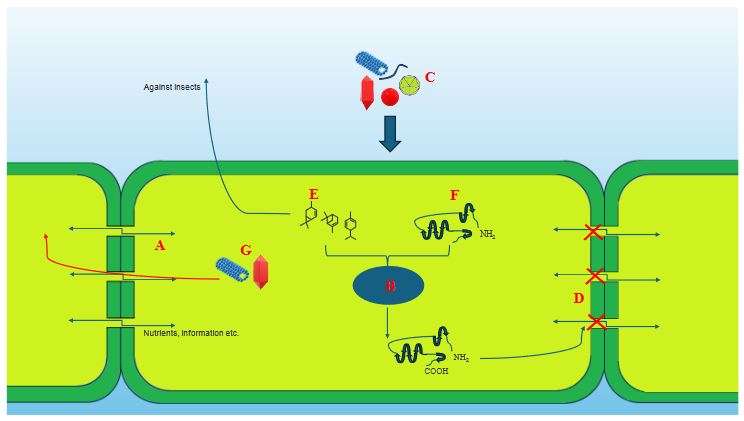
Figura 2. Plant components involved in viral mixed infections. Normal communication processes between plant cells involve the interrelation of structures such as plasmodesmata (A) and nucleus (B), the former are conducted in the cell walls that allow the passage of molecules between cytoplasm. In the presence of a viral infection (C), the cell counteracts the action through well-defined biochemical pathways such as inhibition of plasmodesmata function and intracellular trafficking (D), production of specific response metabolites (They can occur before and during the development of the viral infection), (E) or increase in the production of proteins involved in detoxification processes (F). In other hand, after a successful internalization by two viruses occurs synergistic effect of mixed viral infection (G).
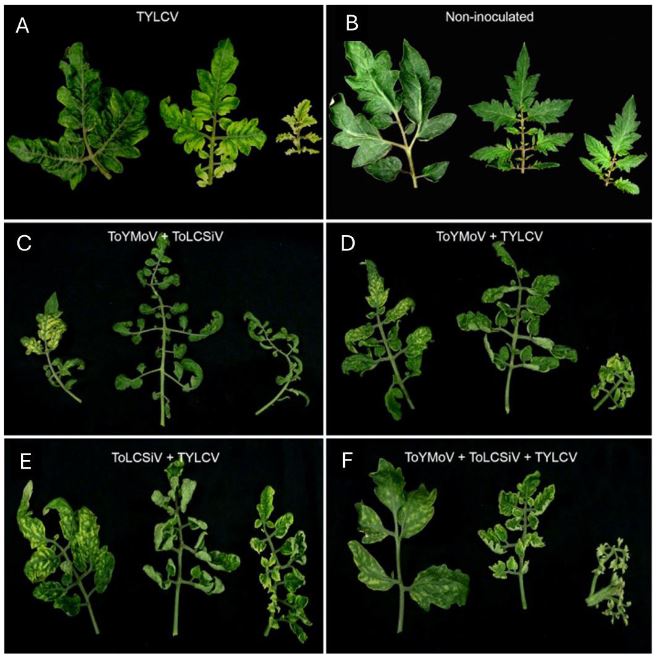
Figure 1. Symptom transition in the lower, middle, and upper leaves of tomato plants agroinoculated with the infectious cloned DNA-A and DNA-B components of isolates of TYLCV from Costa Rica (ToYMoV-[CR:Gre:GR1:90]) and Tomato leaf curl Sinaloa virus (ToLCSiV-[CR:Lib:L1:02]) from Costa Rica and the infectious clone of the genomic DNA of TYLCV from the Dominican Republic (TYLCV-[DO]) individually or in all combinations. (A) TYLCV; (B) non-inoculated tomato plant; (C) ToYMoV and ToLCSiV; (D) ToYMoV and TYLCV; (E) ToLCSiV and TYLCV; (F) ToYMoV, ToLCSiV and TYLCV. Plants were photographed 21 d after agroinoculation (with permission of Maliano <em>et al.,</em> 2022)
Figure 1. Symptom transition in the lower, middle, and upper leaves of tomato plants agroinoculated with the infectious cloned DNA-A and DNA-B components of isolates of TYLCV from Costa Rica (ToYMoV-[CR:Gre:GR1:90]) and Tomato leaf curl Sinaloa virus (ToLCSiV-[CR:Lib:L1:02]) from Costa Rica and the infectious clone of the genomic DNA of TYLCV from the Dominican Republic (TYLCV-[DO]) individually or in all combinations. (A) TYLCV; (B) non-inoculated tomato plant; (C) ToYMoV and ToLCSiV; (D) ToYMoV and TYLCV; (E) ToLCSiV and TYLCV; (F) ToYMoV, ToLCSiV and TYLCV. Plants were photographed 21 d after agroinoculation (with permission of Maliano et al., 2022)