Click on the cite to copy
-
Or Copy link

Article filters
Search Papers:
Morphological and molecular characterization of Fusarium incarnatum associated to the malformation of mango (Mangifera indica) in Sinaloa, Mexico
By Leonardo Román Román, Tomás Aarón Vega Gutiérrez, Martín Abraham Tirado Ramírez, Luz Llarely Cázarez Flores, Lorena Molina Cárdenas*, Indira Rojo Báez
*Corresponding Author.
Received: 01/July/2024 – Published:
29/April/2025
DOI:
https://doi.org/10.18781/R.MEX.FIT.2407-1
-
Or Copy link
Abstract Background/Objective. The malformation in mango is one of the main diseases to attack this crop, and therefore limits its worldwide production. The aim of this study was to identify, morphologically and molecularly, the phytopathogen associated to the malformation of mango in Sinaloa, Mexico.
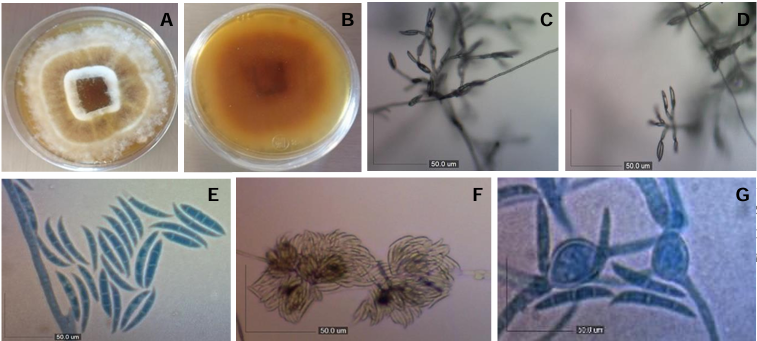
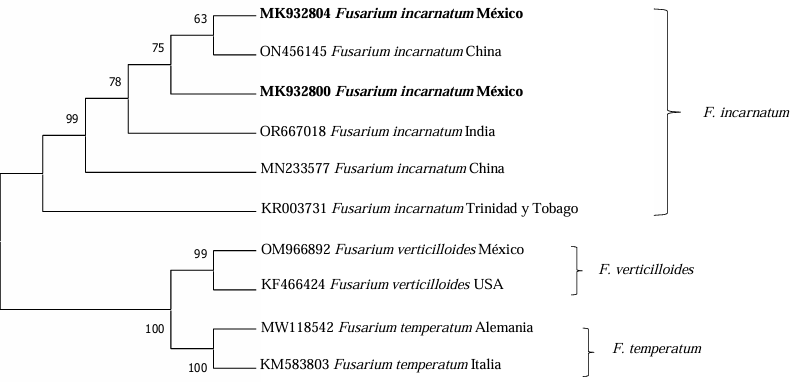
Materials and methods. In 2018, samples showing malformation symptoms, such as compacted panicles and the eruption of multiple vegetative shoots, were collected from mango orchards in Sinaloa. Based on morphological characteristics, the isolates were identified as Fusarium incarnatum. The molecular identification was carried out by amplifying the partial sequence of the elongation factor gene (TEF-1α) and conducting a phylogenetic analysis. Pathogenicity tests were performed on mango plants through artificial inoculation.
Results. Symptoms on the inoculated plants were observed seven weeks after inoculation, with a disease severity scale rating between 2 and 4; no symptoms were observed in the control plants. The pathogen was re-isolated from symptomatic tissue and identified based on morphology, thus fulfilling Koch’s postulates.
Conclusion. Fusarium incarnatum is repored for the first time as associated with mango malformation in Sinaloa, Mexico.
Keywords: Elongation factor, Fusarium, Koch’s postulates