RMF Logo

Article filters

Search Papers:

For searching before 2024 see Archive (2000-2023)
  • Vol. 2025, 43(2)
  • Scientific Article

Characterization and identification of Burkholderia glumae in seeds of rice (Oryza sativa) varieties planted in Mexico

By Gabriel Alejandro Hernández Nava, Sergio Aranda Ocampo*, Guadalupe Valdovinos Ponce, Obdulia Segura León, Mónica Osnaya González, Eridani García Vázquez, Sergio Ramírez Rojas, Leonardo Hernández Aragón

*Corresponding Author.

Received: 19/August/2024 – Published: 21/April/2025
DOI: https://doi.org/10.18781/R.MEX.FIT.2408-3

  • PDF
  • HTML
  • XML

Abstract Backgrounds/Objectives. Burkholderia glumae is the most important pathogen transmitted through seeds that reduces the yield of rice (Oryza sativa). In 2022, seeds were found with symptoms of glume blotch in Mexico. The aim of this investigation was to characterize and identify the causal agent of the symptoms of glume blotch of 11 varieties of rice planted in Mexico.

Materials and Methods. A total of 37 seeds samples were analyzed. From each sample, 1 g of seed was disinfested with sodium hypochlorite and macerated in a PBS buffer and subsequently streaked onto SPG, B de King and Wilbrinks culture media. The isolated bacterial strains were characterized by API20 and identified by amplification and partial sequencing of universal and specific genes. Pathogenicity was evaluated using a 3.5 x 10⁸ CFU mL-1 suspension on rice seeds and seedlings of the Milagro Filipino and INIFLAR R varieties.

Results. Out of 37 samples, in nine (24.3 %), 11 isolates were taken with the morphology described for B. glumae. Characterization by API20 identified two groups with different metabolic profiles between the 11 strains. With PCR, the 11 strains were identified with a coverage of 100% as B. glumae with the universal primers 8F-1492R, and specific to B. glumae Bglu3F-Bglu3R and OgF-OgR. The pathogenicity of B. glumae was confirmed in rice seeds and seedlings of the Milagro Filipino and INIFLAR-R varieties.

Conclusion. B. glumae is the causal agent of the symptoms of glume blotch in rice seeds, and it was detected in seeds from seven varieties (63.6 %): GOLFO FL-16, INIFLAR-R, INIFLAR-RT, IRGA, Milagro Filipino, Morelos A-98 and PACÍFICO FL-15 of 11 rice varieties planted in Mexico.

Keywords: Bacterial panicle blight, Isolation, Varieties, Pathogenicity
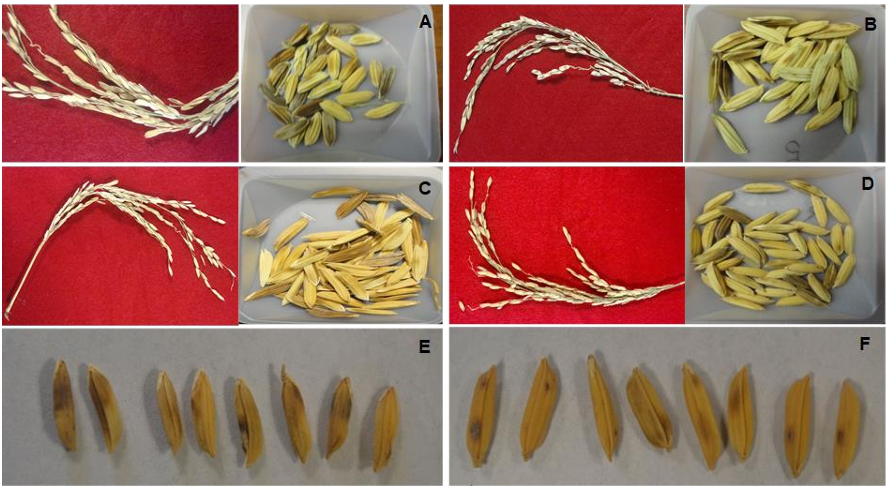
Figure 1. Symptoms of glume blotch in panicles and seeds in the rice varieties: <strong>A</strong>. MILAGRO FILIPINO, <strong>B</strong>. MORELOS A 98, <strong>C</strong>. PACÍFICO FL-15, <strong>D</strong>. IRGA. Symptoms of blotch in seeds of the rice varieties: <strong>E</strong>. MILAGRO FILIPINO, <strong>F</strong>. MORELOS A-98.
Figure 1. Symptoms of glume blotch in panicles and seeds in the rice varieties: A. MILAGRO FILIPINO, B. MORELOS A 98, C. PACÍFICO FL-15, D. IRGA. Symptoms of blotch in seeds of the rice varieties: E. MILAGRO FILIPINO, F. MORELOS A-98.
Figure 2. Morphological characteristics of the bacterial colonies isolated from rice seeds with symptoms of glume blotch. Culture of the colonies at 28 °C for 72 h in a culture medium. <strong>A</strong>. Sucrose-phosphate-glutamate (S-PG), <strong>B</strong>. King’s B, <strong>C</strong>. Wilbrinks.
Figure 2. Morphological characteristics of the bacterial colonies isolated from rice seeds with symptoms of glume blotch. Culture of the colonies at 28 °C for 72 h in a culture medium. A. Sucrose-phosphate-glutamate (S-PG), B. King’s B, C. Wilbrinks.
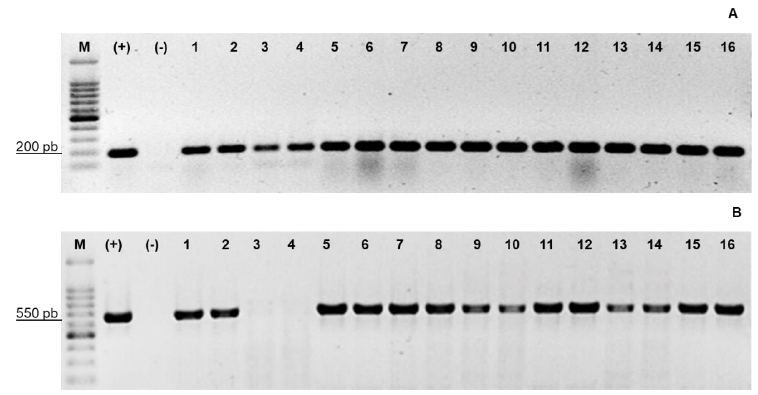
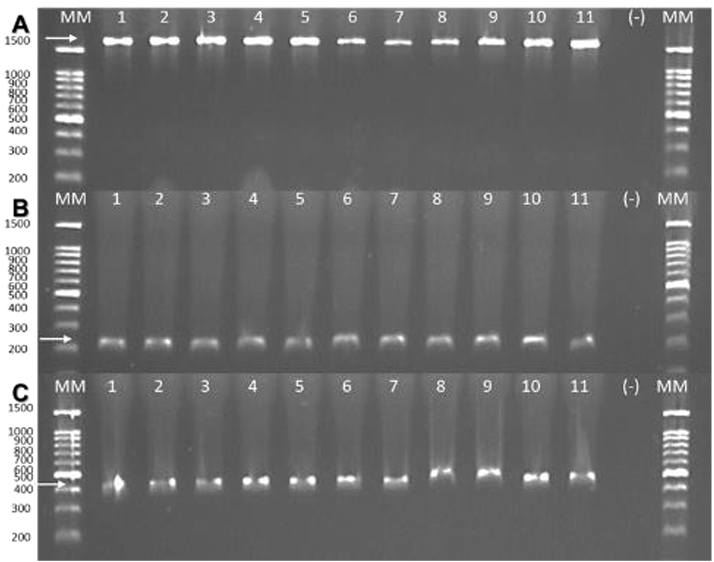
Figure 3. Detection of <em>B. glumae</em> by endpoint PCR. Partial amplification of the following genes: <strong>A</strong>. 16S rRNA with primers 8F-1492R (1500 bp). <strong>B</strong>. Putative protein with primers Bglu3 (174 bp). <strong>C</strong>. 16S-23S rRNA intergenic spacer region with primers Og (402 bp). Lane 1: INIFLAR-R (CPM01); lanes 2-3: INIFLAR-RT (CPM02 and CPM03, respectively); Lane 4: GOLFO FL-16 (CPM04); lanes 5-6: PACÍFICO FL-15 (CPM05 and CPM06, respectively); Lanes 7-9: Milagro Filipino (CPN01, CPN03 and CPJ02, respectively); Lane 10: IRGA (CPJ01) and lane 11: Morelos A-98 (CPN02). MM: Molecular marker 100 bp (GOLDBIO); (-): Negative control (sterile distilled water).
Figure 3. Detection of B. glumae by endpoint PCR. Partial amplification of the following genes: A. 16S rRNA with primers 8F-1492R (1500 bp). B. Putative protein with primers Bglu3 (174 bp). C. 16S-23S rRNA intergenic spacer region with primers Og (402 bp). Lane 1: INIFLAR-R (CPM01); lanes 2-3: INIFLAR-RT (CPM02 and CPM03, respectively); Lane 4: GOLFO FL-16 (CPM04); lanes 5-6: PACÍFICO FL-15 (CPM05 and CPM06, respectively); Lanes 7-9: Milagro Filipino (CPN01, CPN03 and CPJ02, respectively); Lane 10: IRGA (CPJ01) and lane 11: Morelos A-98 (CPN02). MM: Molecular marker 100 bp (GOLDBIO); (-): Negative control (sterile distilled water).
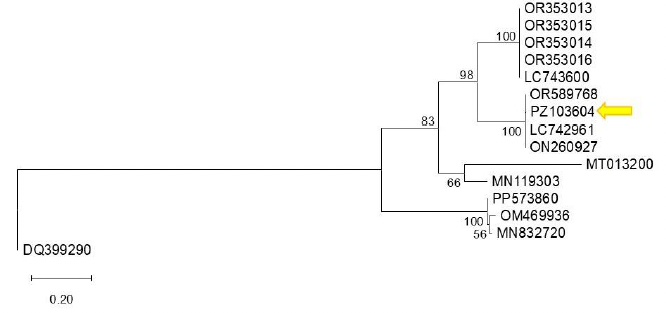
Figure 4. Phylogenetic analysis of the fragment of region 16S rRNA of 11 strains of <em>B. glumae</em> isolated in Mexico. Consensus phylogenetic tree inferred by the Maximum likelihood method. Model GTR+G+I and 500 Bootstrap replicates. The <em>Burkholderia gladioli</em> sequence CP098321.1 was included as an outgroup. = B. glumae strains isolated from seeds with symptoms of glume blotch from rice varieties planted in Mexico.
Figure 4. Phylogenetic analysis of the fragment of region 16S rRNA of 11 strains of B. glumae isolated in Mexico. Consensus phylogenetic tree inferred by the Maximum likelihood method. Model GTR+G+I and 500 Bootstrap replicates. The Burkholderia gladioli sequence CP098321.1 was included as an outgroup. = B. glumae strains isolated from seeds with symptoms of glume blotch from rice varieties planted in Mexico.
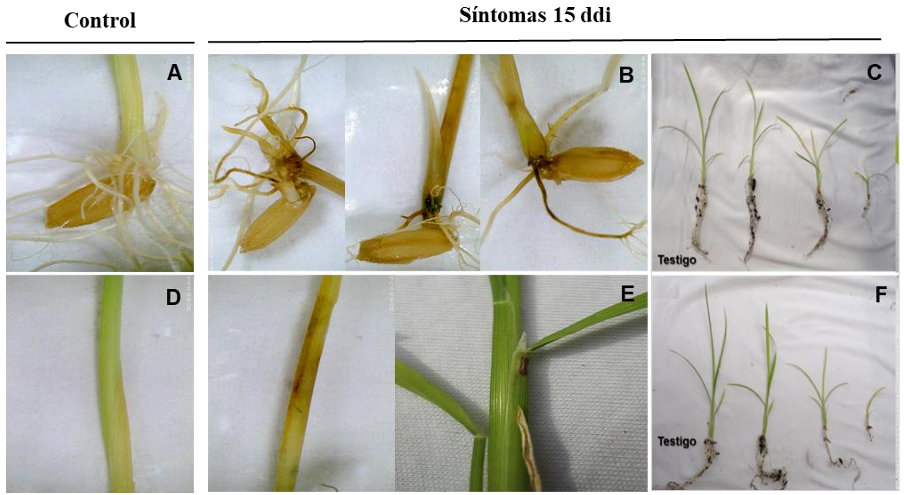
Figure 5. Symptoms induced by <em>B. glumae</em> CPM01 15 dai in rice seeds and seedlings. MILAGRO FILIPINO variety: <strong>A</strong>. Control, submersion of seed in sterile distilled water. <strong>B</strong>. Necrosis and rotting of seeds, roots and stem. <strong>C</strong>. Reduction in growth and abnormal root development. INIFLAR-R variety: <strong>D</strong>. Control, spraying of sterile distilled water on stem. <strong>E</strong>. Necrosis and rotting of seedling stems. F. Reduction in growth and abnormal development of roots.
Figure 5. Symptoms induced by B. glumae CPM01 15 dai in rice seeds and seedlings. MILAGRO FILIPINO variety: A. Control, submersion of seed in sterile distilled water. B. Necrosis and rotting of seeds, roots and stem. C. Reduction in growth and abnormal root development. INIFLAR-R variety: D. Control, spraying of sterile distilled water on stem. E. Necrosis and rotting of seedling stems. F. Reduction in growth and abnormal development of roots.
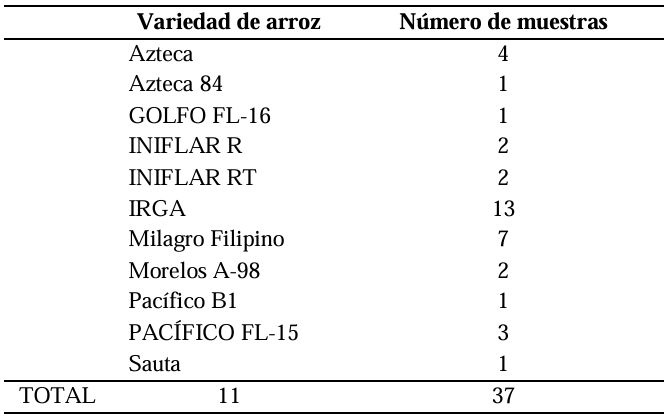
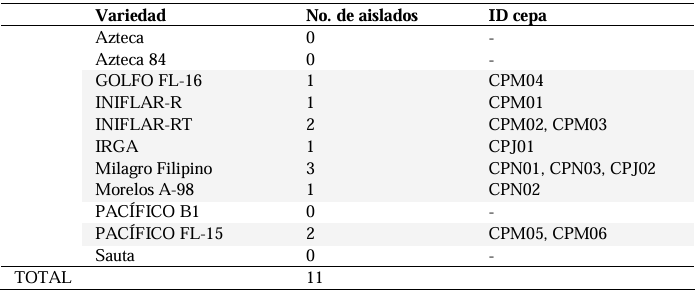
Table 1. Varieties of rice analyzed to identify the causal agent of the glume blotch in seeds.
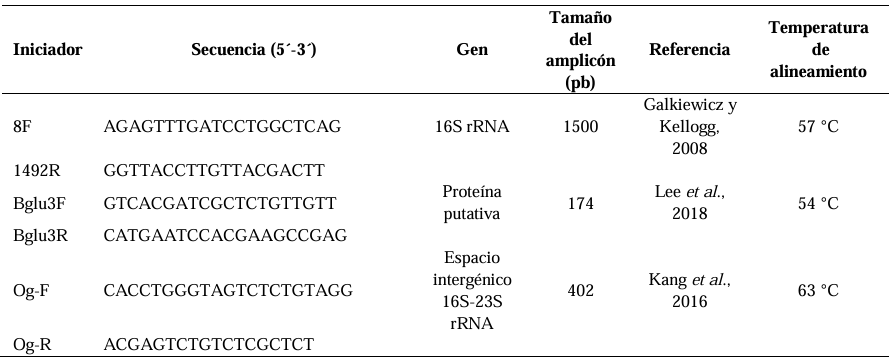
Table 2. Primers used for the identification of bacteria isolated from seeds with symptoms of glume blotch in rice varieties planted in Mexico.
Table 3. Bacterial strains with a <em>B. glumae</em> phenotype isolated with symptoms of glume blotch in rice varieties planted in Mexico.
Table 3. Bacterial strains with a B. glumae phenotype isolated with symptoms of glume blotch in rice varieties planted in Mexico.
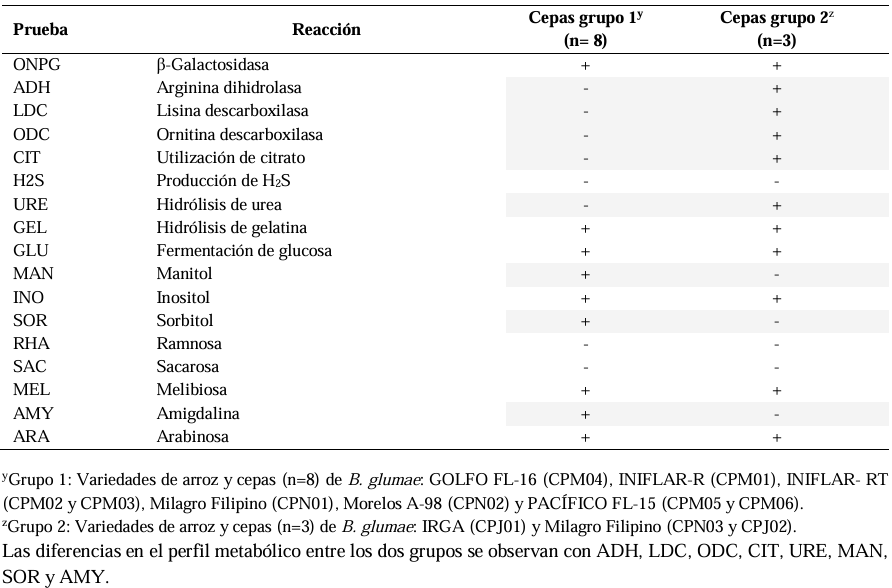
Table 4. Physiological and biochemical characterización with API 20E from 11 strains with a <em>B. glumae</em> phenotype of rice seeds with symptoms of necrosis in glumes.
Table 4. Physiological and biochemical characterización with API 20E from 11 strains with a B. glumae phenotype of rice seeds with symptoms of necrosis in glumes.
Table 5. Molecular identification of 11 strains isolated from seeds of rice varieties planted in Mexico with symptoms of glume blotch.