RMF Logo

Article filters

Search Papers:

For searching before 2024 see Archive (2000-2023)
  • Vol. 2025, 43(2)
  • Scientific Article

Competitive interaction between Rotylenchulus reniformis and Meloidogyne enterolobii in tomato and cucumber plants

By María Trinidad Valdez Morales, José Armando Carrillo Fasio, Raymundo Saúl García Estrada, Josefina León Félix, José Ángel Martínez Gallardo, Juan Manuel Tovar Pedraza*

*Corresponding Author.

Received: 22/September/2024 – Published: 29/April/2025
DOI: https://doi.org/10.18781/R.MEX.FIT.2409-2

  • PDF
  • HTML
  • XML

Abstract Background/Objective. The production of tomato (Solanum lycopersicum) and cucumber (Cucumis sativus) is affected by the nematodes Rotylenchulus reniformis and Meloidogyne enterolobii; however, the interaction between these two nematodes on these plant species is unknown. The aim of this study was to determine the interaction of R. reniformis and M. enterolobii in tomato and cucumber plants through artificial inoculations under greenhouse conditions.

Materials and Methods. Twenty-one-day-old seedlings were inoculated with 2000 juveniles (J2) of each nematode per plant. The experiment followed a completely randomized three-factor design with six treatments: T1= R. reniformis; T2= M. enterolobii; T3= R. reniformis was inoculated and 15 days later M. enterolobii was added; T4 = M. enterolobii was inoculated and 15 days later R. reniformis was added; T5 = both species were inoculated on the same day; T6 = uninoculated control. The reproduction factor (RF) of both nematodes, galling index for M. enterolobii, and root necrosis percentage for R. reniformis were recorded at 30 and 50 days after inoculation.

Results. In cucumber plants, M. enterolobii reduced its reproduction by up to 73% in the presence of R. reniformis, while in tomato plants, its reproduction decreased by 52%, with a reduction in the galling index of 72 and 60% in cucumber and tomato plants, respectively, compared to T1 and T2. On the other hand, R. reniformis reduced its reproduction by 72% in cucumber plants and 67% in tomato plants in the presence of M. enterolobii, and a reduction in symptom severity was observed by 78 and 77% in cucumber and tomato plants, respectively, compared to T1 and T2.

Conclusion. In treatments where one species was inoculated before the other, the species inoculated first showed a higher RF and caused greater disease severity. In simultaneous co-inoculations, both nematodes reduced their RF and caused lower symptom severity in tomato and cucumber plants.

Keywords: Solanum lycopersicum, Cucumis sativus, Reproduction factor, Severity, Galling index
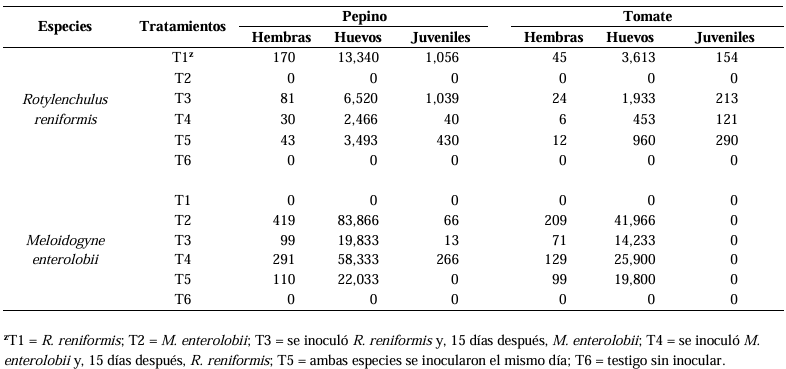
Table 1. Number of females, eggs, and juveniles of <em>R. reniformis</em> and <em>M. enterolobii</em> by treatment in cucumber and tomato plants at 50 days after inoculation.
Table 1. Number of females, eggs, and juveniles of R. reniformis and M. enterolobii by treatment in cucumber and tomato plants at 50 days after inoculation.
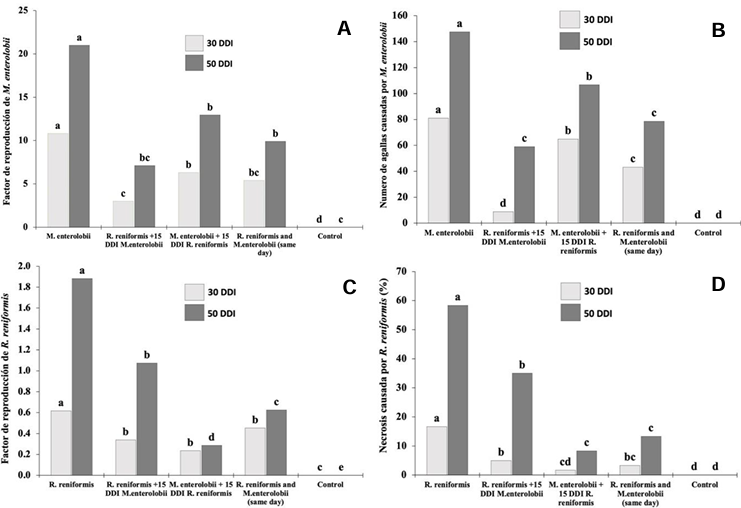
Figure 1. Reproduction and severity of <em>R. reniformis</em> and <em>M. enterolobii</em> in cucumber plants at 30 and 50 days after inoculation (DAI). A) Reproduction factor of <em>M. enterolobii</em>. B) Number of galls caused by <em>M. enterolobii</em>. C) Reproduction factor of <em>R. reniformis</em>. D) Percentage of root necrosis caused by <em>R. reniformis</em>. The comparison of means was conducted between bars of the same color; means that do not share a letter are significantly different.
Figure 1. Reproduction and severity of R. reniformis and M. enterolobii in cucumber plants at 30 and 50 days after inoculation (DAI). A) Reproduction factor of M. enterolobii. B) Number of galls caused by M. enterolobii. C) Reproduction factor of R. reniformis. D) Percentage of root necrosis caused by R. reniformis. The comparison of means was conducted between bars of the same color; means that do not share a letter are significantly different.
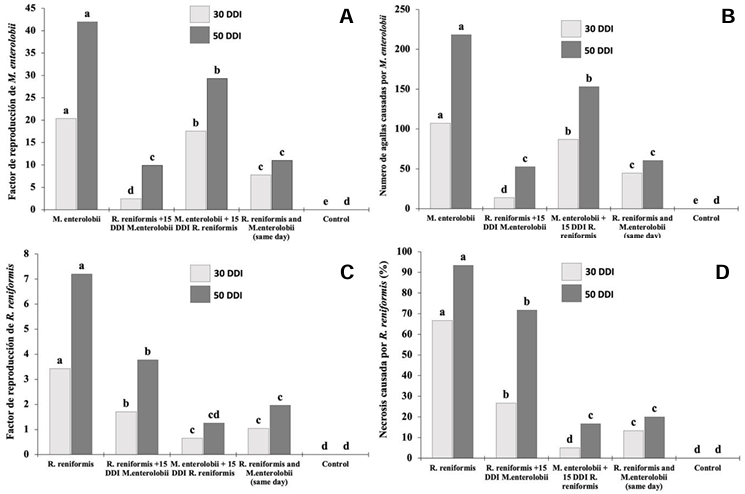
Figure 2. Reproduction and severity of <em>R. reniformis</em> and <em>M. enterolobii</em> in tomato plants at 30 and 50 days after inoculation (DAI). A) Reproduction factor of <em>M. enterolobii</em>. B) Number of galls caused by <em>M. enterolobii</em>. C) Reproduction factor of <em>R. reniformis</em>. D) Percentage of root necrosis caused by <em>R. reniformis</em>. The comparison of means was conducted between bars of the same color; means that do not share a letter are significantly different.
Figure 2. Reproduction and severity of R. reniformis and M. enterolobii in tomato plants at 30 and 50 days after inoculation (DAI). A) Reproduction factor of M. enterolobii. B) Number of galls caused by M. enterolobii. C) Reproduction factor of R. reniformis. D) Percentage of root necrosis caused by R. reniformis. The comparison of means was conducted between bars of the same color; means that do not share a letter are significantly different.
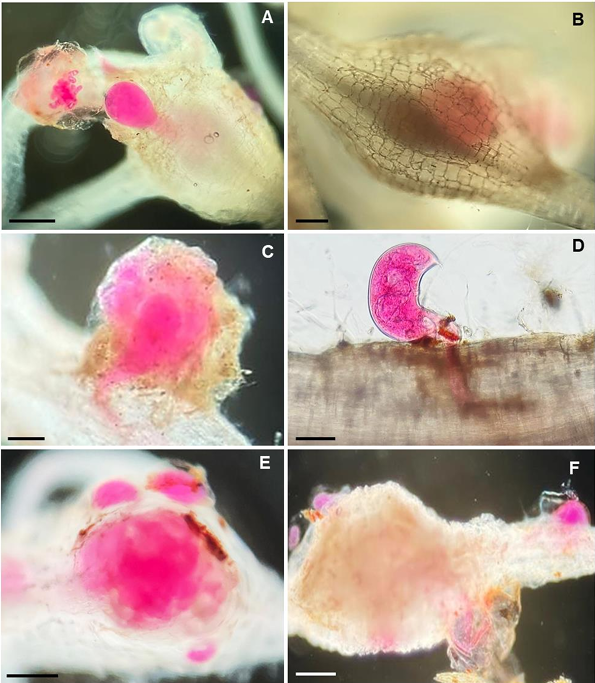
Figure 3. Micrographs of <em>Rotylenchulus reniformis</em> and <em>Meloidogyne enterolobii</em> parasitizing cucumber and tomato roots at 50 days after inoculation (DAI). A) Female of <em>M. enterolobii</em> in cucumber root. B) Female of <em>M. enterolobii</em> causing galls in tomato root. C) Female of <em>R. reniformis</em> affecting cucumber roots. D) Female of <em>R. reniformis</em> in tomato root. E) Cucumber root with a gall caused by <em>M. enterolobii</em> and three mature females of <em>R. reniformis</em> around it. F) Tomato root with a gall from <em>M. enterolobii</em> and necrosis caused by <em>R. reniformis</em>. Scale Bars: A= 300 μm; B, E, F= 500; C, D= 100 μm.
Figure 3. Micrographs of Rotylenchulus reniformis and Meloidogyne enterolobii parasitizing cucumber and tomato roots at 50 days after inoculation (DAI). A) Female of M. enterolobii in cucumber root. B) Female of M. enterolobii causing galls in tomato root. C) Female of R. reniformis affecting cucumber roots. D) Female of R. reniformis in tomato root. E) Cucumber root with a gall caused by M. enterolobii and three mature females of R. reniformis around it. F) Tomato root with a gall from M. enterolobii and necrosis caused by R. reniformis. Scale Bars: A= 300 μm; B, E, F= 500; C, D= 100 μm.
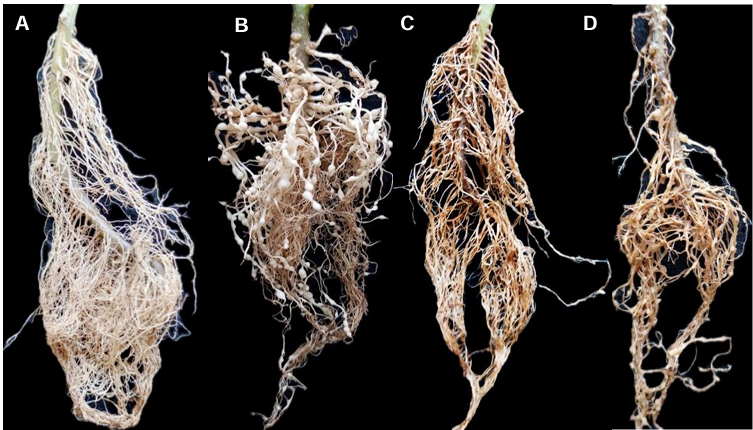
Figure 4. Tomato roots at 50 days after inoculation (DAI). A) Control without inoculation. B) Root with galls caused by <em>M. enterolobii</em>. C) Root with stunting and necrosis caused by R. reniformis. D) Root with galls, necrosis, and stunting symptoms, inoculated with <em>R. reniformis</em> and <em>M. enterolobii</em> simultaneously.
Figure 4. Tomato roots at 50 days after inoculation (DAI). A) Control without inoculation. B) Root with galls caused by M. enterolobii. C) Root with stunting and necrosis caused by R. reniformis. D) Root with galls, necrosis, and stunting symptoms, inoculated with R. reniformis and M. enterolobii simultaneously.
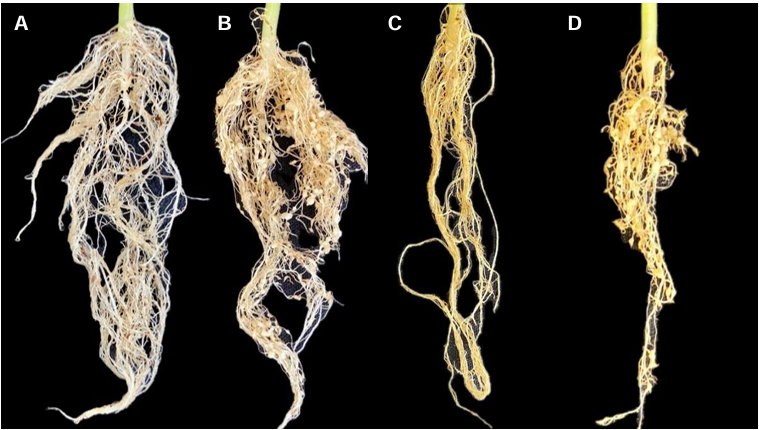
Figure 5. Cucumber roots at 50 days after inoculation (DAI). A) Control without inoculation. B) Root with galls caused by <em>M. enterolobii</em>. C) Root with symptoms of stunting and necrosis caused by <em>R. reniformis</em>. D) Root with galls, necrosis, and stunting symptoms, inoculated with R. reniformis and <em>M. enterolobii</em> simultaneously.
Figure 5. Cucumber roots at 50 days after inoculation (DAI). A) Control without inoculation. B) Root with galls caused by M. enterolobii. C) Root with symptoms of stunting and necrosis caused by R. reniformis. D) Root with galls, necrosis, and stunting symptoms, inoculated with R. reniformis and M. enterolobii simultaneously.