RMF Logo

Filtros de Contribuciones

Buscar Contribución:

Búsquedas previas al 2024 ver Archivo (2000-2023)
  • Acceso abierto
  • Artículo Científico
  • Número Especial

Bipolaris oryzae agente asociado a la mancha foliar en Cocos nucifera híbrido “Enano Verde de Brasil”

por Oscar Guillermo Rebolledo Prudencio, Wilberth Chan Cupul*, Guadalupe Moreno Zúñiga, Carlos Adrián Cruz Jiménez, Juan Carlos Sánchez Rangel

Recibido: 15/noviembre/2024 – Publicado: 21/febrero/2025
DOI: https://doi.org/10.18781/R.MEX.FIT.2024-09

Resumen Antecedentes/Objetivo. En Tecomán, Colima, México, se detectó una mancha foliar (MF) con incidencia del 92.0% en Cocos nucifera híbrido “Enano Verde de Brasil” (EVB). El objetivo fue caracterizar morfológica, molecular y bioquímicamente al hongo asociado a la MF en palma de coco EVB y evaluar su susceptibilidad a fungicidas biológicos comerciales.

Materiales y métodos. El aislado se caracterizó morfológica y molecularmente. Se evaluó su crecimiento, esporulación y producción de lacasas en diferentes medios de cultivo. Se determinó la inhibición micelial in vitro y dosis letal media (DL50) de fungicidas biológicos comerciales a base de hongos antagonistas (Trichoderma harzianum y T. viride), bacterias (Bacillus subtilis y B. amyloliquefaciens) y actinobacterias (Streptomyces lydicus y S. jofer).

Resultados. Bipolaris oryzae fue el agente asociado a la MF, produjo 25.54 y 22.17 U mg de proteína-1 de actividad lacasa en los medios Sivakumar y salvado de trigo (ST). El medio ST permitió la mayor esporulación. T. harzianum inhibió al 100% a B. oryzae en las cuatro dosis evaluadas. B. subtilis y B. amyloliquefaciens inhibieron al 100% a B. oryzae en la dosis más alta evaluada (20 mL L-1).

Conclusión. Bipolaris oryzae es el agente asociado a la MF, produjo la mayor actividad lacasa en Sivakumar y ST. La mayor esporulación y crecimiento diario fue en ST. T. harzianum destacó sobre T. viride al inhibir en 100% el crecimiento de B. oryzae. Bacillus subtilis, S. lydicus y B. amyloliquefaciens fueron más efectivas contra B. oryzae comparado con S. jofer.

Palabras clave: Antagonismo, Bipolaris, actinobacterias, bacterias, cocotero, Colima.
Mostrar Figuras y/o Cuadros
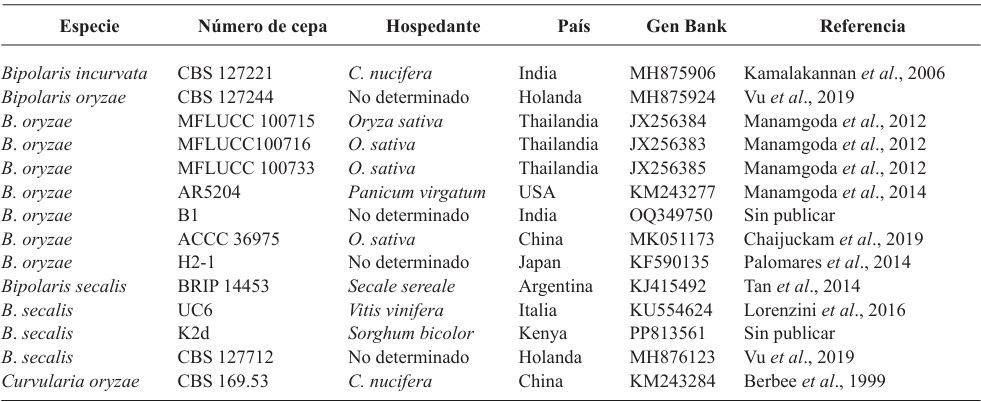
Cuadro 1. Secuencias utilizadas para la generación del árbol filogenético de <em>Bipolaris oryzae</em> agente asociado a la mancha foliar de cocotero.
Cuadro 1. Secuencias utilizadas para la generación del árbol filogenético de Bipolaris oryzae agente asociado a la mancha foliar de cocotero.
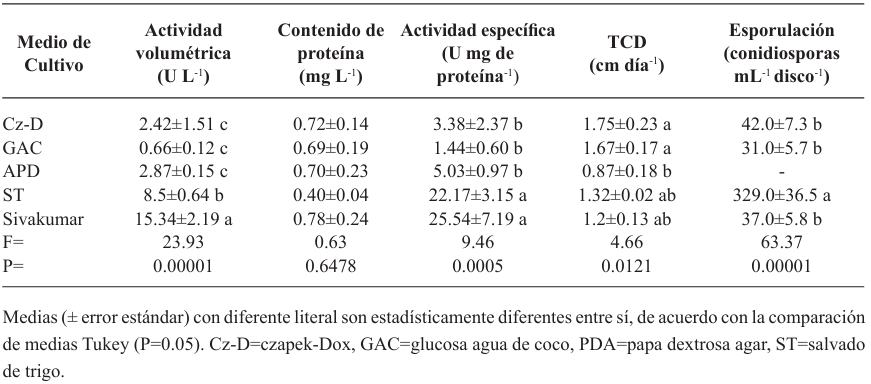
Cuadro 2. Actividad lacasa, tasa de crecimiento diario (TCD) y esporulación de <em>Bipolaris oryzae</em> en medios semisólidos.
Cuadro 2. Actividad lacasa, tasa de crecimiento diario (TCD) y esporulación de Bipolaris oryzae en medios semisólidos.
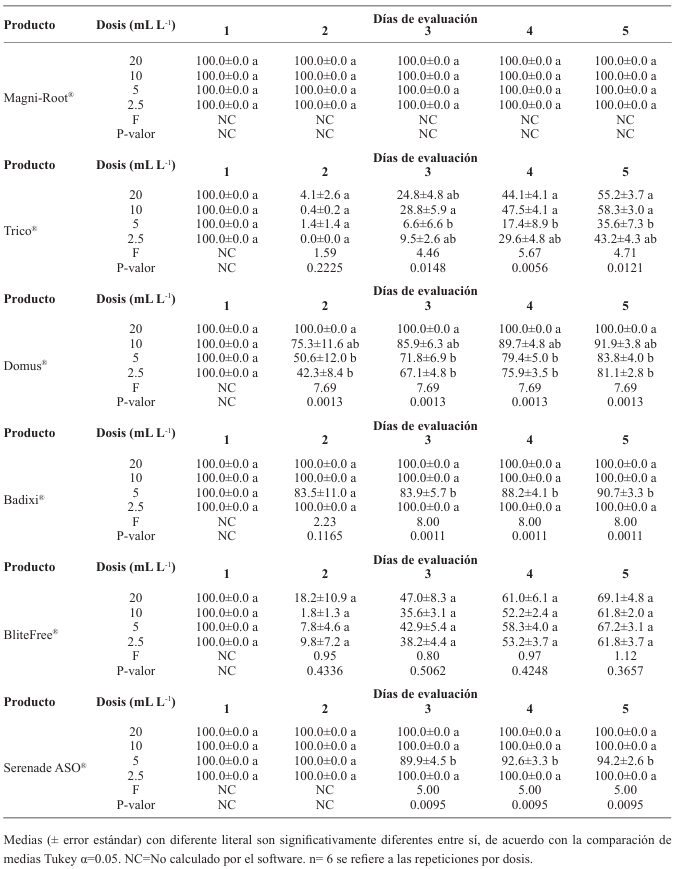
Cuadro 3. Inhibición del crecimiento micelial (%) de <em>Bipolaris oryzae</em> por diferentes dosis de fungicidas biológicos comerciales.
Cuadro 3. Inhibición del crecimiento micelial (%) de Bipolaris oryzae por diferentes dosis de fungicidas biológicos comerciales.
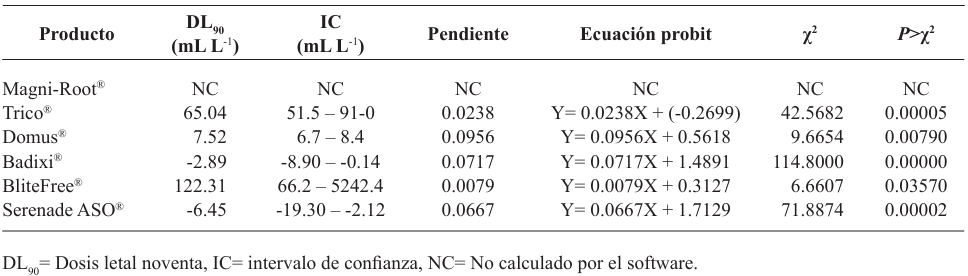
Cuadro 4. Dosis letal noventa (DL90) de seis fungicidas biológicos comerciales sobre <em>Bipolaris oryzae</em>.
Cuadro 4. Dosis letal noventa (DL90) de seis fungicidas biológicos comerciales sobre Bipolaris oryzae.
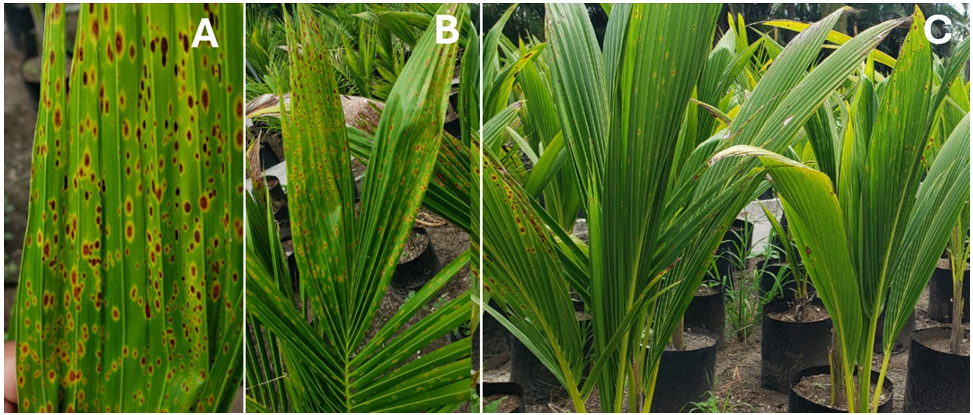
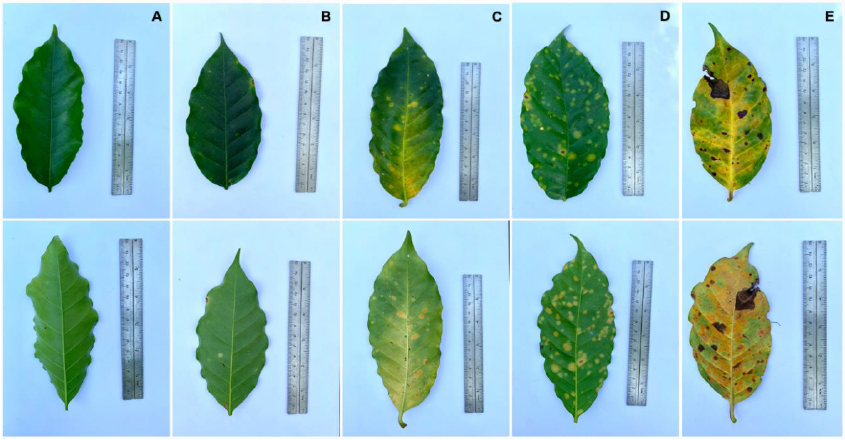
Figura 1. Hojas con síntomas de mancha foliar en palma de cocotero híbrido “Enano Verde de Brasil”. A) Manchas ovaladas color marrón y halo amarillo, B) hojas con de palma con múltiples manchas ovaladas y C) vista del vivero con plantas con síntomas de mancha foliar.
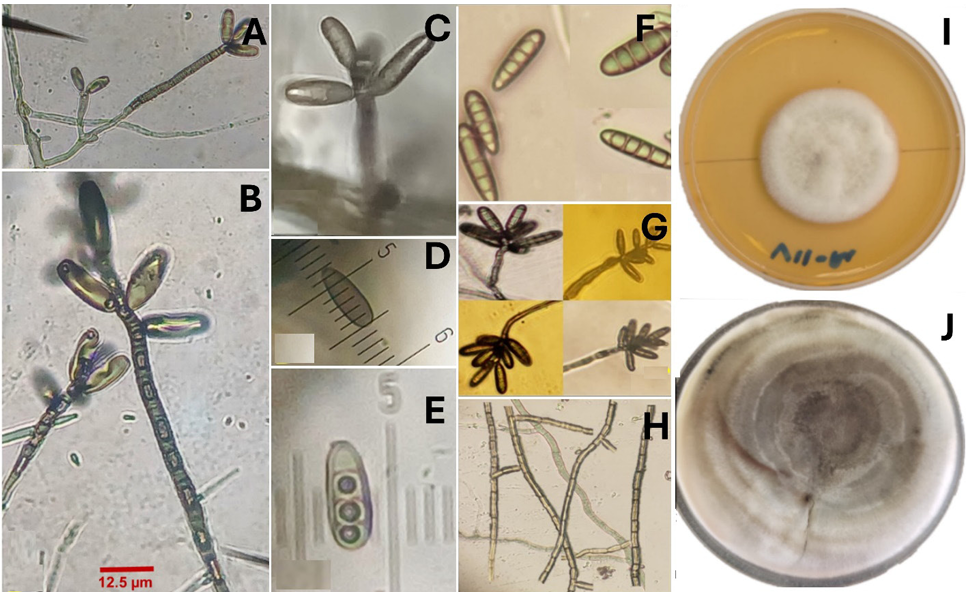
Figura 2. Características culturales y morfológicas de <em>Bipolaris oryzae</em>. A y B) Conidioforos; C a F) conidiosporas; G) agrupación de conidióforos; H) hifas septadas; I) micelio joven de cinco días de crecimiento en medio; J) micelio maduro de 20 días de crecimiento en medio PDA.
Figura 2. Características culturales y morfológicas de Bipolaris oryzae. A y B) Conidioforos; C a F) conidiosporas; G) agrupación de conidióforos; H) hifas septadas; I) micelio joven de cinco días de crecimiento en medio; J) micelio maduro de 20 días de crecimiento en medio PDA.
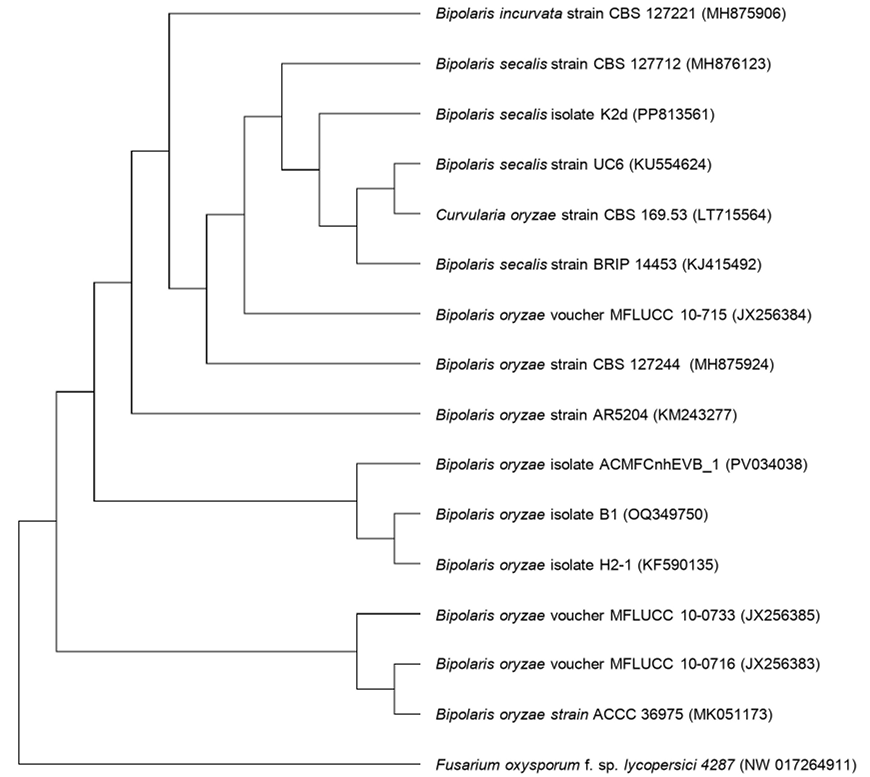
Figura 3. Análisis filogenético con base en el método de máxima verosimilitud utilizando el modelo Kimura de 2 parámetro (G+I). Árbol creado con el logaritmo de probabilidad más alto (-5759.36) de la secuencia del ADNr 28S de las cepas de <em>Bipolaris</em> similares a las del agente asociado a la MF en palma de cocotero EVB (<em>Bipolaris oryzae</em> ACMFCnhEVB_1) usando MEGA11. Es árbol se enraizó utilizando a Fusarium oxysporum se utilizó como grupo externo.
Figura 3. Análisis filogenético con base en el método de máxima verosimilitud utilizando el modelo Kimura de 2 parámetro (G+I). Árbol creado con el logaritmo de probabilidad más alto (-5759.36) de la secuencia del ADNr 28S de las cepas de Bipolaris similares a las del agente asociado a la MF en palma de cocotero EVB (Bipolaris oryzae ACMFCnhEVB_1) usando MEGA11. Es árbol se enraizó utilizando a Fusarium oxysporum se utilizó como grupo externo.
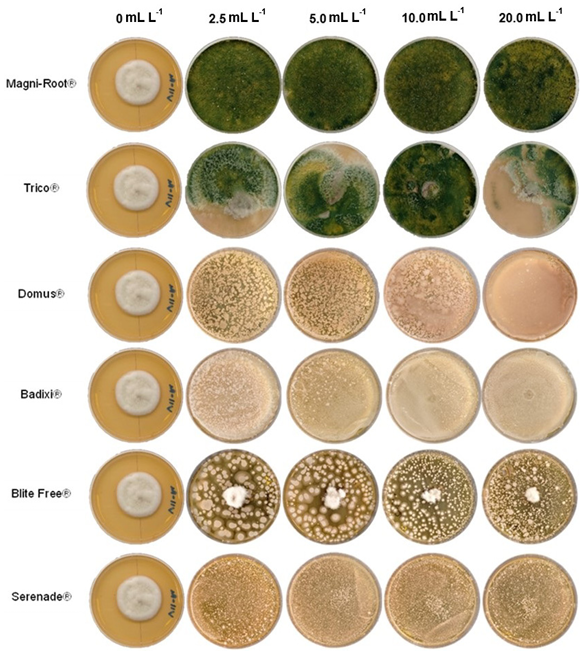
Figura 4. Crecimiento de <em>Bipolaris oryzae</em> a cinco días después de la inoculación en PDA modificado con diferentes dosis de fungicidas biológicos comerciales.
Figura 4. Crecimiento de Bipolaris oryzae a cinco días después de la inoculación en PDA modificado con diferentes dosis de fungicidas biológicos comerciales.
Figura 5. Regresión lineal entre la inhibición (%) del crecimiento de <em>Bipolaris oryzae</em> y las dosis utilizadas de cada fungicida biológico comercial.
Figura 5. Regresión lineal entre la inhibición (%) del crecimiento de Bipolaris oryzae y las dosis utilizadas de cada fungicida biológico comercial.
  • Open access
  • Scientific Article
  • Número Especial

Bipolaris oryzae associated agent at the leaf spot disease in Cocos nucifera hybrid “Brazilian Green Dwarf”

By Oscar Guillermo Rebolledo Prudencio, Wilberth Chan Cupul*, Guadalupe Moreno Zúñiga, Carlos Adrián Cruz Jiménez, Juan Carlos Sánchez Rangel

Received: 15/November/2024 – Published: 21/February/2025
DOI: https://doi.org/10.18781/R.MEX.FIT.2024-09

Abstract Background/objective. In Tecoman, Colima, Mexico, a leaf spot (LS) disease was detected with an incidence of 92.0% in Cocos nucifera hybrid Brazilian Green Dwarf (BGD). The objective was to characterize morphologically, molecularly and biochemically the fungus associated with LS in BGD coconut palm and evaluate its susceptibility to commercial biological fungicides.

Materials and methods. The isolate was characterized morphologically and molecularly. Their growth, sporulation and laccase production were evaluated using different culture media. The in vitro mycelial inhibition and mean lethal doses (LD50) of commercial biological fungicides based on antagonistic fungi (Trichoderma harzianum and T. viride), bacteria (Bacillus subtilis and B. amyloliquefaciens) and actinobacteria (Streptomyces lydicus and S. jofer) were determined.

Results. Bipolaris oryzae was the associated agent of LS, it produces 25.54 and 22.17 U mg of protein-1 of laccase activity in the Sivakumar and wheat bran (WB) media. The WB medium allowed the greatest sporulation. Trichoderma harzianum inhibited B. oryzae at 100% in the four evaluated doses. B. subtilis and B. amyloliquefaciens inhibited B. oryzae at 100% at the highest tested doses (20 mL L-1).

Conclusion. Bipolaris oryzae is the associated agent of LS, it produced the highest laccase activity in Sivakumar and WB culture media. The highest sporulation and daily growth rate were in WB. T. harzianum stood out over T. viride by inhibiting B. oryzae growth by 100%. B. subtilis, S. lydicus and B. amyloliquefaciens were more effective against B. oryzae in vitro compared to S. jofer.

Keywords: Antagonism, Bipolaris, actinobacteria, bacteria, coconut, Colima.

Show Figures and/or Tables
Table 1. Sequences used to generate the phylogenetic tree for <em>Bipolaris oryzae</em>, an agent associated to the coconut tree leaf spot.
Table 1. Sequences used to generate the phylogenetic tree for Bipolaris oryzae, an agent associated to the coconut tree leaf spot.
Table 2. Laccase activity, daily growth rate (DGR) and sporulation of <em>Bipolaris oryzae</em> in semi-solid media.
Table 2. Laccase activity, daily growth rate (DGR) and sporulation of Bipolaris oryzae in semi-solid media.
Table 3. Inhibition of the mycelial growth (%MGI) of <em>Bipolaris oryzae</em> by different doses of commercial biological fungicides.
Table 3. Inhibition of the mycelial growth (%MGI) of Bipolaris oryzae by different doses of commercial biological fungicides.
Table 4. Ninety lethal dose (LD<sub>90</sub>) of six commercial biological fungicides on <em>Bipolaris oryzae</em>.
Table 4. Ninety lethal dose (LD90) of six commercial biological fungicides on Bipolaris oryzae.
Figure 1. Leaves with symptoms of leaf spot in hybrid coconut tree “Brazilian Green Dwarf”. A) Brown oval spots and yellow halo, B) palm leaves with multiple oval spots and C) view of the nursery with plants with leaf spot.
Figure 2. Cultural and morphological characteristics of <em>Bipolaris oryzae</em>. A and B) Conidiophores; C to F) conidiospores; G) cluster of conidiophores; H) septated hyphae; I) young mycelium, aged 5 days in medium; J) mature mycelium after 20-day growth in PDA medium.
Figure 2. Cultural and morphological characteristics of Bipolaris oryzae. A and B) Conidiophores; C to F) conidiospores; G) cluster of conidiophores; H) septated hyphae; I) young mycelium, aged 5 days in medium; J) mature mycelium after 20-day growth in PDA medium.
Figure 3. Phylogenetic analysis based on the maximum likelihood method using the 2 parameter Kimura method (G+I). Tree created with the highest probability logarithm (-5759.36) of the sequence of rDNA 28S of the <em>Bipolaris</em> strains, similar to those of the agent associated to LS in the BGD coconut tree (<em>Bipolaris oryzae</em> ACMFCnhEVB_1) using MEGA11. This tree was rooted using <em>Fusarium oxysporum</em> and was used as an external group.
Figure 3. Phylogenetic analysis based on the maximum likelihood method using the 2 parameter Kimura method (G+I). Tree created with the highest probability logarithm (-5759.36) of the sequence of rDNA 28S of the Bipolaris strains, similar to those of the agent associated to LS in the BGD coconut tree (Bipolaris oryzae ACMFCnhEVB_1) using MEGA11. This tree was rooted using Fusarium oxysporum and was used as an external group.
Figure 4. Growth of <em>Bipolaris oryzae</em> five days after inoculation in PDA modified with different doses of commercial biological fungicides.
Figure 4. Growth of Bipolaris oryzae five days after inoculation in PDA modified with different doses of commercial biological fungicides.
Figure 5. Linear regression between the inhibition (%) in the growth of <em>Bipolaris oryzae</em> and the doses of each commercial biological fungicide used.
Figure 5. Linear regression between the inhibition (%) in the growth of Bipolaris oryzae and the doses of each commercial biological fungicide used.