Filtros de Contribuciones
Buscar Contribución:
Inhibición del crecimiento de Colletotrichum causante de antracnosis de café (Coffea arabica) por cepas nativas de Trichoderma
por Abimael Rubio Sosa, Misael Martínez Bolaños, Juan Florencio Gómez Leyva, Salvador Lozano Trejo*, Ernesto Castañeda Hidalgo, Gustavo Omar Diaz Zorrilla
Recibido: 30/agosto/2024 – Publicado:
26/marzo/2025
DOI:
https://doi.org/10.18781/R.MEX.FIT.2307-1
Resumen Antecedentes/Objetivo. El objetivo del estudio fue aislar y caracterizar cepas nativas de Trichoderma provenientes de cultivos orgánicos de café arábica (Coffea arabica) en el estado de Oaxaca, así como evaluar su potencial de biocontrol in vitro contra Colletotrichum spp., agente causal de la antracnosis.
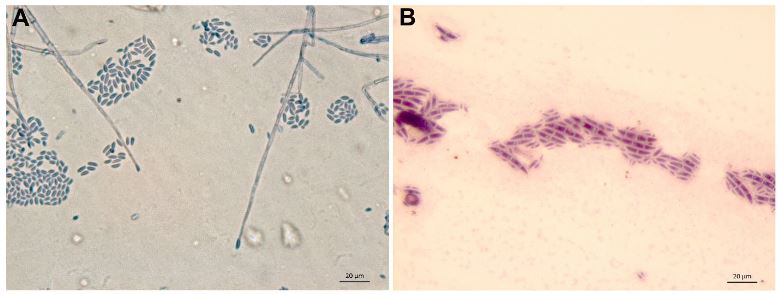
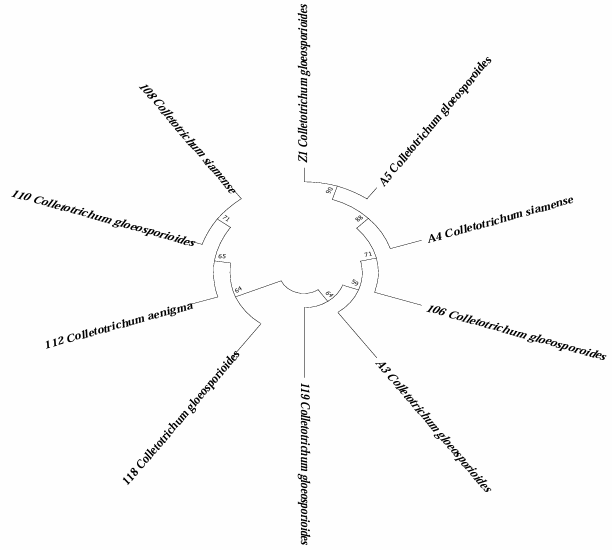
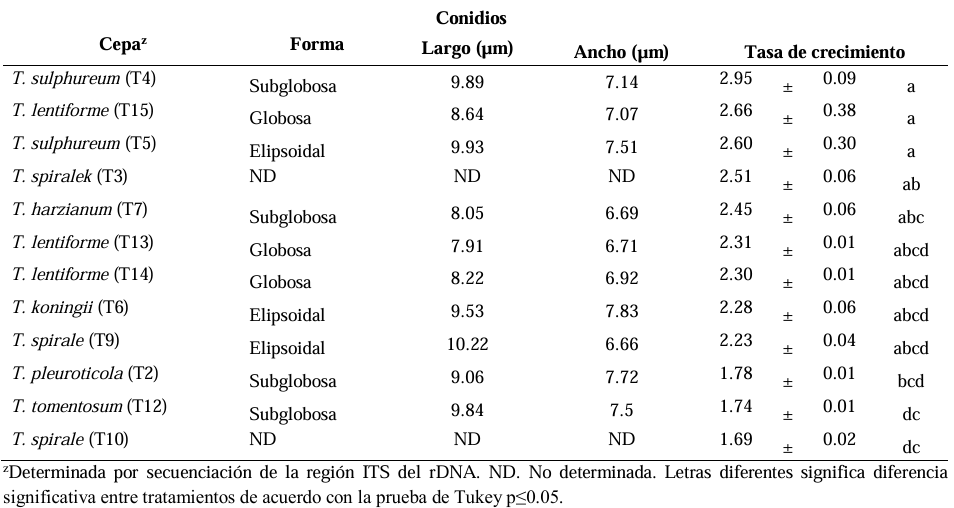
Materiales y Métodos. Se colectaron muestras de suelo y material vegetativo de parcelas de plantas de café, a partir de las cuales se aislaron cepas de hongos correspondientes al género Trichoderma y Colletotrichum. Se realizó la caracterización macroscópica, microscópica y se evaluó la tasa de crecimiento de cada uno de los aislamientos. Finalmente se realizó la caracterización molecular mediante secuenciación de la región ITS de RNAr. Para evaluar el potencial de biocontrol se hicieron pruebas de antagonismo entre las cepas de los dos géneros.
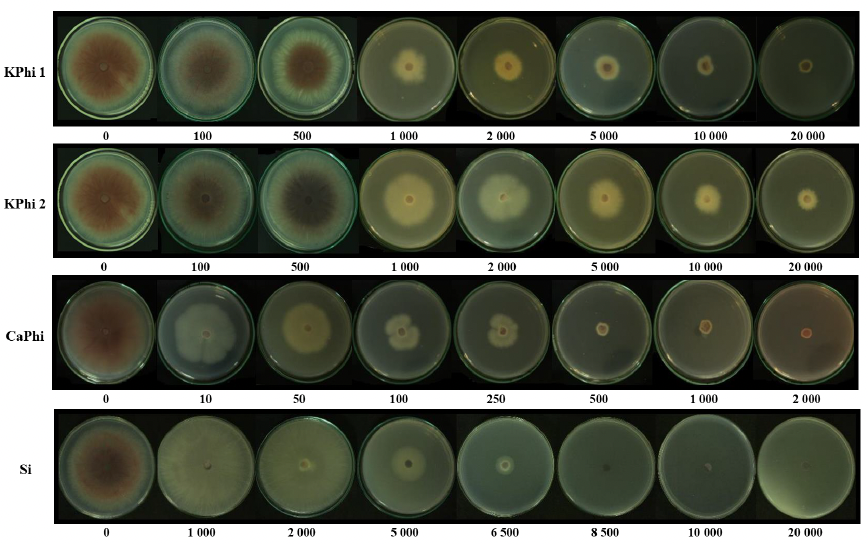
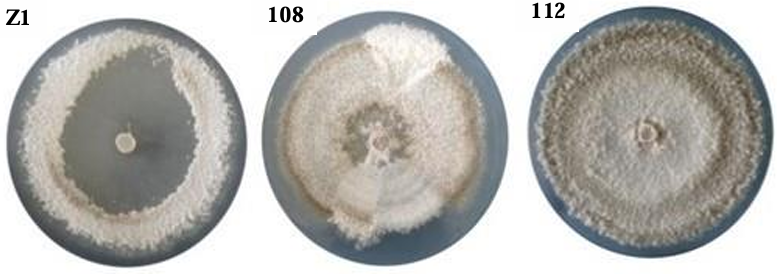
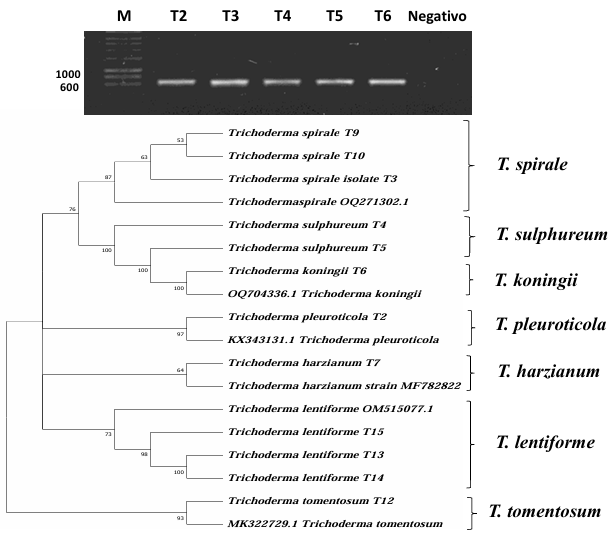
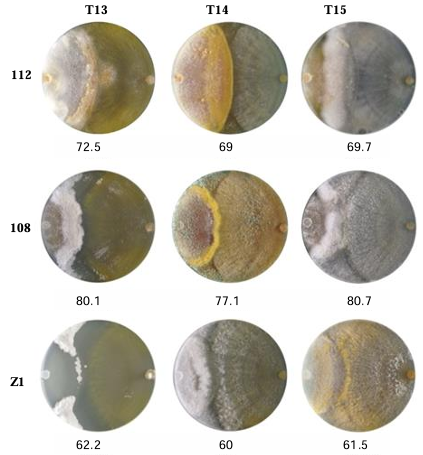
Resultados. Se identificaron siete especies diferentes: T. harzianum, T. pleuroticola, T. sulphureum, T. tomentosum, T. koningii, T. spirale y T. lentiforme. Estos últimos fueron los más abundantes. De ellos, se seleccionó y evaluó a T. lentiforme en su capacidad de inhibición in vitro contra tres especies de Colletotrichum. Se observó que es capaz de inhibir entre 20 y 80% el crecimiento del hongo.
Conclusión. Se destaca el potencial de Trichoderma como biocontrolador sobre Colletotrichum actuando de diferentes maneras ante este fitopatógeno. Esto, aporta al conocimiento sobre la diversidad de Trichoderma nativos de la región cafetalera del estado de Oaxaca. Además, esta comprensión más profunda, contribuye a enriquecer el conocimiento y a elegir dichas especies para futuros estudios en el biocontrol de fitopatógenos, con el fin de promover prácticas agrícolas sostenibles.
Palabras clave: Antagonista, antracnosis, control biológico, ITS.

Inhibition of Colletotrichum spp. causing anthracnose in coffee (Coffea arabica) using native isolates of Trichoderma sp.
By Abimael Rubio Sosa, Misael Martínez Bolaños, Juan Florencio Gómez Leyva, Salvador Lozano Trejo*, Ernesto Castañeda Hidalgo, Gustavo Omar Diaz Zorrilla
Received: 30/August/2024 – Published:
26/March/2025
DOI:
https://doi.org/10.18781/R.MEX.FIT.2307-1
Abstract
Background/Objective. The objective of the study was to isolate and characterize native isolate of Trichoderma from organic crops of Arabica coffee (Coffea arabica) in Oaxaca state, as well as to evaluate their in vitro biocontrol potential against Colletotrichum spp., causal agent of anthracnose.
Materials y Methods. Soil and vegetative material samples were collected from coffee plant plots, from which fungal strains corresponding to the genera Trichoderma and Colletotrichum were isolated. Macroscopic and microscopic characterization was performed and the growth rate of each of the isolates was evaluated. Finally, molecular characterization was performed by sequencing the ITS region of rRNA. To evaluate the biocontrol potential, antagonism tests were performed between the isolates of the two genera.
Results. Seven different species were identified: T. harzianum, T. pleuroticola, T. sulphureum, T. tomentosum, T. koningii, T. spirale and T. lentiforme. The latter were the most abundant. Of these, T. lentiforme was selected and evaluated for its in vitro inhibition capacity against three Colletotrichum spp. It was observed that the growth of the fungus was inhibited by 20 to 80%.
Conclusion. The potential of Trichoderma as a biocontrol agent for Colletotrichum spp. is highlighted, acting in different ways against this phytopathogen. This contributes to the knowledge about the diversity of native Trichoderma species, to the coffee-growing region of the state of Oaxaca. In addition, this deeper knowledge contributes to enriching knowledge and choosing these species for future studies in the biocontrol of phytopathogens, in order to promote sustainable agricultural practices.
Keywords: Antagonist, anthracnose, biological control, ITS.