
Introduction:
Roselle (Hibiscus sabdariffa) is considered an economically (
Among the most important diseases affecting roselle in Guerrero are the calyx spot induced by Corynespora cassiicola (
Studies performed on calyces report that out of 1,470 kg of roselle gathered in Guerrero, 40.8% were of commercial quality, with spots and smut on the tips (equivalent to 588 g of the unit) with calyxes under bad innocuousness conditions. The phytopathogenic fungi related to roselle in storage were Fusarium and Corynespora (
Mexico has a wide variety of temperate climate coniferous and broadleaf tree species (
The J. curcas resin sample was gathered fresh and the linaloe (B. linanoe) resin was taken from the collection of the National Forestry, Agriculture, and Livestock Research Institute (INIFAP), Zacatepec, Morelos experimental field. Both resin samples were taken from the fruit, which were placed in sterile jars with a screw-on lid for their transportation under refrigeration at a 20 °C.
The C. cassiicola with Access in GenBank (MF000865) responsible for roselle spot, F. oxysporum (KM519188) and F. solani (KM519190) associated to the “black leg” symptom, originate from the roselle cultivation in the state of Guerrero, and were provided by the Laboratory of Plant Health and Safety of the Phytosanitary Institute at the Colegio de Postgraduados-Campus Montecillo.
To determine the in vitro effect of the resins on the fungi, the strains were planted in Petri dishes in a Potato-Dextrose-Agar (PDA) medium at room temperature (25 ± 2 °C). After 7 days, it was covered with 10 mL of sterile saline solution at 0.85%, shaken for 3 minutes and rubbed on the surface of the culture, firmly and gently, using a bacteriological loop. The suspension obtained from each one of the strains was poured directly into sterile test tubes and left to rest for 20-30 min. The turbidity of the spore suspension was measured by spectrophotometry, 70 75% transmittance at 530 nm, according to the technique by
For the agar well technique, the technique followed was the one proposed by
The Petri dishes were incubated at 25 ± 2 °C for 7 days. Subsequently, the diameter of the radial growth was calculated. The percentage of growth inhibition was calculated considering that the inhibition is the opposite of the growth (TequidaMeneses et al., 2002). The inhibiting effect of the resins was determined to be positive with the appearance of a zone of inhibition around the perforations, which was measured using a 150 x 0.02 mm Fumetax® caliper every 24 h for 7 days.
The minimum inhibitory dose (MID) was determined, which is defined as the lowest concentration of resins that showed no growth in the test tubes. PDA culture medium was used, in which 8 tubes were inoculated with 1 mL of PDA with 10 μL of spore suspension, at a concentration of 1x101, adjusted at 530 nm, 70 75% of transmittance (
Statistical analysis. The sample averages of the studied factors were calculated and added to their standard deviations in parentheses. Box graphs were also created to know their distribution. The experiment followed a completely randomized factorial design with fixed effects. Four factors were studied: technique (Ti) with two levels: agar disk (Kirby Bauer) and agar well diffusion; resins (Rj) with four levels: B. linanoe, J. curcas, the mixture of both, and thiabendazole, volume (Vk) with three levels: 10, 20 and 30 µL and fungi (Hl) with three species: C. cassiicola, F. oxysporum and F. solani, and the response variable was the diameter of the inhibition halo. The statistical model used was:
Yijklt = μ + Ti + Rj + Vk + Hl + (TR)ij + (TV)ik + (TH)il + (RV)jk + (RV)jl + (RH)kl+ (TRV)ijk + (TRH)ijl + (RVH)ikl + (RVH)jkl + (TRVH)ijkl + εijklt
ε ~ IIDN(0, σ 2); i = 1, 2; j = 1, 2, 3; k = 1, 2, 3; l = 1,2, 3, 4; t = 1, 2, 3.
The data were analyzed using the R statistical package R (R Core Team, 2020). In the analysis of variance, a significance level of α = 0.05 was used. The nonparametric aligned ranks version was used to determine whether the main effects and interactions were significant (
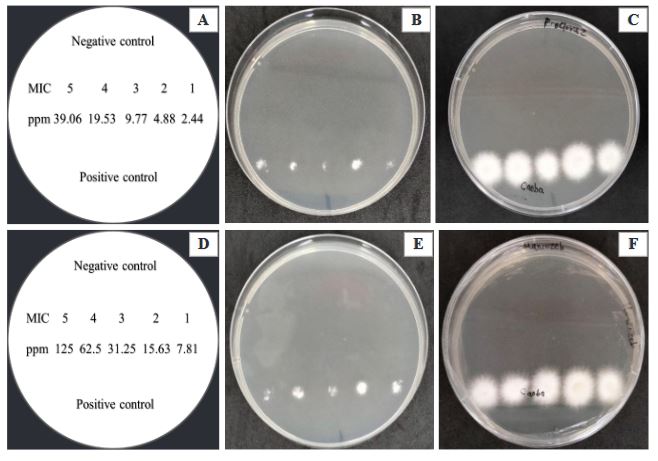
A modification was performed on the minimum inhibitory concentration (MIC) since, due to the handling of raw and natural samples without lab equipment, their concentrations are unknown; only different doses were handled (
| Fungi evaluated | Isolation key | Resin of Jatropha curcas μL mL-1 | Resin of Bursera linanoe μL mL-1 | Mix of (J. curcas and B. linanoe) μL mL-1 |
|---|---|---|---|---|
| Fusarium oxysporum | FsrT5 | 140 | 4 | 12 |
| Fusarium solani | Fs34 | 100 | 4 | 12 |
| Corynespora cassiicola | CC33GRO | 120 | 4 | 8 |
The 20 treatments show a predominance of the agar well technique, since it appears in 12 treatments; the B. linanoe resin treatment is amongst the 20 best treatments, since it appears in nine treatments; the mixture of resins in five treatments, and thiabendazole, in six treatments; the 10 and 20 µL volumes appear in eight and seven treatments respectively, and the fungi C. cassiicola and F. oxysporum appear in 12 and eight treatments, respectively. The combination of agar well and B. linanoe appeared in six of the 20 treatments.
On the opposite end, the group with the lowest means of the inhibition halo diameter contains the five treatments that had a minimum of the inhibition halo diameter of 13 mm (DJcV30Fo, DTV10Fs, DTV30Fs, PTV10Fs and PTV30Fs) and another 14 treatments (DJcV10Cc, DTV20Fo, DJcV30Cc, DTV30Fo, PTV30Fo, DJcV20Cc, DJcV20Fs, PJcV20Fo, DJcV30Fs, PJcV30Fo, DTV20Fs, PTV20Fs, DJcV10Fs, DJcV20Fo), making up a total of 19 treatments. In these treatments, the agar disk technique was predominant, since it appears in 13 treatments; the J. curcas resin appears in 10 treatments and thiabendazole, in nine treatments. The 30, 20 and 10 µL volumes appear in eight, seven and four treatments, and the microorganisms F. solani, F. oxysporum and C. cassiicola appear in nine, seven and three treatments, respectively (
| Trto | MDHI | Group* | Trto | MDHI | Group* | Trto | MDHI | Group* |
|---|---|---|---|---|---|---|---|---|
| DBIV10Cc | 30.0 | a | DMV30Cc | 11.5 | hijklmnop | PJcV20Cc | 12.1 | efghijklmn |
| DBIV10Fo | 11.3 | ijklmnopq | DMV30Fo | 21.6 | ab | PJcV20Fo | 7.4 | uvwxy |
| DBIV10Fs | 10.0 | klmnopq | DMV30Fs | 10.6 | ijklmnopq | PJcV20Fs | 8.3 | qstuvw |
| DBIV20Cc | 30.0 | a | DTV10Cc | 12.3 | efghijklmn | PJcV30Cc | 12.0 | efghijklmn |
| DBIV20Fo | 12.7 | cdefghijkl | DTV10Fo | 9.0 | nopqrstuv | PJcV30Fo | 7.3 | vwxy |
| DBIV20Fs | 9.2 | mnopqrstuv | DTV10Fs | 7.0 | y | PJcV30Fs | 8.6 | opqrstuvw |
| DBIV30Cc | 30.0 | a | DTV20Cc | 15.0 | abcdefghi | PMV10Cc | 18.7 | ab |
| DBIV30Fo | 9.6 | klmnopqst | DTV20Fo | 7.6 | stuvwxy | PMV10Fo | 12.6 | defghijklm |
| DBIV30Fs | 8.7 | opqrstuvw | DTV20Fs | 7.2 | wxy | PMV10Fs | 9.4 | lmnopqrst |
| DJcV10Cc | 7.8 | rstuvwx | DTV30Cc | 12.0 | fghijklmn | PMV20Cc | 17.8 | abd |
| DJcV10Fo | 8.1 | rstuvwx | DTV30Fo | 7.4 | tuvwxy | PMV20Fo | 15.5 | bcdefghi |
| DJcV10Fs | 6.9 | wxy | DTV30Fs | 7.0 | y | PMV20Fs | 8.8 | opqrstuvw |
| DJcV20Fo | 7.1 | xy | PBIV10Cc | 30.0 | a | PMV30Cc | 13.0 | bcdefghijk |
| DJcV20Fs | 7.4 | tuvwxy | PBIV10Fo | 30.0 | a | PMV30Fo | 12.7 | cdefghijkl |
| DJcV30Fo | 7.0 | y | PBIV10Fs | 13.8 | bcdefghi | PMV30Fs | 13.9 | bcdefghij |
| DJcV30Fs | 7.3 | uvwxy | PBIV20Cc | 30.0 | a | PTV10Cc | 30.0 | a |
| DMV10Cc | 16.1 | abcdef | PBIV20Fo | 30.0 | a | PTV10Fo | 30.0 | a |
| DMV10Fo | 16.2 | abcdef | PBIV20Fs | 13.9 | bcdefghi | PTV10Fs | 7.0 | y |
| DMV20Cc | 11.8 | ghijklmn | PBIV30Cc | 30.0 | a | PTV20Cc | 30.0 | a |
| DMV20Fo | 18.3 | abcdefg | PBIV30Fo | 16.7 | abcde | PTV20Fo | 30.0 | a |
| DMV20Fs | 11.3 | ijklmnop | PBIV30Fs | 13.6 | bcdefghij | PTV20Fs | 7.2 | wxy |
All factors were found to be significant, including the main effects of the technique, the resins, the volume and the fungi in the diameter of the inhibition halo, as well as the double, triple and quadruple interactions. The B. linanoe resin displayed the highest inhibition, and therefore the greatest antifungal effect against C. cassiicola and F. oxysporum. This antifungal effect can be related to a variety of secondary metabolites found in the plant, such as saponins, phenols, flavonoids and monoterpenic compounds such as the linalyl acetate (
This aligns with
The case of the J. curcas resin did not provide promising results, showing that with the agar well technique, an inhibition halo was obtained in the fungus C. cassicola, between 12.0 and 13.5 mm in diameter. Despite
On the other hand, the mixture of both resins (B. linanoe + J. curcas) to boost the antifungal effect was lower than expected, presenting inhibition halos of 16.1 to 18.7 mm, greater than those found with the J. curcas resin, which presented inhibition halos of 7 to 13.1 mm, though lower than those with B. linanoe, with inhibition halos with a diameter of 30 mm. These are marginal means that do not consider the effect of the other three factors studied. Therefore, mixing both resins is not considered a good option. The best minimum inhibitory concentration was for B. linanoe (4 µL mL⁻¹), followed by the mixture (12 µL mL⁻¹), and finally, J. curcas (140 µL mL⁻¹) (
The commercial control thiabendazole displayed control in six of the treatments, presenting an inhibition halo of 30 mm with the agar well technique of the fungi C. cassiicola and F. oxysporum. This coincides with
Regarding every fungal species, the largest inhibition halos, with 30 mm, were found in C. cassiicola, being one of the most susceptible and with the least resistance, since it displayed greater zones in all the volumes used. F. oxysporum also displayed susceptibility with a 30 mm inhibition halo, presenting larger zones in the fungal volumes of 10 and 20 µL. This suggests that the use of these resins may be a viable alternative against the roselle leaf and calyx spots. These findings coincide with those by
No significant differences were found in the evaluations of the volumes of fungi used, since the largest inhibition halo diameters were consistently observed in the volumes of 10, 20 and 30 µL. The B. linanoe resin, obtained from the fruit of the tree, is considered a promising and efficient alternative as a biofungicide in the control of C. cassiicola, F. oxysporum and F. solani, according to the in vitro results. Therefore, investing in the development of medicinal plant-based products for the control of crop diseases caused by pathogens is a growing sector that should be considered and developed (
Reducing the use of conventional synthetic fungicides by incorporating natural effective products is a crucial step towards a sustainable agricultural production. Nevertheless, it is crucial to understand the action mechanism of these resins and evaluate their effectiveness under field conditions. It was found that all terms were significant, including the main effects of technique, resins, fungal volume and fungal species on the diameter of the inhibition halo, as well as the double, triple and quadruple interactions.
The results of this in vitro investigation show that the B. linanoe resin exhibited greater inhibition for C. cassiicola and F. oxysporum in both techniques (the agar well technique and agar disk or the Kirby Bauer technique), making it the type of resin with the greatest biocontrol potential.