

Share this link via
Or copy link



Article filters
Search Papers:
byAndrés Villalobos*, Ana Lucía Dubón, María Renée Álvarez, Sergio Osorio, Margarita Palmieri
Received: 31/January/2022 – Published: 23/August/2023
DOI: https://doi.org/10.18781/R.MEX.FIT.2301-2
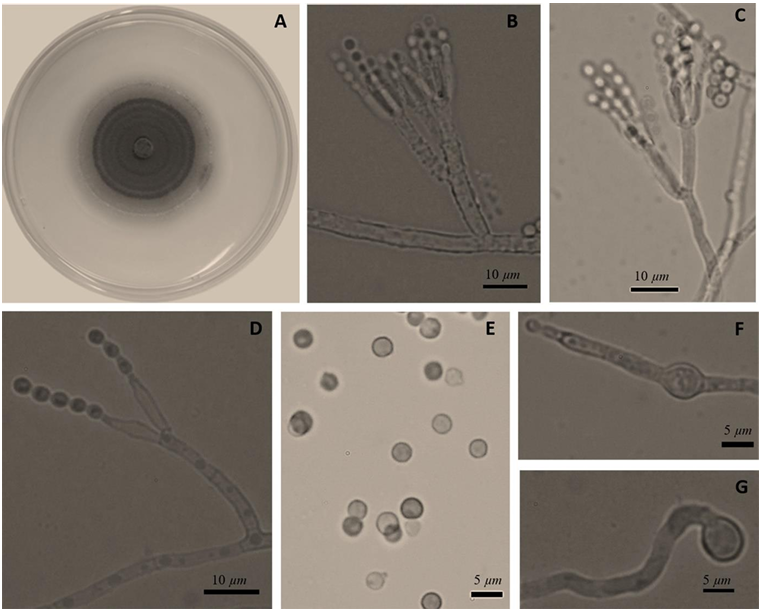
Abstract In recent years, a new pest has been reported in Guatemalan fir (Abies guatemalensis) plantations, a biofilm of microorganisms known as “green algae”. The objective of this research was to identify the algae and fungi that make up the biofilm growing on Guatemalan fir leaves. Leaf samples were collected from three locations where the biofilm has been reported, and the algae and fungi present on the leaves were isolated. Microorganisms were cultured in vitro and identified by light microscopy; in the case of fungi, DNA extraction and amplification of the ITS region were also performed. Four algae of the genera Desmococcus, Klebsormidium and the class Trebouxiophyceae, and 11 fungi of the genera Alternaria, Aspergillus, Fusarium, Mucor, Trichoderma and Ulocladium were identified from 120 leaves of 15 trees. It was concluded that the biofilm affecting Guatemalan fir plantations in Guatemala is composed of several species of epiphytic algae and fungi, which may vary according to the locality. The factors affecting the richness of microorganisms in the biofilm and their symbiotic relationship still need to be addressed
Share this link via
Or copy link
There are no images, at the moment, loaded for this article.
Multidiscipline, a basic component of innovation in the biological control of plant pathogens
Received: 03/August/2023 – Published: 24/August/2023
DOI: https://doi.org/10.18781/R.MEX.FIT.2308-1
Abstract
Share this link via
Or copy link
There are no images, at the moment, loaded for this article.